

Anticipatory Bail Under Section 482 BNSS: Arrest Protection in PMLA and Economic Offence Cases
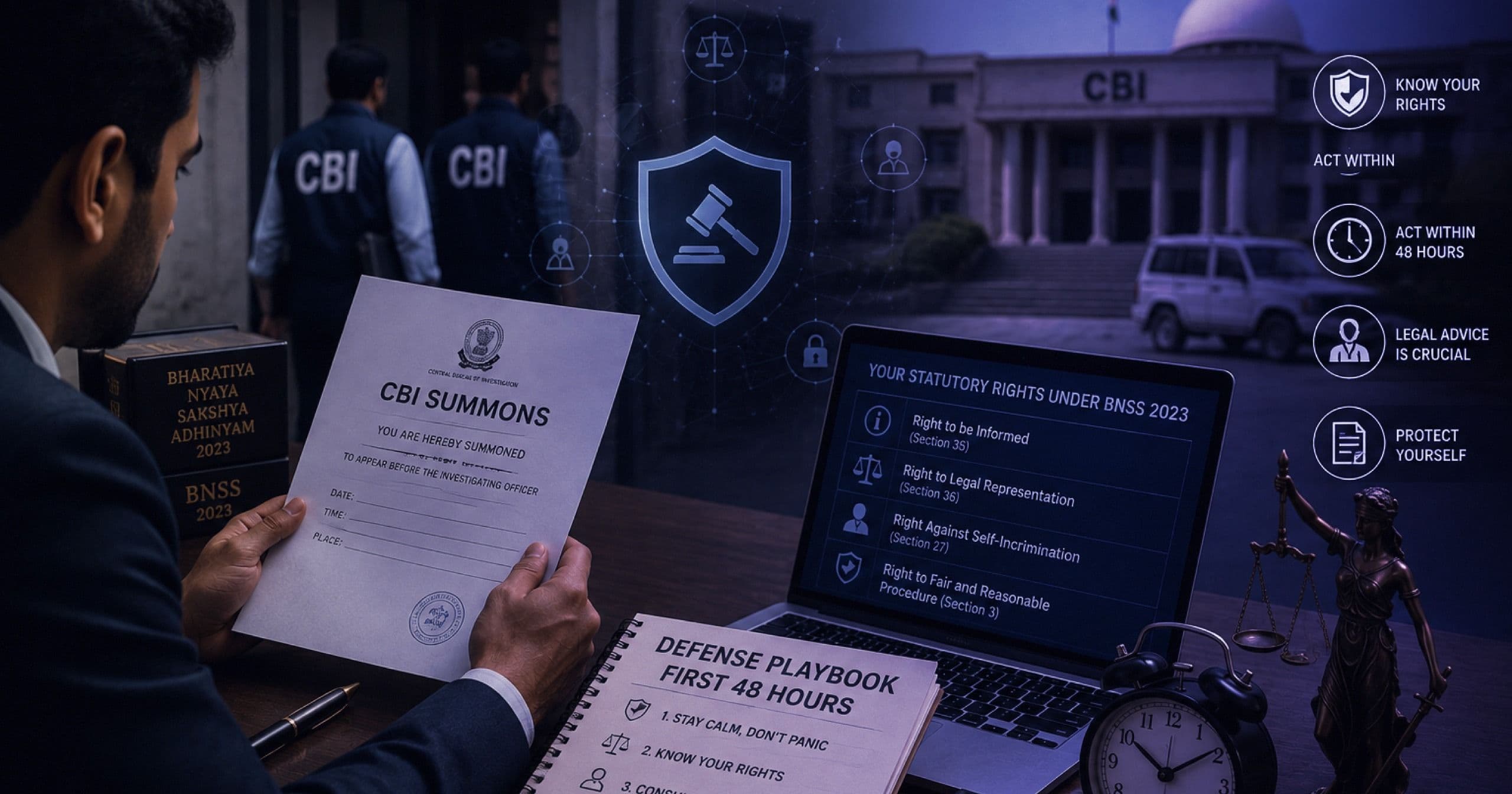
The threat of arrest in a white-collar case rarely begins with a police officer arriving at the door. It often begins with an EOW, CBI, ED or specialised police summons, a search at the office, seizure of laptops, repeated demands for documents, questioning of employees, arrest of a co-accused, or an allegation that the investigating agency now wants "custodial interrogation" of a director or promoter.
At that stage, waiting for an actual arrest can be a serious strategic mistake. Once a person is taken into custody, the immediate remedy changes from anticipatory bail to regular bail. Access to business records becomes difficult, the company may lose operational control, and the prosecution gains the advantage of arguing from an accomplished arrest.
Anticipatory bail is the legal mechanism designed to prevent that outcome where the apprehension of arrest is real and the person is willing to cooperate with the investigation. It is not immunity from investigation, a declaration of innocence, or permission to ignore summons. It is a court direction that, if the applicant is arrested in the specified case, he or she must be released on bail subject to the conditions imposed.
The correct provision is Section 482 of the Bharatiya Nagarik Suraksha Sanhita, 2023. It replaced Section 438 of the Code of Criminal Procedure, 1973 from 1 July 2024. A person looking for an anticipatory bail lawyer Delhi should therefore insist on a petition that uses the correct BNSS provision, identifies the exact source of arrest apprehension, and deals separately with every special statute involved.
The position becomes significantly more difficult when the Enforcement Directorate invokes the Prevention of Money-Laundering Act, 2002. A PMLA application must satisfy not only the ordinary principles governing pre-arrest bail but also the additional restrictions under Section 45 of the PMLA. That is why an ordinary economic-offence petition cannot simply be relabelled as a PMLA anticipatory bail application.
When Should You Apply for Anticipatory Bail?
An application should be considered as soon as there are concrete facts showing a reasonable apprehension of arrest for a non-bailable offence. The applicant does not have to wait to be arrested. In an appropriate case, the applicant need not even wait for a formal FIR to be supplied if the surrounding facts clearly show an accusation and an imminent risk of custody.
Common warning signs include:
- +a summons requiring personal appearance after searches or seizures have already taken place
- +questions focused on personal knowledge, authorisation, money trail or alleged conspiracy rather than routine document verification
- +arrest of a co-director, business partner, accountant, beneficiary or alleged intermediary in the same transaction
- +a written or oral demand that the person appear for custodial interrogation
- +repeated allegations of non-cooperation despite documents having been supplied
- +an FIR containing non-bailable offences in which the applicant is named or is likely to be added
- +an ECIR, prosecution complaint or predicate offence that exposes the person to PMLA arrest
- +searches at home or office followed by seizure of phones, laptops, bank records or corporate files
- +a statement by the investigating officer that arrest will follow unless a particular version is accepted or a disputed amount is paid
A vague fear is not enough. The petition must show why the apprehension is genuine, who may arrest the applicant, in which case, for which offences, and on what recent events that apprehension is based.
Section 482 BNSS: The Correct Provision for Anticipatory Bail
Section 482 BNSS authorises the High Court or the Court of Session to direct that a person apprehending arrest for a non-bailable offence be released on bail in the event of arrest. The provision substantially carries forward the earlier Section 438 CrPC, which means that the principles developed by the Supreme Court under the old Code continue to guide courts under the BNSS.
The provision allows the court to impose conditions suited to the case, including:
- +making the applicant available for interrogation whenever lawfully required
- +prohibiting any inducement, threat or promise to a witness
- +restricting foreign travel without prior permission of the court
- +requiring regular appearance before the investigating officer or court
- +requiring disclosure of address, mobile number and travel itinerary
- +directing preservation and production of specified records or devices
Section 482 does not apply to accusations under Section 65 and Section 70(2) of the Bharatiya Nyaya Sanhita, 2023, which concern specified aggravated sexual offences. That statutory exclusion is not ordinarily relevant to commercial or white-collar cases, but it demonstrates that anticipatory bail remains a discretionary remedy subject to legislative limitations.
The expression anticipatory bail BNSS is sometimes misunderstood to mean that the new criminal procedure has created an entirely different remedy. It has not. The section number has changed, but the central constitutional balance remains the same: the investigation must proceed, while unnecessary arrest should not become punishment before trial.
What Anticipatory Bail Does and Does Not Do
1. It Protects Against Arrest in a Specified Accusation
The order is ordinarily tied to a particular FIR, ECIR, complaint, transaction or clearly identified accusation. It does not create universal protection against arrest in every future case. If another agency registers a separate case arising from a different transaction, separate protection may be required.
2. It Does Not Stop the Investigation
The applicant may still be summoned, questioned, confronted with documents and required to produce records. The court can direct strict cooperation. Breach of those conditions may lead to cancellation of bail.
3. It Does Not Automatically Unfreeze Assets
Bank-account freezing, attachment of property, seizure of devices and arrest are different legal measures. Pre-arrest bail protects personal liberty. Separate applications or statutory proceedings may be required to challenge attachment, freezing or retention of property.
4. It Is Not a Finding That the Case Is False
At the anticipatory bail stage, the court does not conduct a full trial. It makes a limited assessment of the accusation, the applicant's role, the need for custody, the possibility of interference with evidence and the statutory restrictions that apply.
5. It Is Not the Same as a General "No Coercive Action" Order
A vague direction that no coercive action be taken may not provide the clarity of a statutory anticipatory bail order. A properly framed order states that, in the event of arrest in the identified case, the applicant shall be released on bail on specified terms.
Anticipatory Bail, Interim Protection, Regular Bail and Protective Bail
These expressions are often used loosely, but they serve different purposes.
Anticipatory Bail
This is protection granted before arrest under Section 482 BNSS. The order becomes operational if the applicant is arrested in the case covered by it.
Interim Anticipatory Bail
The court may grant temporary protection while issuing notice to the State or the investigating agency and calling for a status report. Interim protection is crucial where the arrest threat is immediate but the final application cannot be decided on the first date.
Regular Bail
Once a person has been arrested and is in custody, the remedy is regular bail. The legal test, forum and practical difficulties then change materially.
Protective or Transit Bail
The phrase protective bail Delhi is commonly used where a person in Delhi apprehends arrest in a case registered in another State and seeks short, temporary protection to approach the court having territorial jurisdiction. Such relief is not a final adjudication of the anticipatory bail application. It is intended to prevent immediate arrest during the limited period required to approach the competent court.
The petition must be precise about which relief is being sought. Asking for final anticipatory bail from a court without territorial jurisdiction, when only transit protection is legally available, can cause avoidable delay.
The Supreme Court's Foundational Principles on Pre-Arrest Bail
Gurbaksh Singh Sibbia v. State of Punjab
In Gurbaksh Singh Sibbia v. State of Punjab, (1980) 2 SCC 565, the Constitution Bench rejected rigid formulas for anticipatory bail. It held that the power is discretionary, fact-specific and rooted in protection of personal liberty. The court should not presume that every accusation requires custody, nor should it convert anticipatory bail into an exceptional remedy available only in rare cases.
The decision remains the starting point under Section 482 BNSS. Courts examine the nature of the accusation, the applicant's role, the possibility of absconding, the risk of witness influence, the need for custodial interrogation and the applicant's conduct. No single factor is conclusive in every case.
Sushila Aggarwal v. State (NCT of Delhi)
In Sushila Aggarwal v. State (NCT of Delhi), (2020) 5 SCC 1, another Constitution Bench clarified that anticipatory bail need not automatically expire after a fixed period or upon filing of the charge sheet. In the absence of special reasons, protection can continue through the trial. The court can still limit the duration or impose case-specific conditions where the facts justify doing so.
This is important in long-running economic investigations. A person should not be forced to return to court every few weeks merely because the agency has not completed its investigation. At the same time, continuing protection depends upon continuing compliance. Evasion, concealment or interference with evidence can justify cancellation.
How Courts Assess Anticipatory Bail in Economic Offence Cases
Courts repeatedly describe economic offences as serious because they may involve public money, institutional fraud, forged documents, multiple victims or complex layering of transactions. That description, however, does not create an automatic rule that anticipatory bail must be rejected.
The seriousness of the allegation is one factor. The court must still examine:
- +the specific role attributed to the applicant rather than the size of the alleged fraud alone
- +whether the applicant personally authorised, received, concealed or benefited from the questioned transaction
- +whether the evidence is principally documentary and already in the agency's possession
- +whether digital devices and records have already been seized and cloned
- +whether the applicant has answered summons and supplied documents
- +whether the applicant is likely to flee, influence witnesses or destroy evidence
- +whether custodial interrogation is genuinely required or merely asserted
- +whether similarly placed co-accused have been arrested or protected
- +whether the dispute is being given a criminal colour to pressurise repayment or commercial settlement
P. Chidambaram v. Directorate of Enforcement, (2019) 9 SCC 24, is often cited by investigating agencies for the proposition that economic offences may require a different approach and that custodial interrogation can be relevant. The judgment does not establish a blanket ban on anticipatory bail in financial cases. It reinforces the need for a fact-specific inquiry into the investigation, the material and the requirement of custody.
A strong petition therefore does not rely only on the slogan that bail is the rule. It demonstrates, through documents and chronology, why arrest is unnecessary for that particular applicant.
Why PMLA Anticipatory Bail Is More Difficult
A PMLA case adds a special statutory layer. The Enforcement Directorate may investigate an alleged offence of money-laundering under Section 3, punishable under Section 4, where property is alleged to be proceeds of crime generated from a scheduled offence.
The principal provisions affecting pre-arrest strategy are:
- +Section 3, which defines the offence of money-laundering
- +Section 19, which permits specified ED officers to arrest on recorded reasons to believe based on material in possession
- +Section 45, which imposes additional restrictions on release on bail
- +Section 50, which empowers ED officers to summon persons, record statements and require production of records
- +Sections 44, 46 and 65, which regulate proceedings before the Special Court and the application of criminal procedure
An ECIR is not the same as an FIR and is not ordinarily supplied in the same manner. In practice, the person may first learn of the ED investigation through a Section 50 summons, a search, seizure, freezing order or questioning about the scheduled offence.
The absence of an arrest warrant does not eliminate arrest risk. Section 19 is a statutory power of arrest. The anticipatory bail petition must therefore analyse both the ordinary BNSS test and the PMLA restrictions.
Section 45 PMLA: The Twin Conditions
Section 45 makes offences under the PMLA cognizable and non-bailable and places two additional conditions on release. The Public Prosecutor must be given an opportunity to oppose the application. If the application is opposed, the court must be satisfied that there are reasonable grounds for believing:
- +that the applicant is not guilty of the offence of money-laundering; and
- +that the applicant is not likely to commit any offence while on bail.
These are known as the twin conditions. They operate in addition to the ordinary considerations governing bail. The Supreme Court has held that the Section 45 restrictions apply to anticipatory bail as well. Decisions including Assistant Director, Directorate of Enforcement v. V.C. Mohan, (2022) 12 SCC 698, and Vijay Madanlal Choudhary v. Union of India, (2023) 12 SCC 1, leave no room for treating a PMLA anticipatory bail application as an ordinary Section 482 petition.
The expression "reasonable grounds for believing that the applicant is not guilty" does not require the court to conduct a full trial. It requires more than a superficial defence. The applicant must identify a legal or evidentiary defect that goes to the foundation of the PMLA accusation, such as absence of proceeds of crime, lack of knowledge, absence of personal involvement, a legitimate source of funds, or a broken link between the scheduled offence and the property in question.
The Proviso to Section 45: Special Categories
The first proviso to Section 45 permits the Special Court to release certain categories of accused without applying the twin conditions in the same manner. The categories include:
- +a person below sixteen years of age
- +a woman
- +a person who is sick or infirm
- +a person accused, alone or with co-accused, of money-laundering involving a sum of less than Rs. 1 crore
The proviso does not create automatic bail. The court still exercises discretion, examines the accusation and may impose conditions. The amount test also concerns the total money-laundering accusation in the case and cannot safely be assumed from the amount personally received by one applicant without examining the prosecution case.
Where the application invokes illness or infirmity, medical material must be detailed, current and connected to the need for release. A generic prescription is rarely sufficient. Where the woman proviso is invoked, the defence should still address role, cooperation and flight risk rather than treat the proviso as a substitute for the merits.
Not Every Financial Allegation Becomes Money-Laundering
PMLA is not a general law against every unexplained transaction, unpaid loan, commercial breach or accounting irregularity. The offence requires proceeds of crime linked to criminal activity relating to a scheduled offence and involvement in a process or activity connected with those proceeds.
A proper pre-arrest defence should test the following questions:
- +What is the identified scheduled offence?
- +What specific property is alleged to have been derived or obtained from that offence?
- +How has the amount been quantified?
- +What transaction connects the applicant to the alleged proceeds?
- +Did the applicant know the criminal origin of the property?
- +Is the allegation based only on designation, family relationship, directorship or association?
- +Are lawful receipts being incorrectly described as proceeds of crime?
- +Has the predicate case been quashed, closed or resulted in discharge or acquittal?
Vijay Madanlal Choudhary emphasised that property becomes proceeds of crime only when it is derived or obtained as a result of criminal activity relating to a scheduled offence. An agency cannot begin with unexplained property and simply assume that a scheduled offence must have generated it.
The Delhi High Court's 2026 PMLA Bail Ruling
In Moideen Kutty K @ M.K. Faizy v. Directorate of Enforcement, 2026:DHC:1308, decided on 16 February 2026, the Delhi High Court granted regular bail in a PMLA matter after closely examining the alleged proceeds of crime, the applicant's personal role, the evidentiary record and the likely duration of trial.
The Court held, on the facts before it, that guilt could not be founded merely on association or organisational position without specific and concrete evidence of personal involvement in money-laundering. It also reiterated that funds do not become proceeds of crime merely because they may later be used for unlawful activity; the property must be derived or obtained from criminal activity relating to a scheduled offence.
The judgment was a regular bail decision, not an anticipatory bail ruling. It also considered the period of custody and the improbability of an early trial. It should therefore not be cited as if it has removed the Section 45 restrictions at the pre-arrest stage.
Its real value for an anticipatory bail petition is narrower but important: Section 45 requires an evidence-based examination of the statutory ingredients. Serious allegations, large records and organisational designation do not relieve the prosecution from identifying proceeds of crime and a specific role.
Section 19 PMLA: Arrest Must Be Based on Recorded Reasons and Material
Section 19 permits an authorised ED officer to arrest where, on the basis of material in possession, the officer has reason to believe, recorded in writing, that the person is guilty of an offence under the PMLA. The arrested person must be informed of the grounds of arrest and produced before the competent court within the prescribed period.
Supreme Court decisions including Pankaj Bansal v. Union of India, 2023 INSC 866, have strengthened the requirement that the grounds of arrest be meaningfully communicated in writing. Later decisions have dealt with the manner and timing of compliance, but the central point remains: arrest cannot rest on an undisclosed conclusion unsupported by legally relevant material.
These safeguards do not by themselves guarantee anticipatory bail. A court hearing a Section 482 application will not ordinarily conduct a complete judicial review of a future arrest that has not yet occurred. The defence should nevertheless use the absence of a clear money trail, the applicant's cooperation and the documentary nature of the case to show why a lawful necessity for arrest is missing.
A Section 50 PMLA Summons Is Not an Arrest Warrant
A summons under Section 50 may require a person to attend, state facts and produce records. Statements recorded in the inquiry can have serious consequences. A summons should therefore never be ignored, but it does not automatically mean that arrest will follow.
The risk becomes more concrete where:
- +the applicant has been called repeatedly for prolonged questioning
- +the agency alleges contradictions or concealment
- +co-accused have already been arrested
- +the questioning concerns personal receipt or layering of funds
- +the agency has demanded original devices or access credentials
- +the applicant has been described as a beneficiary, controller or mastermind
A court may expect the applicant to appear and cooperate even while granting protection. The objective is not to avoid questioning. It is to prevent the agency from using arrest as a substitute for evidence or as pressure to secure a particular statement.
Step-by-Step Strategy for an Anticipatory Bail Application
1. Identify the Exact Source of Arrest Risk
Begin with the documents and events, not assumptions. Collect the FIR, summons, search authorisation, seizure memo, remand papers of co-accused, notices, emails and any communication referring to arrest or custodial interrogation. In an ED matter, identify the scheduled offence and every known ECIR or prosecution complaint.
2. Map Every Applicable Statute
A single transaction may involve BNS offences, the Prevention of Corruption Act, Companies Act, GST law, Customs law, PMLA or another special enactment. Each statute may contain a different arrest power, bail restriction or forum. The petition must address all provisions actually invoked.
3. Prepare a Role-Specific Defence
A director should not file a petition that speaks only about the company. The application must show the applicant's own designation, period of involvement, authority, access to accounts, participation in the transaction, source of funds and response to the investigation.
4. Build a Documentary Record of Cooperation
Prepare a chart of every summons, date of attendance, duration of questioning, reply supplied and document produced. If attendance was impossible, preserve the written request for another date. Cooperation is established through records, not a general assertion in the petition.
5. Address the Need for Custodial Interrogation
Explain which records are already with the agency, which devices have been seized, which witnesses have been examined and why confrontation can occur without arrest. If the applicant is willing to provide passwords, account statements or clarifications, state that willingness in a controlled and legally appropriate manner.
6. Address Flight Risk and Witness Influence
Permanent residence, family ties, professional practice, ongoing business, prior travel and return, absence of criminal history and compliance with earlier court orders are relevant. Where foreign travel is necessary, offer prior permission rather than resisting every travel condition.
7. Deal with Section 45 Separately in a PMLA Case
Do not bury the twin conditions in a general bail argument. The petition should have a dedicated analysis of the scheduled offence, proceeds of crime, applicant's knowledge, personal role, money trail and likelihood of committing any offence while on bail.
8. Seek Interim Protection Where Arrest Is Imminent
If the appearance date is near or co-accused have just been arrested, ask for reasoned interim protection until the State or ED files its response. The petition should explain the immediate trigger rather than merely state that arrest may occur at any time.
9. Offer Workable Conditions
Courts are more likely to protect an applicant who presents a credible compliance plan. Offer to join investigation, preserve devices, share travel details, avoid contact with specified witnesses and appear on reasonable notice.
Where Should Anticipatory Bail Be Filed in Delhi?
Section 482 gives concurrent jurisdiction to the Court of Session and the High Court. In ordinary practice, applicants often approach the Sessions Court first. A direct petition before the Delhi High Court may still be considered where there are exceptional circumstances, urgent multi-agency issues, a substantial jurisdictional question or a reason why the lower forum cannot grant effective relief in time.
The correct Delhi forum depends on the case:
- +an EOW or local police FIR will ordinarily be connected to the Sessions Court having territorial jurisdiction over the police station
- +CBI matters may proceed before designated Special CBI Courts, including courts at Rouse Avenue, depending on allocation
- +PMLA proceedings are dealt with by the notified Special Court, which is deemed to be a Court of Session for relevant procedural purposes
- +where the case is registered outside Delhi, the Delhi court may only be able to consider short transit protection unless an independent jurisdictional basis exists
Territorial jurisdiction should be decided before filing. The location of the applicant's residence is not always sufficient. The place of the FIR, ECIR unit, alleged transaction, investigating office and threatened arrest all require examination.
Documents That Strengthen an Anticipatory Bail Petition
A persuasive petition is built around a verified record. Depending upon the matter, the documents may include:
- +FIR, complaint, ECIR details or scheduled-offence papers
- +summons, notices and proof of attendance
- +search panchnama, seizure memo and inventory of electronic devices
- +replies and document-production letters
- +company incorporation records, board resolutions and role descriptions
- +bank statements and transaction documents showing the lawful source and purpose of funds
- +contracts, invoices, ledgers, tax returns and audited accounts
- +medical documents where illness or infirmity is relied upon
- +passport and travel history showing prior return to India
- +orders granting bail or protection to similarly placed co-accused
- +communications showing that a commercial dispute is being converted into criminal pressure
- +a complete date-wise chronology of cooperation and investigation events
Large annexures should not become an unorganised document dump. The petition must explain why each document matters to arrest risk, custodial interrogation or the statutory ingredients.
What the Prosecution Usually Argues and How the Defence Must Respond
The Applicant Has Not Cooperated
Answer with a date-wise attendance and document chart. If a question could not be answered because records were unavailable, explain when the record was subsequently supplied.
Custodial Interrogation Is Necessary
Ask what remains to be recovered, which confrontation requires custody, and why the same questioning cannot occur while the applicant is protected and present. Where the evidence is documentary and already seized, say so specifically.
The Amount Involved Is Very Large
Quantum is relevant, but it does not identify the applicant's role. Separate the total alleged transaction from the amount personally attributed to the applicant, while remaining careful that the Section 45 proviso may look at the overall money-laundering accusation.
The Applicant May Tamper With Evidence
Show that the records have already been seized, bank data is independently available, statutory filings cannot be altered retrospectively, and the applicant is willing to preserve identified material. Avoid broad claims that no evidence can ever be affected.
The Applicant Is Influential
Influence is not a substitute for proof of likely interference. Offer specific no-contact conditions and identify why relevant witnesses are independent professionals, public officials or persons whose records are already secured.
The Applicant May Leave India
Offer passport deposit or prior court permission where proportionate. Demonstrate permanent roots, business obligations, dependants and a history of returning from foreign travel.
Conditions Commonly Imposed by Delhi Courts
Depending upon the accusation, a court may direct the applicant to:
- +join investigation on specified dates and thereafter whenever reasonably required
- +provide a mobile number and keep it operational
- +not change residence without prior intimation
- +not contact or influence witnesses
- +not tamper with physical or electronic evidence
- +surrender the passport or obtain permission before leaving India
- +appear before the trial court and not seek unnecessary adjournments
- +execute a personal bond and furnish surety
- +provide specified documents, devices or access required for the lawful investigation
The defence should object to a condition that is impossible, unrelated to the accusation or so oppressive that it effectively defeats the bail order. At the same time, resisting every ordinary condition can make the applicant appear unwilling to cooperate.
What Happens if ED Did Not Arrest Before Filing the PMLA Complaint?
Tarsem Lal v. Directorate of Enforcement, 2024 INSC 434, addressed an important but different stage. The accused had not been arrested during the ED investigation. After the Special Court took cognizance and issued summons, the Supreme Court held that appearance pursuant to summons should not automatically result in custody merely to force the accused to apply for bail.
The Court explained that where ED did not exercise Section 19 arrest powers before filing the complaint, an accused appearing before the Special Court can furnish a bond for appearance. The Special Court should not follow a practice of mechanically taking such a person into custody. After cognizance, ED cannot independently arrest an accused named in the complaint for the same offence without approaching the Special Court for custody.
Under the BNSS framework, the corresponding provision for taking a bond for appearance is Section 91. The practical lesson is that the defence must identify the procedural stage. A person facing imminent pre-complaint arrest requires anticipatory bail analysis. A person who was never arrested and has received a court summons after a PMLA complaint may have a different remedy based on Tarsem Lal.
Common Mistakes That Weaken Anticipatory Bail Cases
- +waiting until the evening before appearance despite a long and documented arrest threat
- +filing on a vague fear without identifying the FIR, transaction, summons or recent trigger
- +ignoring summons after filing and assuming the pending petition excuses non-appearance
- +volunteering unnecessary statements or documents without first understanding the accusation
- +deleting chats, changing devices, altering ledgers or contacting witnesses after a search
- +concealing earlier complaints, criminal cases, foreign travel or adverse orders from the court
- +treating a company designation as a complete defence instead of explaining personal role
- +relying only on cooperation without answering the merits of the accusation
- +in a PMLA case, failing to address the Section 45 twin conditions
- +seeking broad protection against all agencies and all future cases instead of precise relief
An effective arrest prevention strategy starts before drafting. Statements, documents, digital evidence, travel and communications with co-accused must all be managed consistently with the defence placed before the court.
Frequently Asked Questions
1. Is Anticipatory Bail Under the BNSS Different From Section 438 CrPC?
The section number is different. Anticipatory bail is now governed by Section 482 BNSS. The language and remedy substantially continue the earlier Section 438 framework, so the leading Supreme Court decisions under Section 438 remain relevant.
2. Can I Apply Before an FIR Is Registered?
Yes, in an appropriate case, if there is a concrete accusation and a reasonable apprehension of arrest. The application cannot be based on a speculative fear. The transaction, agency, possible offences and events creating the apprehension must be identified with reasonable clarity.
3. Can I Be Arrested on the Day I Appear Pursuant to a Summons?
A summons is not an arrest warrant, but appearance does not automatically prevent arrest where the investigating authority has an independent statutory power and satisfies the legal requirements. The risk must be assessed from the agency, offences, stage of investigation and surrounding facts.
4. Can Anticipatory Bail Be Granted in a PMLA Case?
Yes, the remedy is legally available, but the Section 45 PMLA restrictions apply. The applicant must satisfy both the ordinary bail considerations and the twin conditions unless the case falls within the statutory proviso and the court exercises discretion in the applicant's favour.
5. How Long Does Anticipatory Bail Last?
There is no automatic rule that protection must end after a few weeks or on filing of the charge sheet. Under Sushila Aggarwal, it may continue through trial unless the court limits it for stated reasons or the protection is later cancelled for breach, non-cooperation or misuse.
6. Should I Approach the Sessions Court or Delhi High Court First?
Both have statutory jurisdiction. In practice, the Sessions Court is commonly approached first. Direct recourse to the Delhi High Court may be justified by urgency, exceptional facts, multi-agency complications or a substantial legal issue. Forum strategy should be decided from the case record, not habit.
7. Will I Have to Surrender My Passport?
Not in every case, but courts frequently restrict foreign travel or require prior permission where flight risk is raised. A narrowly tailored travel condition is often preferable to rejection of bail. Existing LOCs or passport proceedings require separate attention.
8. Can Anticipatory Bail Be Cancelled Later?
Yes. Protection may be cancelled where the applicant violates conditions, avoids investigation, threatens witnesses, tampers with evidence, commits another offence or obtains the order through concealment or misrepresentation.
Why Choose Pramanika Legal for Anticipatory Bail and PMLA Defence
Anticipatory bail in a white-collar case cannot be prepared as a routine criminal application. The advocate must understand the business transaction, corporate documents, financial trail, summons record, digital evidence and the arrest powers of the particular agency.
Pramanika Legal advises and represents directors, founders, professionals and business owners facing EOW, CBI, ED and other economic-offence investigations. The work includes assessment of arrest risk, response to summons, preservation and presentation of documentary evidence, anticipatory bail before the Sessions Court or Delhi High Court, PMLA bail strategy, travel conditions and related asset-protection proceedings.
The objective is not to obstruct a lawful investigation. It is to ensure that cooperation does not become surrender to an unnecessary arrest, and that the court receives a clear, evidence-based account of the applicant's actual role.
Conclusion
Section 482 BNSS protects a person who faces a real risk of arrest for a non-bailable offence and is willing to cooperate with the investigation. The remedy is preventive, not evasive. A successful application must show concrete apprehension, a credible personal defence, absence of flight or interference risk, and why custodial interrogation is unnecessary.
In a PMLA matter, the threshold is higher. The petition must separately satisfy Section 45, test the existence of proceeds of crime, identify the scheduled offence, analyse the applicant's knowledge and role, and respond to the ED's stated need for arrest. Recent bail decisions show that courts will examine the evidence, but they will not dilute the statutory restrictions merely because the allegation arises from a business transaction.
The strongest time to act is before arrest, while the applicant can still collect records, coordinate the corporate response and place a complete chronology before the court. Delay, inconsistent statements and destroyed evidence can turn a defensible investigation into an avoidable custody battle.
Schedule consultation to assess the arrest risk and secure appropriate protection before custody.