

Bank Account Frozen by Cyber Cell? How to Get It Unfrozen in 2026 (BNSS Guide)
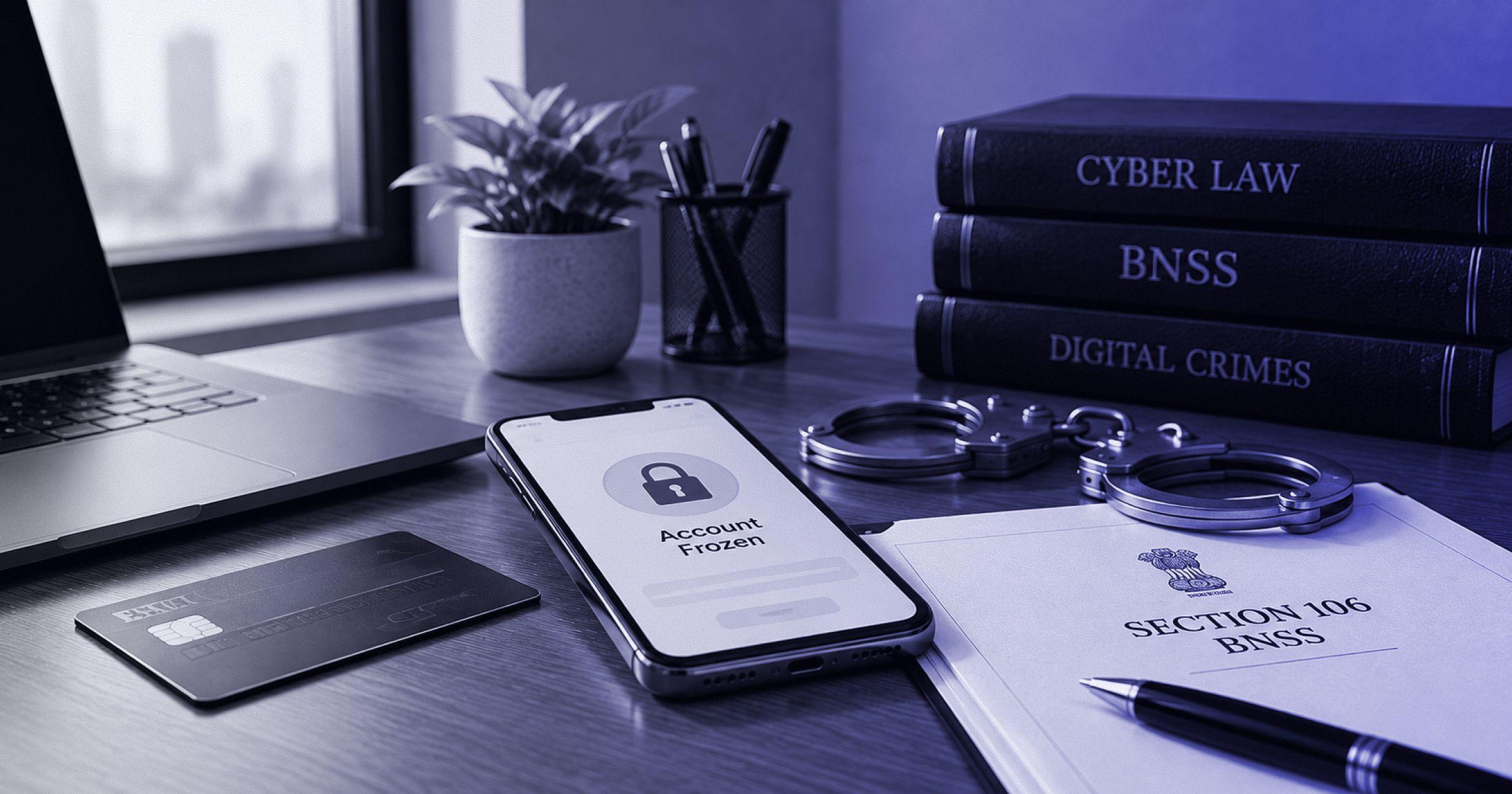
A bank account can become unusable without the account holder ever being accused of a crime. A freelancer in Delhi receives payment from a customer. A trader in Noida sells goods against a bank transfer. A business owner in Gurgaon receives funds in an ordinary commercial transaction. Weeks later, the bank refuses withdrawals, UPI transfers or cheque payments, citing a cybercrime complaint registered in another State.
The difficulty is not merely that a particular payment has been questioned. Sometimes the disputed entry is a small fraction of the account balance, yet every outgoing transaction is blocked. Salaries, rent, EMIs and business obligations may become impossible to meet. The account holder is then told to obtain a “cyber cell NOC”, without being informed who issued the restriction or which amount is actually disputed.
The law does permit investigators to preserve property connected with an offence. It does not follow that every bank restriction is automatically lawful, proportionate or required to continue indefinitely. The proper remedy depends on whether the bank has placed a lien on a specified amount, imposed a complete debit freeze, suspended digital banking, or acted under a court order.
The commonly searched expression “Section 102 CrPC account freeze” refers to the former procedural law. The relevant provisions in 2026 are Sections 106 and 107 of the Bharatiya Nagarik Suraksha Sanhita, 2023 (BNSS), which came into force on 1 July 2024, together with the provisions governing custody and release of seized property. There is also a significant development: the Ministry of Home Affairs has issued a 2026 Standard Operating Procedure (SOP) for the National Cybercrime Reporting Portal (NCRP) and the Citizen Financial Cyber Fraud Reporting and Management System (CFCFRMS), including a structured grievance process for account holders.
Quick Answer: How to Unfreeze Bank Account Frozen by Cyber Crime 2026
First, obtain a written explanation from the bank identifying the restriction, the disputed amount, the relevant complaint or FIR, and the investigating agency. Next, assemble documents proving the lawful source and purpose of the questioned payment. Request review through the bank and the investigating officer, and invoke the 2026 NCRP-CFCFRMS SOP where applicable. If the restriction remains unjustified, the account holder may seek relief from the jurisdictional Magistrate and, in an appropriate case, the High Court.
The immediate objective may not always be release of every disputed rupee. Where a specific transaction is genuinely under investigation, it may be possible to retain a lien over that amount while allowing normal operation of the remaining balance. A complete freeze, however, requires a closer examination of the alleged involvement, the statutory power invoked and the safeguards followed.
Why Do Innocent Bank Accounts Get Frozen in Cyber Fraud Investigations?
Financial cyber fraud rarely ends with one transfer. Money may move from the victim to an initial receiving account, then through multiple other accounts or payment intermediaries. Police and banks try to trace and preserve amounts passing through this chain before they are withdrawn. An account may therefore be flagged even when its holder dealt with a customer, purchaser or counterparty without knowing about the original fraud.
For example, assume that a Delhi trader sells electronic goods for Rs. 18,000/- and receives payment by UPI. Unknown to the trader, the payer had previously received funds traced to an online investment scam. A complaint filed elsewhere may result in a hold on the trader's account. The fact that an amount is reflected in a money trail is a reason to investigate the transaction; by itself, it is not proof that the trader knowingly participated in the fraud.
A freeze is more difficult to challenge where investigators can point to stronger indicators: rapid onward transfers, accounts opened on false particulars, unexplained cash withdrawals, repeated receipts from suspected accounts, or evidence that the account holder acted as a money mule. The expression “money mule” commonly refers to a person who makes an account available to receive or transfer illicit funds, often for a commission. Merely receiving money from a questionable payer does not automatically make a person a money mule. The facts and any criminal responsibility still have to be established.
Lien, Debit Freeze and Account Seizure: Know the Difference
1. Lien or Hold on a Specific Amount
People searching for lien on bank account cyber complaint are usually dealing with a situation where the bank has blocked a particular sum because that amount has been traced to an NCRP or police complaint.
A specified sum is earmarked and cannot be withdrawn or used. The rest of the balance may remain available. For example, on an account containing Rs. 4,00,000/-, a cyber-complaint lien of Rs. 12,000/- may leave the account holder free to use the remaining balance, subject to any other restrictions. A lien is not necessarily a final finding that the earmarked amount belongs to the complainant.
2. Complete Debit Freeze
The bank blocks outgoing transfers, ATM withdrawals, UPI payments and other debits, even where the account contains sums unrelated to the disputed transaction. Credits may still be accepted in some cases. Such a restriction can cause far greater damage than a hold on the identified sum and must be examined against the legal authority relied upon.
3. Suspension of Digital Banking Services
Internet banking, UPI or other electronic facilities may be disabled without necessarily stopping every branch-based transaction. The bank should clarify whether this is a fraud-prevention measure, a restriction based on a police communication, a KYC issue or a separately ordered seizure.
4. Attachment Under a Judicial Order
An attachment directed by the competent court under Section 107 BNSS has a different statutory procedure. The bank cannot treat an account holder's informal request as authority to disregard a subsisting judicial order. Relief must be sought from the appropriate court under the applicable statutory framework.
These distinctions matter. Before searching for a “frozen bank account lawyer Delhi”, determine what the bank has actually done. A demand to remove a lien, a request to allow ordinary operation with the disputed amount protected, and a challenge to an attachment order are not identical legal proceedings.
A common concern is what to do when a person discovers that his or her bank account frozen by police is linked to a cybercrime investigation in which the account holder may not even be an accused.
Section 106 BNSS: What Power Does the Police Actually Have?
Section 106 BNSS substantially corresponds to Section 102 of the former Code of Criminal Procedure, 1973 (CrPC). Section 106(1) enables a police officer to seize property alleged or suspected to have been stolen, or found in circumstances giving rise to suspicion of the commission of an offence. Under Section 106(2), an officer subordinate to the officer in charge of a police station must report the seizure to that officer. Section 106(3) further requires every officer acting under sub-section (1) to report the seizure forthwith to the Magistrate having jurisdiction.
The expression “forthwith” is important. The statutory duty should not be confused with a universal, fixed 24-hour or 48-hour deadline written into Section 106 itself. Whether a report was made and when it was made are matters that can be raised before the competent court.
The Supreme Court in State of Maharashtra v. Tapas D. Neogy, (1999) 7 SCC 685, held under Section 102 CrPC that money in a bank account is “property” capable of being seized or made subject to a prohibitory direction where it has the required direct link with the investigated offence. In Teesta Atul Setalvad v. State of Gujarat, (2018) 2 SCC 372, the Supreme Court also considered the scope of freezing bank accounts during investigation and held that prior notice to the account holder was not a condition of seizure under the old Section 102 framework. That does not eliminate the requirement to comply with applicable statutory safeguards.
Those decisions explain why a blanket assertion that “the police can never freeze an account” would be legally inaccurate. But the introduction of Section 107 BNSS, which expressly deals with attachment, forfeiture and restoration of property, has produced an important debate about the dividing line between an investigative seizure and an attachment of suspected proceeds of crime.
Section 107 BNSS: Why It Matters for a Complete Bank Account Freeze
Section 107 introduces a specific route for attachment of property believed to have been derived or obtained, directly or indirectly, from criminal activity. Under Section 107(1), an investigating police officer may, with the approval of the Superintendent of Police or Commissioner of Police, apply to the competent Court or Magistrate for attachment. The provision contains safeguards involving notice, an opportunity to respond and judicial assessment, with a mechanism for interim attachment in appropriate circumstances.
Several High Courts have reasoned that Section 106 concerns seizure for investigative purposes, while Section 107 governs attachment of alleged proceeds of crime. On that approach, a police direction amounting to a wholesale debit freeze cannot bypass Section 107 merely by mentioning Section 106.
However, the judicial position is not identical throughout India. On 10 August 2026, the Karnataka High Court in State of Karnataka v. Jar Gold Retail Private Limited, Criminal Petition No. 5929/2026 and connected matters, held that an investigative or preservative debit freeze can fall within Section 106, provided its statutory requirements, particularly reporting to the Magistrate, are complied with. It distinguished that temporary investigative measure from the longer-term attachment contemplated by Section 107.
Importantly, the Karnataka High Court also recognised that the power of seizure is tied to property or amounts suspected of involvement in an offence. A restriction covering an entire account is not justified merely because a limited identifiable amount is under suspicion, without the necessary factual basis.
What this means: An account holder should not build a case around the proposition that every police-imposed freeze is void for lack of a prior Magistrate's order. In Delhi, recent High Court decisions support the Section 107 objection against blanket debit freezing; in another jurisdiction, the investigating agency may rely on a different High Court interpretation of Section 106. Across both approaches, the source of the money, extent of the disputed sum, proportionality, proper reporting and procedural compliance remain central questions.
Important Supreme Court and High Court Judgments on Frozen Bank Accounts
State of Maharashtra v. Tapas D. Neogy, (1999) 7 SCC 685 — Bank Accounts Can Be Seized
The Supreme Court rejected the proposition that a bank balance falls outside the meaning of “property” under Section 102 CrPC. Its reasoning continues to inform the interpretation of Section 106 BNSS, which carries forward the principal language of the old provision. The judgment does not mean that every account receiving a remotely connected transfer may be frozen without reasons or statutory safeguards.
Neelkanth Pharma Logistics Pvt. Ltd. v. Union of India, 2025 SCC OnLine Del 1055 — A Rs. 200/- Credit Cannot Be Ignored, but Neither Can Proportionality
The Delhi High Court considered an extraordinary situation: a business account with a very substantial balance had been entirely frozen following a disputed credit of just Rs. 200/-. The subsequent restriction was narrowed to a lien of Rs. 200/-, and the petition was disposed of as not pressed. Nevertheless, the Court made significant observations about the hardship caused by indiscriminate freezing of innocent account holders' business funds.
The Court explained that where an identified sum can be preserved, a blanket freeze calls for reasons, particularly when no complicity of the account holder is shown. This judgment is important for traders, service providers and businesses whose otherwise legitimate operations are disrupted by a small disputed entry.
Malabar Gold and Diamond Limited v. Union of India, 2026 SCC OnLine Del 297 — Seizure and Attachment Are Distinct
The Delhi High Court examined the relationship between Sections 106 and 107 BNSS and held that an investigating agency does not have independent authority under Section 106 to impose a debit freeze amounting to attachment of alleged proceeds of crime. It identified Section 107, involving the competent Magistrate's order, as the relevant route for such attachment.
The case also makes an important practical point: receiving funds from a customer does not, by itself, establish that the business was involved in the customer's alleged criminal activity. Suspicion should be linked to material and not merely assumed from the movement of money.
Captain Rakesh Walia (Retd.) v. Union of India, W.P.(C) 19715/2025, decided on 17 February 2026 — Blanket Freezing Set Aside
The Delhi High Court dealt with an account initially subject to a specific lien and subsequently placed under a complete debit freeze. The petitioners were not shown to be accused or suspects, and no Section 107 order was produced. The Court found the blanket restriction unsustainable and directed that the account be defrozen, while preserving the investigating agency's right to proceed lawfully if specific material emerged.
The decision reinforces that an investigation can continue without automatically depriving an uninvolved account holder of every banking facility.
State of Karnataka v. Jar Gold Retail Private Limited, decided on 10 August 2026 — A Different View of Section 106
The Karnataka High Court took the view that investigative seizure under Section 106 can include a debit freeze without prior judicial permission, so long as the statutory conditions and post-seizure reporting requirement are observed. This decision differs from the approach adopted in the above Delhi and Kerala decisions. It is therefore important not to present the Section 106 versus Section 107 issue as conclusively resolved across all High Courts.
A practical legal challenge should be supported by the law applicable to the relevant forum and the actual records of the seizure rather than a selective quotation from one judgment.
The 2026 NCRP-CFCFRMS SOP: A New Route for Challenging a Bank Lien or Freeze
On 2 January 2026, the Ministry of Home Affairs issued the SOP for NCRP-CFCFRMS, Custody, Restoration of Money and Grievance Redressal. The Ministry publicly confirmed its standardised framework in July 2026. Clause 10 concerns grievances arising from holds, account seizures and suspension of digital banking services. The SOP provides a process involving the bank, the investigating officer and designated district and State grievance officers.
Clause 10.1: Where a Particular Amount Is on Hold
The affected person should approach the bank branch or other designated banking office and provide an explanation and supporting records. Following the prescribed customer due diligence, the bank is expected to raise the grievance through the CFCFRMS Grievance Redressal Module as early as possible and not beyond seven calendar days from the customer's complaint, where the prerequisites for raising it are satisfied.
The grievance is referred to the investigating officer for verification. The SOP prefers verification through videoconferencing where possible. If satisfied, the officer is expected to direct removal of the hold within the stipulated fifteen-calendar-day process. If the explanation is rejected, reasons must be recorded and communicated through the prescribed system.
Where the officer does not act within fifteen calendar days, the SOP provides for escalation to the District Grievance Officer. An aggrieved person may also seek review within fifteen calendar days of receiving an adverse intimation. The district-level review and further escalation have their own time frames.
Clause 10.1 also contains a conditional mechanism concerning a contested hold where no lawful continuation direction is received within ninety calendar days of the bank submitting the grievance. This is not an unconditional rule that every cybercrime lien automatically disappears after ninety days. The SOP contemplates notice to the law-enforcement agency, checks for other complaints or court proceedings, enhanced due diligence and possible extensions. The wording should be applied to the facts of the specific hold.
Clause 10.2: Where the Entire Account or Digital Banking Is Restricted
Clause 10.2 addresses suspension of digital banking services, seizure of accounts and related measures. It contemplates a grievance raised through the concerned bank, ordinarily within the same seven-calendar-day period for the bank to submit it, followed by verification by the police. Where satisfied, the officer may direct restoration of account operations or digital facilities while keeping the reported amount on hold, where appropriate.
If the investigating officer does not respond within fifteen calendar days, the matter is to be notified to the District Grievance Officer. The SOP also provides a review before the District Grievance Officer and a further appeal to the State Grievance Officer, subject to the specified fifteen-day periods. It expressly preserves the option of approaching the jurisdictional court.
The SOP refers in Clause 10.2 to Section 106 BNSS or other applicable law for account seizure or suspension directions. That administrative language must be read alongside the judicial decisions concerning Sections 106 and 107. The SOP does not itself settle the differing interpretations adopted by the High Courts or replace statutory safeguards.
Practical point: The online grievance module is part of the SOP's implementation framework. An account holder should begin with a documented branch or bank grievance and request that the bank initiate the applicable NCRP-CFCFRMS process, rather than assuming that a public-facing account holder can directly operate every part of the police-and-bank portal.
Seven Steps to Unfreeze a Bank Account Frozen by Cyber Crime Authorities
Step 1. Obtain the Bank's Written Reason for the Restriction
Ask the branch manager and bank's grievance or nodal officer to identify whether the restriction is a lien, partial hold, debit freeze, digital banking suspension or court-ordered attachment. Request the date of the action, exact disputed amount, relevant transaction reference, NCRP acknowledgement or FIR details if available, name of the requesting police station or agency, and copies or particulars of the communication or order that can lawfully be disclosed. Ask whether multiple complaints have generated separate holds.
If the bank will not provide the underlying police correspondence, at least obtain its written position and the identity of the authority to whom a representation can be addressed. Keep proof of delivery and a complaint reference. An unexplained oral refusal is a poor foundation for a court application.
Step 2. Trace the Questioned Transaction and Collect Proof of Its Lawful Origin
Download the complete relevant bank statement, not merely a screenshot of the blocked balance. Mark the disputed UTR or transaction entry and identify the payer, date, purpose and onward movement. For an ordinary commercial receipt, preserve the invoice, purchase order, agreement, delivery proof, ledger, GST documentation where relevant and correspondence with the counterparty. For salary, keep the appointment or employment record and payslips. For family transfers, retain a coherent explanation and supporting account records.
A crypto P2P seller may need platform order records, trade history, matching wallet-transfer information, screenshots, KYC information lawfully available and tax disclosures where relevant. No single document establishes innocence by itself; consistency between the explanation, transaction trail and independent records is what matters.
Step 3. File a Formal Bank Grievance Under the 2026 SOP
Submit a short written representation asking the bank to initiate the grievance process contemplated by Clause 10.1 or 10.2, as applicable. Attach relevant proof and ask for acknowledgement, the grievance or escalation reference, and the date on which the request is forwarded. Where a lien can protect the precise disputed amount, request restoration of ordinary banking operations over the unaffected balance.
Escalate through the bank's customer grievance mechanism if the branch gives no meaningful response. The RBI Integrated Ombudsman mechanism may be relevant to an independently actionable deficiency in banking services, subject to its conditions; it is not a substitute for a judicial challenge to an otherwise lawful police or court direction.
Step 4. Send a Reasoned Representation to the Investigating Officer
Once the authority is known, write to the investigating officer and, where appropriate, the SHO or supervisory cyber officer. Explain the transaction in chronological order, provide supporting documents and specifically request removal of the freeze or conversion of a complete freeze into a lien confined to the identified sum.
Request clarification of the legal power invoked, whether a report of seizure was sent to the Magistrate under Section 106(3), and whether there is any judicial order under Section 107. Do not treat every appearance request as unlawful; the SOP itself envisages verification, preferably through video conference where feasible. Cooperation should be documented, and statements should remain factual and consistent with the records.
Step 5. Escalate to District and State Grievance Officers Where Applicable
If the NCRP-CFCFRMS grievance process is being used, track the bank's seven-day submission expectation and the investigating officer's fifteen-day response period. Ask the bank to confirm whether the issue has been escalated. Where an adverse decision is communicated, consider the SOP's review window before the District Grievance Officer and, if necessary, the appeal mechanism before the State Grievance Officer.
A representation sent only to generic bank email addresses is not necessarily the same as a grievance registered through the prescribed module. Preserve acknowledgement of each step. Nor does the SOP prevent an account holder from approaching the jurisdictional court where urgent relief is necessary.
Step 6. Approach the Jurisdictional Magistrate for Appropriate Relief
When the restriction persists, a lawyer may examine a petition before the Magistrate having jurisdiction over the seizure or investigation. Depending on how the property is held and the procedural stage, Section 503 BNSS (corresponding to former Section 457 CrPC) may be relevant where a police seizure has been reported but the property is not produced before a criminal court. Section 497 BNSS (corresponding to former Section 451 CrPC) concerns custody and disposal of property pending investigation, inquiry or trial where its conditions are met.
If attachment proceedings under Section 107 exist, the account holder must address the orders and safeguards under that provision. The prayers may include calling for the seizure report, recording the bank's status, permitting operation of the account, removing or restricting the lien, or granting other interim relief that protects the disputed sum without paralysing the account.
The correct forum cannot be decided simply by looking at the city where the bank branch is located. If the complaint is being investigated in another State, the relevant Magistrate and records may also be there.
Step 7. Consider a High Court Petition Where the Freeze Is Arbitrary or Disproportionate
A writ petition under Article 226 of the Constitution may be appropriate where a blanket freeze lacks lawful support, the account holder is not implicated, the disputed amount is identified, representations have failed or the restriction causes serious and continuing prejudice. Depending on the procedural posture, other appropriate criminal jurisdiction may also require consideration.
The petition should identify the correct respondents, including the concerned investigating authority and bank; plead territorial jurisdiction; set out a precise money trail; annex every representation and bank reply; and seek carefully framed interim relief. Courts may be more receptive to a request allowing operation of the unaffected balance while preserving the disputed sum than to a demand that every hold be removed irrespective of the investigation.
What Documents Should You Keep Ready Before Speaking to a Lawyer?
- +Bank letter, SMS or email showing the lien, debit freeze or other restriction.
- +Latest statement and relevant historical statements showing the disputed credit and legitimate account activity.
- +NCRP acknowledgement number, FIR particulars and details of the police station or investigating officer, to the extent available.
- +Invoice, contract, order confirmation, delivery proof, salary record, ledger or other evidence explaining the source of funds.
- +Written complaints made to the bank and cyber police, along with acknowledgements and replies.
- +KYC proof and business registration, GST or tax records where they directly support the transaction.
- +Details of other liens, previous court orders and any notice or summons already received.
The quality of the chronology matters more than the number of pages. A lawyer should be able to see immediately whose money was received, why it was received, what the investigating agency disputes and why the restriction is more extensive than necessary.
Common Situations in Delhi, Noida and Gurgaon
Freelancer in Delhi Paid by an Unfamiliar Client
A designer receives a bank transfer for completed work and later discovers that the entire salary account has been debit frozen. Relevant material may include the work order, emails, delivered files, invoice and bank entry. If only one fee payment is disputed and there is no material showing complicity, a request to restore operations while protecting that amount may be appropriate.
Noida Trader Whose Business Account Has Multiple Cyber Liens
A business receives dozens of daily payments. Two unrelated police stations flag different entries. The trader must identify each hold separately and obtain the relevant complaint references; removal of one lien may not remove another. Stock invoices, e-way bills, payment reconciliation and tax records can help establish the commercial context of the receipts. A global assurance that the business is genuine may not answer each investigation.
A person searching for an unfreeze account lawyer Noida should therefore keep the details of every separate lien and complaint ready, because removal of one restriction may leave the remaining holds unaffected.
Gurgaon P2P Crypto Seller Whose Account Is Debit Frozen
A person sells virtual digital assets through a peer-to-peer platform and receives consideration that is later linked to a fraud complaint. P2P transactions require careful examination because payment may come from a third-party account and platform identity verification may be incomplete. The seller should preserve the transaction trail and not delete chat histories or attempt to conceal further transfers. A lawful-source representation can be made, but a court may examine whether the person ignored warning signs or knowingly facilitated suspicious movement of funds.
Someone approaching a bank account freeze lawyer Gurgaon in such a case should preserve the complete P2P order history, payment trail, platform records and communications before making any representation to the police.
What If the Cyber Complaint Was Registered in Another State?
An account in Delhi can be restricted following a complaint in Maharashtra, Karnataka, Telangana or elsewhere. The local bank commonly implements the direction but may not be the authority capable of deciding whether an investigative hold should continue. Obtain the remote police station's particulars and serve a documented representation on the issuing authority as well as the bank.
Jurisdiction should be assessed carefully. A High Court petition may raise questions of where the material part of the cause of action arose and which authorities can effectively be directed. The presence of a local bank branch is relevant but does not automatically resolve every territorial issue. The remedy before a criminal Magistrate may need to be pursued where the relevant seizure has been reported or the case is being investigated.
What If the Bank Says It Needs an NOC From the Cyber Cell?
Ask the bank to identify the precise authority whose clearance it requires and the legal or operational basis for insisting on it. A police communication removing a hold may resolve some cases, while a judicial attachment order requires judicial treatment. Where the bank has independently imposed a KYC or risk-related restriction, the required compliance route may be different.
An “NOC” is often banking shorthand for an instruction lifting a police-origin restriction. It is not an all-purpose statutory document named in Section 106 BNSS, and obtaining one cannot be assumed to cure a separate court-ordered attachment or another complaint-based hold.
Common Mistakes That Delay Defreezing
- +Assuming that a small suspicious credit automatically makes a complete account freeze lawful, or that every freeze is automatically illegal.
- +Sending a generic request to the bank without obtaining the disputed transaction and police authority details.
- +Contacting the complainant to arrange an informal repayment without first understanding the accusation or the competing claims to the funds.
- +Relying on unexplained cash deposits, incomplete invoices or mismatched transaction dates.
- +Ignoring separate holds issued in relation to different complaints.
- +Treating an RBI Ombudsman complaint as if it automatically cancels a lawful police or judicial direction.
- +Deleting chats, modifying records, transferring money through other persons' accounts or otherwise interfering with evidence.
- +Waiting indefinitely for a verbal assurance that the account will be released, without invoking the SOP or obtaining a decision capable of being reviewed.
Frequently Asked Questions
1. How to Unfreeze a Bank Account Frozen by Cyber Crime in 2026?
Obtain the bank's written particulars, establish the source of the disputed money, submit the relevant SOP grievance and representation to the investigating officer, and pursue Magistrate or High Court relief if the restriction remains unlawful or disproportionate. The necessary application depends on whether it is a lien, complete debit freeze or court-directed attachment.
2. Can the Cyber Cell Freeze My Account Even If I Am Not an Accused?
An account may be examined or subjected to lawful measures during investigation even when the holder is not formally named as an accused. But being part of a payment trail does not itself establish guilt. The extent and continuation of any restriction remain open to scrutiny.
3. Can Police Freeze an Entire Bank Account for a Small Transaction?
Courts have criticised blanket freezing based solely on a small and identifiable disputed transfer without material indicating the holder's involvement or another sufficient reason. In appropriate cases the identified amount may be protected by a limited hold while the rest of the account is made operational. The facts, applicable law and investigating authority's reasons are decisive.
4. Does Section 106 BNSS Replace Section 102 CrPC?
Yes. Section 106 BNSS is the corresponding police-seizure provision under the new criminal procedure framework. Earlier Supreme Court decisions interpreting Section 102 remain important. However, Section 107 BNSS introduces an express attachment and restoration mechanism, and High Courts have differed on the exact boundary between the two powers.
5. Is a Magistrate's Order Necessary Before Every Bank Freeze?
The answer cannot be given as an unconditional yes or no. Delhi High Court decisions treat attachment or a complete debit freeze of alleged proceeds of crime as requiring the Section 107 route. The Karnataka High Court has recognised a separate investigative power to debit freeze under Section 106, subject to mandatory safeguards. The character of the measure and law applicable to the relevant proceeding must be examined.
6. Is the Cyber Cell Required to Inform the Magistrate?
Where the police exercise seizure powers under Section 106(1), Section 106(3) requires them to report the seizure forthwith to the Magistrate having jurisdiction. The absence or delay of such a report can be a relevant ground of challenge, assessed in light of the governing authorities and the facts.
7. Is a Cybercrime Lien Automatically Removed After 90 Days?
No. The 2026 SOP has a conditional process for reconsidering a contested hold when no lawful continuation direction is received within a specified period, but it also contemplates notices, verification, other complaints and possible extensions. A pending court order or another lawful hold cannot be ignored.
8. How Long Does It Take to Get a Frozen Bank Account Unfrozen?
The SOP specifies stages such as seven calendar days for a bank's grievance submission and fifteen-day review periods for certain authorities. Those are process standards, not a guaranteed final restoration date in every case. Complex investigations, multiple complaints, contested facts or litigation may take longer.
9. Will Paying the Disputed Amount Automatically Unfreeze My Account?
Not necessarily. Payment does not automatically erase a complaint, establish innocence or cancel a police direction. Before agreeing to any payment, the underlying transaction, entitlement to the funds, police position and legal implications should be considered.
10. Can I File a Petition in Delhi If Another State's Cyber Police Froze My Account?
Possibly, where territorial jurisdiction and the cause of action support it. However, the investigating agency and relevant Magistrate may be situated elsewhere. The correct forum should be selected after examining the issuing authority, the seizure record, location of the bank and nature of the relief sought.
11. Does the Bank Have to Give Me a Copy of the FIR or Freeze Order?
The bank should be asked for the particulars and available directions underlying its action. Some investigation material may not be shareable by the bank or may need to be obtained from the police or court. A refusal should be documented; it does not remove the need to establish the source and type of restriction.
12. Can My Account Be Restored Without Releasing the Disputed Money?
Yes, that can be an appropriate interim outcome. Depending on the case, an order or lawful direction may permit normal operation of the unaffected balance while maintaining a hold over a specified disputed amount. Such relief protects the investigation while reducing unnecessary hardship.
Why Choose Pramanika Legal for Bank Account Defreezing and Cybercrime Lien Matters?
A frozen bank account case is not resolved by sending a standard “unfreeze request”. The factual inquiry must identify the original transaction, the nature of the police direction, the amount genuinely in dispute, the location of the investigating authority, and whether the statutory requirements under Sections 106 and 107 BNSS have been followed.
Pramanika Legal advises individuals, freelancers, entrepreneurs and businesses in Delhi NCR on cybercrime-related bank freezes, disputed liens, representations to investigating authorities, the NCRP-CFCFRMS grievance process and appropriate proceedings before criminal courts and High Courts. Each case requires a document-based assessment, particularly where the account is needed for ordinary living expenses or continued business operations.
The objective is not to frustrate a legitimate cyber fraud investigation. It is to ensure that preservation of disputed funds does not become an open-ended restriction over unrelated money without the necessary legal basis.
Conclusion
If your bank account has been frozen by the cyber cell, the first question is not merely how to obtain an NOC. It is what precisely has been frozen, why, by whom and under which statutory power. Section 106 BNSS, the attachment procedure under Section 107, recent High Court decisions and the 2026 NCRP-CFCFRMS SOP now provide important grounds and procedures for examining the restriction.
There is no universal promise of immediate defreezing. But where a discrete amount can be preserved and the account holder has a credible lawful explanation for the transaction, a reasoned request for partial or complete restoration may be far stronger than repeated informal follow-ups. Promptly collecting evidence and identifying the correct forum can prevent a temporary investigative measure from becoming a prolonged financial crisis.
If your account is under lien or debit freeze, contact Pramanika Legal (www.pramanikalegal.com) for a review of the transaction trail, police communication and available legal remedies in Delhi, Noida, Gurgaon or the appropriate jurisdiction.
Schedule consultation to assess the arrest risk and secure appropriate protection before custody.