

CBI Summons Received? Your First 48-Hour Defence Playbook and Statutory Rights Under BNSS 2023
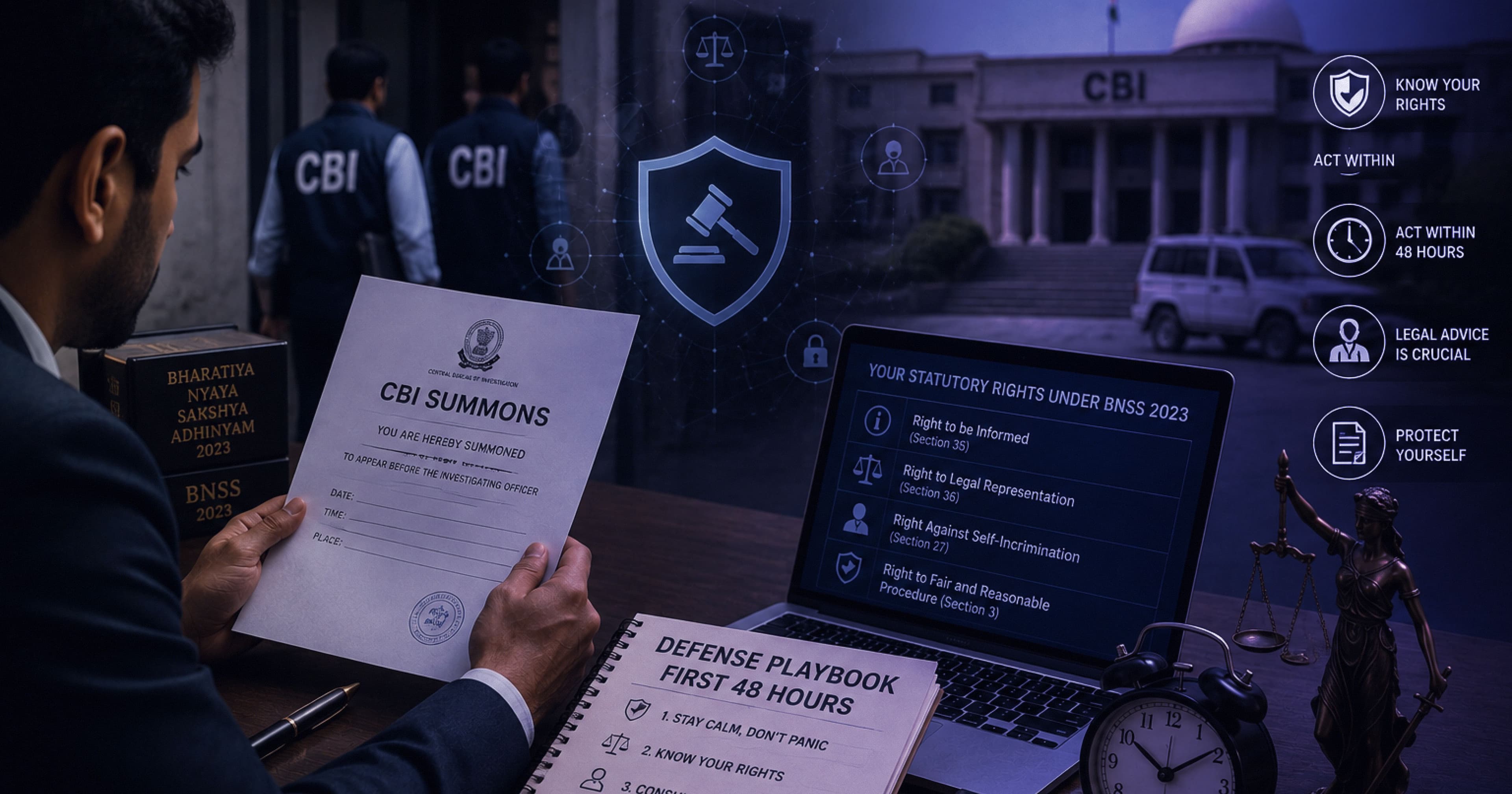
A summons is not an arrest — but how you respond in the first 48 hours shapes everything that follows. What you say, what documents you produce, whether you waive privilege without realising it, and whether you have assessed anticipatory bail risk: all of it is determined in this window. Engage a white collar crime lawyer in Delhi before you appear, not after.
You Have the Summons in Your Hand Right Now
Do not call the investigating officer to acknowledge receipt. Do not ask them what it is about. Do not produce anything yet.
Read the summons carefully: which agency issued it, under which section of the BNSS, what date and time you are required to appear, and whether it names you as a witness or requires you to produce documents.
The section number on the summons tells you more than anything else. Section 179 BNSS and Section 35 or 94 BNSS are entirely different instruments requiring different responses.
Call your lawyer now: +91 9958480667orsubmit an urgent query.
What the Law Says: Summons Under BNSS 2023 and Your Constitutional Position
The Bharatiya Nagarik Suraksha Sanhita, 2023 replaced the Code of Criminal Procedure, 1973 with effect from July 1, 2024. Several section numbers changed. Understanding which provision your summons was issued under is not a technical formality — it determines your legal obligations, your rights, and the strategy for your response.
Section 179 BNSS — Attendance of Witnesses (Formerly Section 160 CrPC)
A summons under Section 179 BNSS requires a person to appear before the investigating officer to give information relevant to the case. It is a witness summons — it does not by itself designate the person as an accused. However, appearance under Section 179 does not mean you are free from risk: the questions asked, and your answers, will be recorded and can be used later in proceedings.
The critical protection under Section 179 is that no person can be compelled to be a witness against themselves under Article 20(3) of the Constitution. This means you are not required to answer questions whose answers may expose you to criminal liability. The provision applies at the investigative stage, not only at trial.
Section 35 and Section 94 BNSS — Production of Documents (Formerly Section 91 CrPC)
A notice or summons under Section 35 or Section 94 BNSS requires the production of specific documents or things. This is a document production summons, not an attendance summons. Your obligation is to produce what is specifically named — nothing more. The scope of what is named, whether the production obligation applies to privileged communications, and whether the documents exist and are in your control are all questions that must be assessed before you produce anything.
Producing documents beyond what is specifically required is one of the most common and most damaging errors at the summons stage. Each additional document handed over becomes part of the agency’s case material and cannot be retrieved.
Section 50 PMLA — ED Examination (Different Regime)
If the summons is from the Enforcement Directorate under Section 50 of the Prevention of Money Laundering Act, 2002, a materially different regime applies. A statement recorded under Section 50 PMLA by an ED officer is admissible as evidence at trial — unlike a statement to a police officer under Section 180 BNSS, which is not admissible. The Supreme Court in Vijay Madanlal Choudhary v. Union of India (2022) confirmed that ED examination under Section 50 is not examination by a police officer and the bar on admissibility does not apply.
This distinction is decisive. Every word recorded in a Section 50 PMLA examination can appear in the charge-sheet and at trial. The standard of care required before and during a Section 50 appearance is therefore significantly higher than for a BNSS witness summons.
Article 20(3) — The Right Against Self-Incrimination and Its Limits
Article 20(3) of the Constitution protects every person from being compelled to be a witness against themselves. It does not, however, protect against all questioning. The settled position from the Supreme Court is:
- +Article 20(3) applies to accused persons, not to witnesses who have not yet been accused of an offence. If you are summoned as a witness and have not been formally accused, the protection does not automatically apply in full — but you retain the right to decline answering questions whose answers would expose you to criminal liability.
- +The protection covers testimonial compulsion — being forced to speak or write in a way that incriminates you. It does not cover the production of physical documents or biometric data.
- +You cannot be physically compelled to make a statement. If you decline to answer a specific question on self-incrimination grounds, the officer may note your refusal, but cannot arrest you solely for the refusal.
The Poolpandi Position: No Absolute Right to Lawyer in the Room
In Poolpandi v. Superintendent of Central Excise (SC), the Supreme Court held that there is no absolute right to have a lawyer physically present in the examination room during examination under a fiscal or economic offence statute. The right to legal counsel under Article 22(1) does not, in every case, require the lawyer’s presence during each moment of questioning.
What this means in practice:
•You are entitled to consult your lawyer before the examination begins.
•You can request breaks during a long examination to consult outside the room.
•Your lawyer can wait outside and be consulted between sessions.
•Preparation before the examination date is therefore the most important legal work — not presence during it.
Key Precedents: Examination, Evidence, and the Admissibility Framework
The legal standards governing what investigating agencies can demand, what you must produce, and what can be used against you at the summons stage are settled by a specific set of Supreme Court rulings.
Arjun Panditrao Khotkar v. Kailash Kushanrao Gorantyal (2020) 7 SCC 1
This Constitution Bench ruling mandated strict compliance with Section 65B certification requirements (now carried forward under the Bharatiya Sakshya Adhiniyam, 2023) for electronic records to be admissible as evidence. The ruling is directly relevant at the summons stage where agencies are requesting digital materials — emails, WhatsApp exports, accounting software exports, cloud storage records.
Before handing over any digital record in response to a Section 94 BNSS production notice, assess whether the agency is observing its own obligations on electronic evidence handling. More importantly, any digital material you produce should be accompanied by your own record of what was produced, when, and in what format — creating your evidentiary baseline for any future admissibility challenge.
This intersects directly with the chain of custody issues covered in our guide on your rights and how to protect digital evidence during a corporate raid. The evidentiary standards are the same whether material is seized during a raid or produced pursuant to a summons.
Vijay Madanlal Choudhary v. Union of India (2022) — PMLA Examination
The Supreme Court upheld the constitutional validity of key PMLA provisions, including the admissibility of Section 50 statements and the PMLA’s power to arrest. The ruling confirmed that Section 50 PMLA examination is distinct from police examination under BNSS, meaning the bar on police statement admissibility does not apply.
The practical implication: if your summons is under Section 50 PMLA, the examination is designed to produce admissible evidence. Every question is strategic. Your preparation must address not just what you are asked but what the examiner is trying to establish.
The BNSS 2023 Procedural Framework (2026 Position)
Delhi High Court decisions through 2025 and 2026 have consistently held that the transition from CrPC to BNSS does not diminish constitutional protections. Article 20(3) continues to apply. The right to consult counsel before examination continues to apply. Procedural protections around summons compliance — timelines, form, content — also continue from the CrPC framework under analogous BNSS provisions.
What has changed in practice is the speed of enforcement. Agencies are using BNSS’s tighter timelines and its updated coercive process provisions more aggressively than in the CrPC era. A non-response to a BNSS summons can trigger coercive process faster than under the old framework.
The First 48 Hours: Your Step-by-Step Defence Playbook
The window between receiving a summons and appearing before the agency is the most important legal phase of the entire investigation. What you do in this window determines your exposure at every stage that follows.
Hours 0–2—Read and Classify the Summons
Before doing anything else, read the summons carefully. Identify:
- +Which agency issued it: CBI, ED, EOW, Income Tax, Serious Fraud Investigation Office, or another body.
- +The section under which it was issued: Section 179 BNSS (witness attendance), Section 94 BNSS (document production), Section 50 PMLA (ED examination), or a combination.
- +Whether you are named as a witness, a person of interest, or whether the notice uses any language suggesting accused status.
- +The appearance date, time, and location — and whether the timeline is practically workable given the notice period.
- +Exactly what documents or information is requested, if it is a production notice.
The section number alone changes your entire response strategy. Section 179 BNSS gives you attendence obligations but stronger self-incrimination protections. Section 50 PMLA means every word is admissible. Do not confuse the two or treat them identically. Call your CBI summons defence lawyer in Delhi immediately after this classification.
Hours 2–12—Document Control and Evidence Preservation
If the summons includes a document production component, gather only what is specifically named. Do not go further. Assess each named document for:
- +Whether it falls within the scope of legal professional privilege — communications with your lawyers about legal advice are privileged and not producible.
- +Whether it is actually in your possession, custody, or control — you cannot be compelled to produce what you do not have.
- +Whether producing it would expose you to criminal liability — in which case your Article 20(3) self-incrimination protection becomes relevant.
- +The format in which you are producing it — keep a certified copy of everything produced, with a covering note listing what is being handed over.
Simultaneously, preserve your own copies of business records that may become relevant later. Documents that are destroyed, deleted, or lost after a summons is received create evidentiary inference issues and can be characterised as obstruction.
Hours 12–24—Engage Counsel and Build the Response Strategy
Your lawyer must be engaged before the appearance date, not on the morning of it. The preparation required for a CBI or ED summons appearance is substantive, not administrative. It involves:
- +Reviewing the investigation context: what is the underlying case, who else has been summoned or arrested, what is the agency’s likely theory of the offence.
- +Mapping the questions the examiner is likely to ask and preparing precise, accurate, non-volunteering answers.
- +Identifying which areas of questioning trigger your Article 20(3) protection and preparing to assert it cleanly and specifically.
- +Assessing whether anticipatory bail should be filed as a pre-emptive measure — see the assessment framework in the section below.
- +Reviewing any co-accused’s publicly known position and ensuring your response does not inadvertently conflict with or expose facts they have relied on.
For PMLA summons under Section 50, counsel should also review all prior communications between you and the investigating agency, any attachment orders that have been issued, and the state of the predicate offence case — because the not-guilty twin-condition argument may need to be developed even at the summons response stage. See our full analysis in Anticipatory Bail Under BNSS Section 482 and PMLA 2002: Statutory Protections and Delhi Court Strategy.
The Appearance Date—In the Room: How to Conduct Yourself
Your lawyer cannot be in the examination room in all cases — see the Poolpandi position above. But what you do and say during the examination is governed by a clear set of principles that your preparation should make second nature:
- +Answer the question asked. Do not answer the question you think they meant to ask, and do not answer the question that would be easier for you to answer. Answer precisely what was asked.
- +Do not volunteer. Every sentence beyond the direct answer to the question asked is material that the agency did not have before you walked in. Keep your answers to the minimum accurate response.
- +If a question would require you to incriminate yourself, state specifically: ‘I decline to answer this question on the basis that the answer may expose me to criminal liability.’ Do not answer and then add this disclaimer — it is too late.
- +Request a break if a question requires time to recall accurately, or if you need to consult your lawyer between sessions. Breaks are available and their request cannot be used against you.
- +Read every word of the statement recorded before signing it. Officers record what they hear, not always what was said. Any error in the recorded statement must be corrected at the time of signing, in writing, not afterward.
- +Note the names and designations of all officers present, the start and end times of the examination, and the questions asked and answers given — independently, in writing, immediately after leaving the premises.
Hours 48–72 After Appearance—Post-Examination Assessment
The examination is not the end of the matter — it is often the beginning of an acceleration in the investigation. Within 48 to 72 hours of the appearance:
- +Review the recorded statement with your lawyer for accuracy and for what it reveals about the direction of the investigation.
- +Assess whether the examination signals that you are moving from witness to accused status — a change in questioning tone, questions about your own conduct rather than others’, or a shift toward specific transaction details rather than general context.
- +Make the anticipatory bail decision. If the examination signals approaching arrest, anticipatory bail under BNSS Section 482 must be filed before arrest, not after. The window between a summons appearance and an arrest in economic offence matters can be as short as a few days.
- +Advise relevant colleagues about the existence of the investigation without coaching or obstructing — ensuring that business continuity does not create additional evidentiary exposure.
Assessing Anticipatory Bail After a Summons: The Decision Framework
A summons and an arrest are not the same thing — but one frequently precedes the other. The question is not whether to consider anticipatory bail. The question is when to file it. And the answer is: as soon as the concrete grounds for apprehension crystallise, which may be before, during, or immediately after the summons appearance.
When a Summons Signals Arrest Risk — The Indicators
Assess the following after receiving or appearing for the summons:
1.Co-accused arrests: If others named in the same investigation have been arrested, your arrest risk is high. The summons may be a procedural step before arrest rather than an alternative to it.
2.Tone of the examination: Questions about your specific conduct, your knowledge of particular transactions, or your intent signal accused-status thinking by the examiner. Witness examinations focus on what happened; accused-stage examinations focus on who did it and why.
3.Attachment orders: A provisional attachment of your property or accounts under PMLA Section 5 is a strong indicator that arrest is being considered. Attachment without anticipated arrest is rare in practice.
4.Multiple summonses: Being summoned repeatedly, with each appearance producing more specific questions, indicates the investigation is narrowing toward you as a principal.
5.Agency public statements: Public statements by agency officials naming you in connection with the investigation are concrete grounds for arrest apprehension.
If any two or more of these indicators are present, the anticipatory bail assessment should be treated as urgent. For the full Section 482 BNSS anticipatory bail strategy including the PMLA twin-condition framework, read our detailed guide on anticipatory bail under BNSS Section 482 and PMLA 2002: statutory protections and Delhi court strategy.
Your Statutory and Constitutional Rights When Responding to a Summons
Rights Checklist — CBI / ED / EOW Summons Appearance
1.Right to read and understand the summons: You are not required to acknowledge or respond to a summons before engaging a lawyer. Read it carefully and seek legal advice on its scope before appearing.
2.Right to consult counsel before appearance: Article 22(1) guarantees the right to consult a lawyer. Preparation before the examination date is the most effective exercise of this right.
3.Right against self-incrimination: Under Article 20(3), you cannot be compelled to answer questions whose answers would expose you to criminal liability. Assert this right specifically and in advance of answering — not as an afterthought.
4.Right to produce only what is named: A document production notice under Section 94 BNSS requires you to produce what is specifically identified. You are not required to produce related or associated documents not named in the notice.
5.Right to breaks during examination: You are entitled to request breaks during the examination to consult your lawyer outside the room. This right cannot be denied.
6.Right to correct the recorded statement: Read the recorded statement before signing. Any inaccuracy in the recording must be corrected in writing at the time of signing. A signed statement is prima facie evidence of its contents.
7.Right to challenge the summons: If the summons is issued beyond the agency’s jurisdiction, without proper authorisation, or in breach of procedural requirements, it can be challenged before the High Court having jurisdiction over the investigating unit.
Common Mistakes That Damage Your Position After Receiving a Summons
- +Ignoring the summons or delaying response without informing the agency: Non-appearance in response to a BNSS summons can trigger coercive process — a warrant for your appearance or, in serious cases, arrest. If you need more time, your lawyer communicates formally with the agency and requests an adjournment. You do not simply not appear.
- +Calling the investigating officer to ask what it is about: Any informal conversation with an investigating officer before your formal appearance is uncontrolled. What you say, and what is noted of what you say, is not governed by the protections that apply during a formal recorded examination. Do not have this conversation.
- +Producing documents beyond the specific scope of the notice: Handing over additional documents as a gesture of cooperation is not strategically neutral. Every document you produce becomes part of the investigation record and cannot be retrieved. Produce only what is named, in the form named, with a detailed covering note.
- +Assuming a lawyer can be present in the room during examination: This assumption, corrected by the Poolpandi ruling, leads to inadequate pre-examination preparation. The preparation IS the legal work. The appearance itself is the execution of a prepared position, not an improvised consultation session.
- +Signing the recorded statement without reading it: Officers are human and records are imperfect. A statement that says ‘I did not authorise the transfer’ when you said ‘I did not personally authorise the transfer’ is materially different. Read every word. Correct every error in writing before signing.
- +Failing to assess anticipatory bail risk early enough: The most consequential error in summons response practice is treating the summons as the end of the risk rather than the beginning of it. If the examination signals that you are moving toward accused status, the anticipatory bail window is open. Once arrest happens, it closes.
- +Discussing the investigation with colleagues, co-accused, or on any digital platform: Post-summons communications between persons under investigation are frequently available to the investigating agency through device seizure, call records, or third-party disclosure. Nothing about the investigation should be discussed on any medium that is not face-to-face consultation with your lawyer.
Delhi NCR and Pan-India Coordination: Forum Strategy for Summons Challenges
CBI, ED, and EOW summonses are issued from zonal or regional offices across India. The legal standard for summons issuance, compliance, and challenge is uniform under the BNSS — but the forum for any legal challenge depends on the location of the investigating unit.
Delhi-Based Investigations
Summonses from the CBI’s Delhi units (Bank Securities and Fraud Cell, Anti-Corruption Branch), the ED’s Delhi Zonal Office, or the EOW Delhi are challengeable before the Delhi High Court by writ petition. Appearance-related matters (adjournment requests, complaint against irregular procedure during examination) are addressed through the Special CBI Courts at Rouse Avenue or the PMLA Special Court depending on the investigation.
Out-of-Delhi Summonses
Where the summons originates from a zonal office in another state — ED Lucknow, CBI Mumbai, EOW Rajasthan — the challenge, if any, lies before the High Court having jurisdiction over that zonal office. However, Pramanika Legal coordinates with local counsel in those jurisdictions for response strategy, document preparation, and the anticipatory bail assessment, with the Delhi component of any cross-jurisdictional matter anchored here.
For matters where a Delhi High Court challenge is the appropriate route — challenging the jurisdiction of the investigating unit, the legality of the summons, or the scope of the production notice — a writ petition or a petition under Section 482 BNSS (quashing) can be filed with urgency. Delhi courts list such matters quickly when the legal grounds are clearly presented.
For the complete framework on defending against raid-stage action following a summons that has escalated, read our guide: ED, CBI or EOW — A White Collar Crime Playbook for Delhi NCR Businesses.
Frequently Asked Questions
Q: Is a summons the same as being arrested?
A: No. A summons is a direction to appear before the investigating officer or to produce documents. It does not restrict your liberty and is not an arrest. However, non-compliance with a summons can trigger coercive process — an arrest warrant or a warrant of arrest — depending on the agency and the statute under which it is issued. Receive a summons seriously, comply through counsel, and treat it as the opening phase of an investigation rather than a routine administrative request.
Q: Can I bring my lawyer into the examination room?
A: Not as an absolute right. The Supreme Court in Poolpandi v. Superintendent of Central Excise held that there is no absolute right to have a lawyer physically present during examination under a fiscal or economic offence statute. Your lawyer can wait outside, be consulted during breaks, and prepare you thoroughly before the examination begins. In practice, the quality of pre-examination preparation is more important than presence in the room.
Q: What happens if I ignore a CBI or ED summons?
A: Ignoring a summons issued under the BNSS or PMLA can trigger coercive process. Under BNSS, non-appearance can lead to a bailable or non-bailable warrant for your attendance. Under PMLA Section 50, the ED can treat non-appearance as obstruction of investigation, which has its own consequences. If you need time — because the notice period is insufficient, you are travelling, or you need legal preparation time — your lawyer must formally communicate with the agency and seek an adjournment. Simply not appearing is not an option.
Q: Can I be arrested on the day I appear for summons questioning?
A: Yes. Appearance pursuant to a summons does not grant you immunity from arrest. If the examining officer concludes during the examination that there are grounds for arrest, or if an arrest decision has already been made and the summons appearance was the final procedural step before executing it, arrest can happen on the same day. This is why assessing anticipatory bail risk before the examination date — not after — is essential. Anticipatory bail obtained before the appearance provides protection on the day of examination and beyond.
Q: Should I apply for anticipatory bail before or after the summons appearance?
A: Before, if the grounds for arrest apprehension are already established. A co-accused arrest, an attachment order, repeated summonses, or agency public statements naming you are each sufficient grounds to file anticipatory bail under BNSS Section 482 before appearing. If the apprehension does not crystallise until after the examination — because the examination itself reveals accused-status questioning — anticipatory bail should be filed within 48 to 72 hours of the appearance. Do not wait to see what happens next.
Q: Is a Section 50 PMLA statement different from a statement to police?
A: Yes, materially. A statement to a police officer under Section 180 BNSS is not admissible as evidence against the maker at trial. A statement recorded by an ED officer under Section 50 PMLA is admissible — the Supreme Court has confirmed that ED officers are not police officers for the purposes of the admissibility bar. This distinction makes Section 50 preparation qualitatively different from ordinary witness examination preparation. Every word of a Section 50 statement can be used against you.
When to Consult a White Collar Crime Lawyer in Delhi
The right time to engage counsel after receiving a summons is immediately — before you do anything else. Not after you have read it, not after you have spoken to a colleague, and not the day before the appearance date.
Engage a lawyer without delay in any of the following situations:
- +You have received any summons, notice, or informal communication from the CBI, ED, EOW, or any other investigating agency.
- +You have been asked to appear for questioning in connection with a matter involving a business transaction, corporate decision, or financial arrangement you were part of.
- +A colleague, co-director, or business partner has received a summons in a matter that touches your own conduct or decisions.
- +You have received a Section 94 BNSS or Section 50 PMLA notice requiring production of documents and you are unsure of the scope or your obligations.
- +You believe the summons is part of a broader investigation that may lead to arrest, attachment of assets, or charge-sheet.
- +You have already appeared without counsel and need to assess what was recorded and what your next steps should be.
Pramanika Legal — led by Advocate Akhil Bharat Kukreja, practicing before the Delhi High Court, Special CBI Courts at Rouse Avenue, and PMLA Special Courts — handles summons response strategy, pre-examination preparation, anticipatory bail applications, and post-examination challenge for CBI, ED, and EOW matters across Delhi NCR.
For urgent matters, call +91 9958480667 or schedule a confidential consultation. Emergency consultations are available within 30 minutes for active summons matters.
Related Articles
If the summons has already escalated to a search, seizure, or raid, read our zero-hour corporate defence playbook: CBI Raid at Your Office? Your Rights and How to Protect Laptops and Data in Delhi (2026).
For the complete ED, CBI, and EOW investigation and arrest defence framework, including PMLA arrest rights under Section 19 and bail strategy, read Best Cyber Crime Advocate in Delhi NCR: Defending Against ED, CBI and EOW Raids and PMLA Charges (2026).
If the summons signals approaching arrest and you need to act before the arrest window closes, read our full anticipatory bail strategy guide: Anticipatory Bail Under BNSS Section 482 and PMLA 2002: Statutory Protections and Delhi Court Strategy.
For the broader white-collar crime investigation and economic offence framework in Delhi NCR, read ED, CBI or EOW — A White Collar Crime Playbook for Delhi NCR Businesses.
Explore all white-collar crime, criminal litigation, and PMLA defence articles at Pramanika Legal Insights.