

ED, CBI or EOW Raid/Summons on Business in Delhi NCR: First 48-Hour Legal Playbook
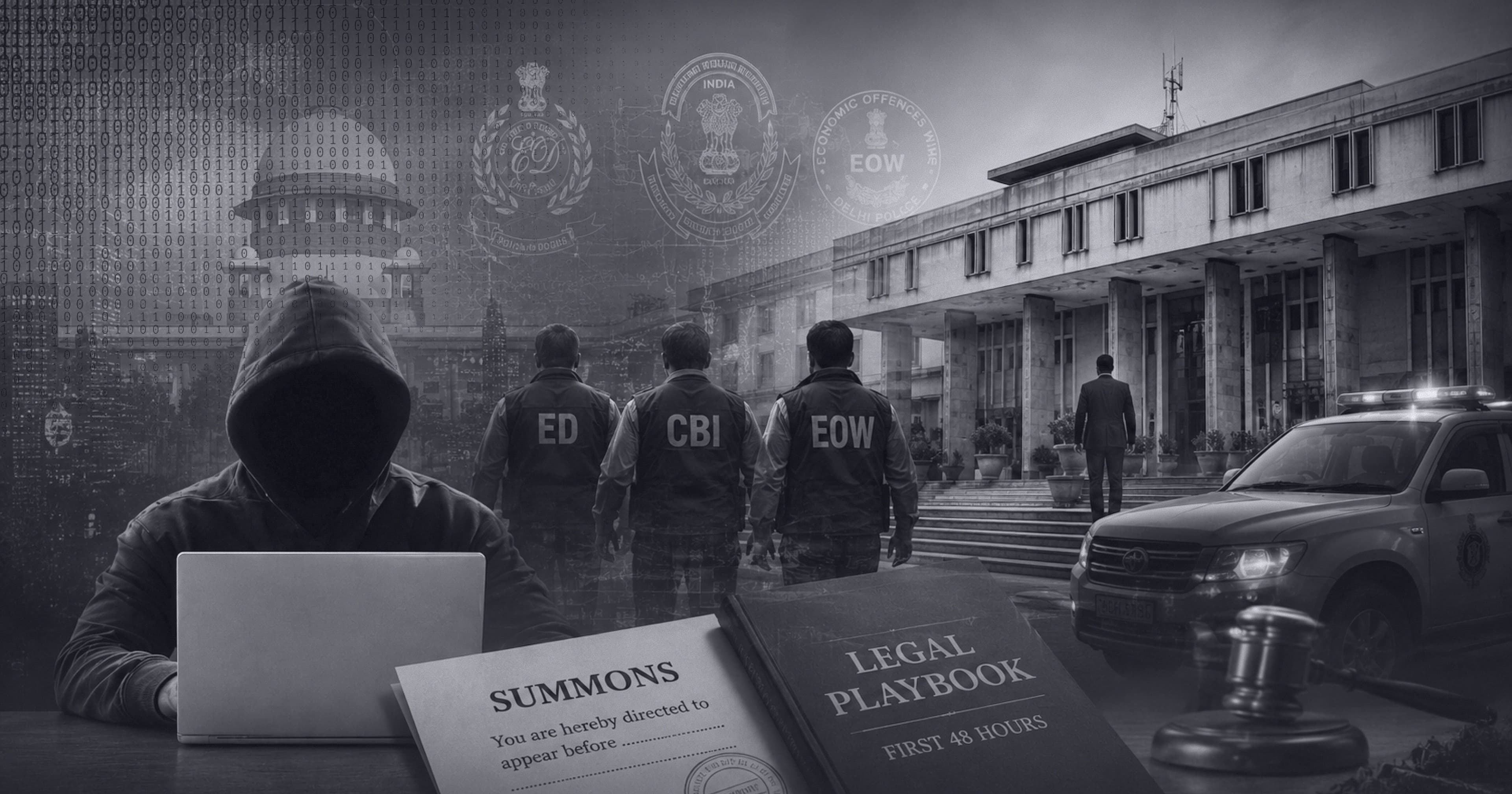
An ED, CBI or EOW summons or raid can turn a normal business day into a legal crisis within minutes. For companies, directors, promoters, CFOs, accountants, employees and consultants in Delhi NCR, the first 48 hours are critical. The immediate priority is not panic, confrontation or silence. The correct approach is lawful cooperation, careful preservation of records, protection against self-incrimination, and immediate legal strategy. This practical guide explains ED raid what to do India 2026, how to respond to a PMLA summons Delhi NCR, what to do if the CBI or EOW reaches your office, and when to consult a white collar crime lawyer Delhi before the situation escalates.
Understanding ED, CBI and EOW Action Against Businesses
ED, CBI and EOW action may look similar from the outside, but legally they operate under different statutes, powers and procedures.
The Enforcement Directorate, commonly known as ED, investigates money laundering cases under the Prevention of Money Laundering Act, 2002. Under Section 3 PMLA, money laundering covers direct or indirect involvement in any process or activity connected with proceeds of crime, including concealment, possession, acquisition, use, projecting or claiming such property as untainted. Section 17 deals with search and seizure, Section 19 deals with arrest, Section 45 deals with bail conditions, and Section 50 gives ED power to summon persons and record statements.
The Central Bureau of Investigation, or CBI, derives its investigative powers from the Delhi Special Police Establishment Act, 1946. The CBI commonly investigates corruption cases, bank frauds, large cheating conspiracies, public servant cases, and matters referred by courts or governments. The DSPE Act specifically deals with constitution and powers of the Special Police Establishment, offences to be investigated by it, and extension of jurisdiction.
The Economic Offences Wing, or EOW, is a specialised police unit dealing with economic offences such as cheating, criminal breach of trust, investment frauds, real estate frauds, forged documents, company-related frauds and organised commercial deception. In Delhi, EOW functions as a specialised wing of Delhi Police, and a separate EOW police station was notified with jurisdiction over the whole of NCT of Delhi.
Common business situations where these agencies may enter include:
- +alleged diversion of company funds
- +bank loan fraud or forged financial documents
- +investment fraud or ponzi-style complaints
- +suspected laundering of proceeds of crime
- +fake invoices, circular transactions or shell company allegations
- +bribery, public procurement or corruption-linked complaints
- +real estate, builder, deposit or group investment disputes
- +crypto, forex, hawala or cross-border fund movement allegations
The practical mistake many businesses make is treating a summons or raid as a routine compliance event. It is not. It is often the first visible step in a larger criminal or financial investigation.
Hour 0 to 2: What to Do During a Raid or Search
The first two hours decide the tone of the entire matter. The biggest mistake is either blind confrontation or blind cooperation. Both can harm you.
- Ask to see the authority for search
If ED officials are conducting a search, ask for the written authorisation and note the provision invoked. Under PMLA, searches are generally linked to Section 17. If CBI or EOW officers conduct a search, ask whether they have a search warrant or are proceeding under statutory police powers.
Do not obstruct the search. Obstruction can create a separate legal problem. But you are entitled to understand who is conducting the search, under what authority, and at which premises.
- Inform your lawyer immediately
A person facing agency action should call counsel immediately. This does not mean the search stops. It means the business has someone monitoring procedure, advising employees, tracking seizure, and ensuring that avoidable mistakes are not made.
For a business in Delhi NCR, this is the point where an ED lawyer Delhi NCR, PMLA lawyer Delhi, or economic offence lawyer Delhi should be involved without delay.
- Do not destroy, delete or move documents
Never delete emails, WhatsApp chats, accounting files, cloud folders, CCTV recordings or transaction records after agency action begins. Deletion may be treated as destruction of evidence and may seriously damage the defence.
Preserve the following immediately:
- +books of accounts
- +ledgers and vouchers
- +invoices and purchase orders
- +bank statements
- +emails and internal approvals
- +board resolutions
- +digital devices and backups
- +GST, ROC and income tax records
- +agreements, MoUs and side letters
- Track what is searched and seized
During a search, insist on a proper seizure memo or panchnama. Check whether documents, devices, cash, jewellery, files, hard disks or phones are correctly described.
Under the Bharatiya Nagarik Suraksha Sanhita, 2023, the process of search and seizure, including preparation of the list of seized articles and signing by witnesses, is to be recorded through audio-video electronic means, preferably by mobile phone, and forwarded without delay to the concerned Magistrate.
- Do not sign casually
Read every document before signing. If something is wrongly recorded, ask for correction. If correction is refused, record your objection in writing before signing, wherever possible.
A signature on a panchnama, statement or seizure list may later become important evidence. Treat every signature seriously.
Hour 2 to 6: Statements, Summons and Self-Incrimination
This is where most damage happens. People panic, over-explain, guess answers, volunteer information, or sign statements without properly reading them.
- Understand the seriousness of Section 50 PMLA summons
Under Section 50 PMLA, ED officers have power to summon persons, require production of documents, and record statements. The proceedings are deemed judicial proceedings for limited purposes, which makes false statements or careless answers risky. The Supreme Court in Vijay Madanlal Choudhary & Ors. v. Union of India, (2023) 12 SCC 1, upheld the broad validity of Section 50 and noted that a person summoned under Section 50(2) and Section 50(3) is not automatically an accused merely because an ECIR exists. Therefore, Article 20(3) protection against self-incrimination does not apply in a blanket manner at the summons stage.
This does not mean a person should answer recklessly. It means the response must be legally prepared, factually accurate, and carefully limited to what is known.
- Cooperate, but do not speculate
The correct approach is not “say nothing” in every situation. The correct approach is:
- +answer truthfully where legally required
- +avoid guessing
- +avoid giving opinions on documents you have not checked
- +avoid accepting allegations in pressure
- +avoid explaining transactions from memory if records are needed
- +ask to consult records before answering accounting questions
- +do not sign a statement unless it reflects what you actually said
- Do not treat informal conversation as harmless
During raids and summons, officials may ask questions casually. Those answers may later shape the investigation.
A director, accountant or employee should not casually say things like:
- +“Sir, maybe this was adjusted in cash”
- +“This entry may be bogus”
- +“The promoter must have handled it”
- +“I only signed whatever I was told”
- +“These companies were only for routing”
Such statements can become damaging, even if made casually and without legal understanding.
- Identify who has been summoned and in what capacity
A summons to a director is not the same as a summons to an accountant, employee, auditor, vendor or consultant. The person may be treated as a witness, suspect or accused depending on the facts and stage of investigation.
Before appearing, identify:
- +the agency issuing summons
- +the case number or ECIR or FIR reference, if provided
- +the documents required
- +whether personal appearance is mandatory
- +whether the person is likely to be confronted with documents
- +whether there is exposure to arrest or coercive steps
- Do not ignore summons
Ignoring an ED, CBI or EOW summons is rarely a good strategy. If attendance is genuinely not possible, seek adjournment in writing with reasons. Silence or repeated non-appearance can be used to allege non-cooperation.
Hour 6 to 24: Legal Response and Damage Control
Once the search or summons stage begins, the business must move from panic to structure. The next 18 hours should be used to build a legal response.
- Prepare an internal chronology
Prepare a clean timeline of events. This should not be a defensive story. It should be a factual chronology.
Include:
- +date of incorporation or business commencement
- +key contracts and transactions
- +fund movement
- +board approvals
- +disputed payments
- +complaints received
- +notices or summons received
- +searches conducted
- +documents seized
- +statements recorded
- +employees questioned
A good chronology helps the lawyer assess exposure quickly.
- Separate business documents from personal documents
In business raids, agency action often extends to promoter residences, employee devices, family assets, company offices and related entities. Separate records by category:
- +company records
- +personal financial records
- +group company records
- +employee documents
- +third-party vendor documents
- +privileged legal communications
- +irrelevant personal material
This helps in later applications for release of documents, objections to seizure, and preparation of defence.
- Assess whether arrest risk exists
Under Section 19 PMLA, ED may arrest if the authorised officer has reason to believe, on the basis of material in possession, that a person is guilty of an offence punishable under the Act. The Supreme Court in Pankaj Bansal v. Union of India & Ors., (2024) 7 SCC 576, emphasised compliance with Section 19 safeguards and held that non-compliance with the mandate of arrest safeguards can benefit the arrested person.
The Supreme Court in Tarsem Lal v. Directorate of Enforcement Jalandhar Zonal Office¸(2024) 7 SCC 61, also clarified that where an accused was not arrested by ED till filing of the PMLA complaint and the Special Court takes cognizance, the normal rule is issuance of summons, not warrant. This is an important safeguard in post-complaint PMLA proceedings.
- Consider anticipatory bail or protective relief where appropriate
In EOW or CBI matters, anticipatory bail may become urgent depending on the FIR, allegations, sections invoked, custodial interrogation risk and cooperation history.
In PMLA matters, the strategy is more complex because of Section 45 PMLA and the twin conditions for bail. Courts continue to apply those statutory conditions, but recent Supreme Court and Delhi High Court decisions have also emphasised that Article 21, prolonged incarceration and delay in trial remain relevant considerations. In Arvind Dham v. Directorate of Enforcement, 2026 SCC OnLine SC 30, the Supreme Court considered bail in the context of Section 45 PMLA and Article 21 concerns around prolonged pre-trial custody.
- Protect business continuity
A raid or summons can paralyse operations. The legal response should also protect the business.
Immediate steps may include:
- +informing key management on a need-to-know basis
- +securing statutory filings
- +ensuring payroll and vendor payments continue lawfully
- +appointing one internal document coordinator
- +preventing employees from giving inconsistent informal accounts
- +preserving emails, books and digital records
- +preparing a communication protocol for banks and auditors
Hour 24 to 48: Strategy, Freezing, Attachment and Next Legal Steps
After the first day, the matter usually enters a more strategic phase. By then, the business should have counsel, a document map, a chronology, and a preliminary risk assessment.
- Check whether bank accounts or assets are frozen
In ED matters, freezing may arise under PMLA search and seizure powers. In police or EOW matters, bank accounts may also be frozen during investigation. The first step is to obtain written communication or bank confirmation identifying the authority, case reference, and scope of freezing.
Do not rely only on oral information from a bank branch.
- Assess provisional attachment risk under PMLA
Under Section 5 PMLA, properties believed to be proceeds of crime may be provisionally attached, subject to statutory requirements and adjudication. Under Section 8, the Adjudicating Authority considers complaints and applications relating to attachment, search, seizure and freezing. This makes early documentation critical because businesses must be ready to explain source of funds, legitimate transactions and absence of proceeds of crime.
- Prepare for the next summons
The second summons is often more pointed than the first. It may involve confrontation with documents, bank entries, seized materials, emails or statements of other persons.
Before appearing again, prepare:
- +transaction-wise explanations
- +supporting documents
- +list of documents seized
- +list of documents still available
- +legal objections, if any
- +prior statement review
- +clarification of any incorrect recording
- Decide between cooperation and contest
Cooperation does not mean surrendering all rights. Contest does not mean obstruction.
A balanced legal strategy may include:
- +appearing when summoned
- +producing relevant documents
- +giving accurate explanations
- +objecting to illegal seizure or overbroad demands
- +seeking copies of relied documents where permissible
- +challenging unlawful arrest or remand
- +seeking release of seized documents required for business
- +filing appropriate bail or protective applications
- Avoid public statements
Do not issue public explanations, social media clarifications, media quotes, employee-wide emails, or client-facing statements without legal review. Anything said publicly can later be used to test consistency.
ED vs CBI vs EOW: Key Differences for Delhi NCR Businesses
Enforcement Directorate (ED)
Main legal framework: Prevention of Money Laundering Act, 2002, FEMA in certain matters.
Typical trigger: Alleged proceeds of crime from a scheduled offence.
Common business risk: Search, seizure, freezing, attachment, summons, arrest.
Important provision: Section 50 PMLA summons, Section 17 search, Section 19 arrest, Section 45 bail.
Practical response: Cooperate with summons, protect against self-incrimination, preserve records, challenge illegal action.
Lawyer involvement: Immediate, especially if summons or search involves PMLA.
Central Bureau of Investigation (CBI)
Main legal framework: Delhi Special Police Establishment Act, 1946, Prevention of Corruption Act, BNS and other laws.
Typical trigger: Corruption, bank fraud, serious fraud, court or government referred matters.
Common business risk: FIR, search, arrest, custodial interrogation, charge-sheet.
Important provision: DSPE Act jurisdiction and investigation powers.
Practical response: Secure FIR and documents, assess bail risk, prepare document defence.
Lawyer involvement: Immediate where FIR, search or arrest risk exists.
Economic Offences Wing (EOW)
Main legal framework: BNSS, BNS, Delhi Police framework and economic offence investigation practice.
Typical trigger: Cheating, breach of trust, investment fraud, real estate fraud, document forgery, commercial deception.
Common business risk: FIR, notices, document seizure, arrest, settlement-linked strategy in some commercial fraud matters.
Important provision: BNSS search and seizure procedure, local police powers.
Practical response: Respond to notices, prepare transaction documents, assess civil-criminal overlap.
Lawyer involvement: Early, especially in high-value commercial fraud or director liability cases.
ED (Enforcement Directorate)
Legal framework: Prevention of Money Laundering Act, 2002; FEMA in certain matters.
Typical trigger: Alleged proceeds of crime from a scheduled offence.
Common business risk: Search, seizure, freezing, attachment, summons, and arrest.
Important provisions: Section 50 PMLA (summons), Section 17 (search), Section 19 (arrest), Section 45 (bail).
Practical response: Cooperate with summons, protect against self-incrimination, preserve records, and challenge illegal action.
Lawyer involvement: Immediate, especially if summons or search involves PMLA.
CBI (Central Bureau of Investigation)
Legal framework: Delhi Special Police Establishment Act, 1946; Prevention of Corruption Act; BNS and other laws.
Typical trigger: Corruption, bank fraud, serious fraud, court or government referred matters.
Common business risk: FIR, search, arrest, custodial interrogation, charge-sheet.
Important provisions: DSPE Act jurisdiction and investigation powers.
Practical response: Secure FIR and documents, assess bail risk, prepare document defence.
Lawyer involvement: Immediate where FIR, search or arrest risk exists.
EOW (Economic Offences Wing)
Legal framework: BNSS, BNS, Delhi Police framework and economic offence investigation practice.
Typical trigger: Cheating, breach of trust, investment fraud, real estate fraud, document forgery, commercial deception.
Common business risk: FIR, notices, document seizure, arrest, settlement-linked strategy in some commercial fraud matters.
Important provisions: BNSS search and seizure procedure, local police powers.
Practical response: Respond to notices, prepare transaction documents, assess civil-criminal overlap.
Lawyer involvement: Early, especially in high-value commercial fraud or director liability cases.
Key Court Principles Businesses Should Know in 2026
- ED summons are serious and cannot be treated casually
The Supreme Court’s approach in Vijay Madanlal Choudhary makes it clear that Section 50 proceedings have a special statutory character. A person summoned by ED should not assume that Article 20(3) automatically permits refusal to answer every question. At the same time, statements must be accurate, voluntary, and carefully read before signing.
- Arrest under PMLA has procedural safeguards
Section 19 PMLA requires statutory conditions for arrest. The Supreme Court in Pankaj Bansal strengthened the importance of arrest safeguards and compliance with legal procedure. This is why the arrest memo, grounds of arrest, timing, production before court, and remand record matter.
- Bail in PMLA remains strict, but Article 21 still matters
The twin conditions under Section 45 PMLA remain a major hurdle. However, recent bail jurisprudence, including Arvind Dham v. Directorate of Enforcement, shows that prolonged custody, delay in trial, filing of complaint, completion of investigation, and Article 21 considerations can still become important.
- Once complaint is filed and cognizance is taken, arrest is not automatic
In Tarsem Lal v. Directorate of Enforcement, the Supreme Court held that where ED did not arrest the accused till filing of the complaint, the Special Court should normally issue summons and not a warrant while taking cognizance. This helps prevent arrest from becoming routine after the prosecution complaint stage.
- Search and seizure must be documented properly
Under the BNSS framework, search and seizure must be recorded through audio-video electronic means, including preparation of seizure lists and signing by witnesses. For businesses, this means documentation of the search process is itself part of the legal defence.
Immediate Action Checklist for the First 48 Hours
- During the raid or search
- +Ask for identification and authority.
- +Do not obstruct officials.
- +Call your lawyer immediately.
- +Identify independent witnesses.
- +Track every room, device, file and document searched.
- +Do not sign without reading.
- During questioning or statement recording
- +Stay calm.
- +Do not guess.
- +Do not volunteer unnecessary explanations.
- +Ask to refer to records where needed.
- +Read the statement fully before signing.
- +Record objections if something is inaccurate.
- After the agency leaves
- +Prepare a written chronology.
- +Preserve CCTV, emails and digital records.
- +Make a list of seized material.
- +Identify employees questioned.
- +Secure copies of summons, panchnama and seizure memo.
- +Hold an internal legal briefing.
- Before the next appearance
- +Prepare transaction-wise notes.
- +Collect bank and accounting documents.
- +Review the legal risk of arrest.
- +Decide whether bail or protective relief is needed.
- +Ensure all future responses are consistent and documented.
- If accounts or assets are frozen
- +Obtain written bank confirmation.
- +Identify the freezing authority.
- +Do not route funds through unrelated accounts.
- +Prepare source-of-funds documents.
- +Consider appropriate legal remedy.
Common Mistakes Businesses Make After ED, CBI or EOW Action
Many businesses damage their defence within the first day. The usual mistakes are:
- +ignoring summons
- +deleting emails or chats
- +giving speculative answers
- +signing statements without reading
- +treating accountants or junior employees as “safe” spokespersons
- +failing to preserve seized-document details
- +making public statements
- +delaying bail strategy
- +assuming that a civil dispute cannot become a criminal case
- +assuming that cooperation means giving up all legal rights
This is why early advice from a white collar crime lawyer Delhi, criminal defense attorney Delhi, or PMLA lawyer Delhi can materially change the legal position.
Frequently Asked Questions
- What should I do first if ED conducts a raid at my business premises?
Ask to see the authorisation, do not obstruct the search, call your lawyer immediately, track what is seized, and do not sign any document without reading it carefully. The first priority is lawful cooperation with procedural protection.
- Can I refuse to appear before ED after receiving a Section 50 PMLA summons?
Ignoring a Section 50 summons is risky. If you cannot appear, seek adjournment in writing with reasons. Before appearing, review the summons, documents demanded, and your legal exposure with counsel.
- Can ED arrest me during or after summons?
ED can arrest under Section 19 PMLA only if statutory conditions are satisfied. However, arrest risk depends on the facts, materials collected, cooperation history, and stage of investigation. Immediate legal assessment is necessary.
- What is the difference between an EOW complaint and a civil recovery case?
An EOW complaint Delhi usually alleges criminality such as cheating, dishonest inducement, forgery or criminal breach of trust. A civil recovery case mainly seeks money recovery or contractual relief. Some disputes may involve both civil and criminal elements.
- Should employees answer agency questions during a raid?
Employees should cooperate lawfully, but they should not guess, speculate, or make admissions beyond their knowledge. If they are asked to sign a statement, they must read it carefully and ensure it accurately records what they said.
Why Choose Pramanika Legal for White Collar Crime and Economic Offence Matters
ED, CBI and EOW matters require a different kind of legal response. These are not ordinary disputes where a reply notice can be drafted after a few days. In a raid, summons or freezing situation, the legal position begins forming immediately through documents seized, statements recorded, answers given, and procedural safeguards invoked.
Pramanika Legal assists clients in white-collar crime, economic offence and criminal litigation matters involving summons, raids, financial fraud allegations, EOW complaints, PMLA issues, cyber-linked financial frauds, and commercial disputes with criminal exposure. The focus is on immediate risk assessment, procedural protection, bail strategy where required, document preservation, and a clear response plan for the next stage of investigation.
For businesses in Delhi NCR facing ED, CBI or EOW action, early legal intervention may help prevent avoidable admissions, inconsistent records, delayed bail strategy, and procedural mistakes that later become difficult to undo.
Conclusion
The first 48 hours after an ED, CBI or EOW summons or raid are not just about responding to an investigation. They are about preserving your legal position. Businesses must cooperate with lawful investigation, but they should also protect their rights, records, employees and future defence. The safest approach is structured, calm and legally guided: verify authority, preserve evidence, avoid speculation, read before signing, prepare a chronology, and assess arrest or freezing risk quickly. In white-collar crime matters, delay and confusion often cause more damage than the first notice itself.
Schedule a confidential consultation to evaluate your situation and take immediate legal action.