

Right to Be Forgotten in India 2026: Delhi High Court Guide for Lawyers
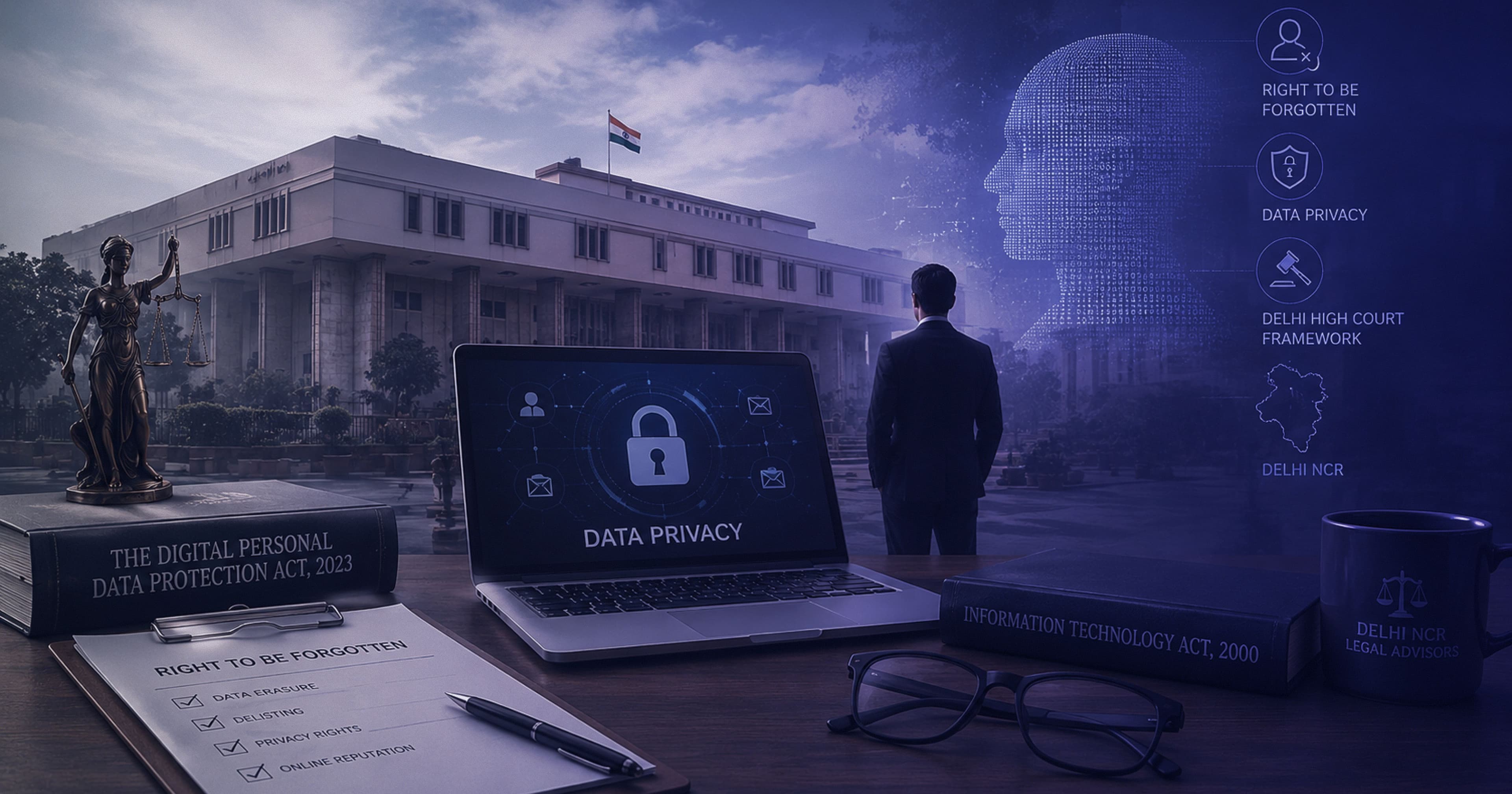
The right to be forgotten in India has moved from a developing privacy argument to a serious legal remedy, especially after the Delhi High Court’s 2026 ruling on de-indexing, delinking and masking of personal information from online judicial records. For individuals in Delhi NCR, this issue often arises after an acquittal, quashing of criminal proceedings, settled matrimonial dispute, employment background check, or online publication of sensitive personal information. The law does not allow a person to erase history simply because it is inconvenient. But where continued name-based search visibility causes disproportionate harm to dignity, reputation and privacy, courts may now consider narrowly tailored relief. This is where advice from a data privacy lawyer Delhi NCR becomes important.
Understanding the Right to Be Forgotten in India
The right to be forgotten means the right of an individual to seek removal, restriction, de-indexing or masking of personal information from easy public digital access, especially where such information is outdated, irrelevant, excessive, prejudicial, or no longer serves any legitimate public purpose.
In simple terms, it asks this question:
Should a person be permanently defined by an old court case, a settled private dispute, an acquittal, a withdrawn proceeding, or a sensitive personal detail merely because search engines continue to display it against their name?
The legal foundation of this right lies in the right to privacy under Article 21 of the Constitution of India. In K.S. Puttaswamy & Anr. v. Union of India & Ors., (2017) 10 SCC 1, the Supreme Court recognised privacy as a fundamental right. That judgment also gave constitutional importance to informational privacy, dignity, autonomy and control over personal data.
The right to be forgotten is not expressly named in one single Indian statute as a complete standalone right. However, Indian courts have increasingly recognised it as part of privacy and dignity, especially in cases involving:
- +acquittal in criminal proceedings
- +discharge from criminal cases
- +quashing of FIRs or complaints
- +settled matrimonial disputes
- +sensitive family law litigation
- +employment-related reputational harm
- +names appearing incidentally in judicial records
- +victims of sexual offences
- +online publication of private or sensitive information
- +digital records that no longer serve any legitimate public interest
The important point is that the right is not absolute. It must be balanced against open justice, freedom of speech, public interest, press freedom, court transparency and the right of the public to access judicial records.
Delhi High Court’s 2026 Framework: What Changed
The Delhi High Court’s decision in Laksh Vir Singh Yadav v. Union of India & Connected Matters, Neutral Citation: 2026:DHC:4891, is now one of the most important Indian rulings on the right to be forgotten.
The Court was dealing with a batch of petitions where different individuals sought relief against continued online visibility of judicial records through name-based internet searches. The cases involved acquittals, matrimonial disputes, quashed proceedings, settlements, discharged accused persons, sexual offence victims and persons whose names appeared incidentally in court records.
The central issue was whether a person whose name appears in judicial records can seek:
- +de-indexing from search engines
- +delinking from name-based search results
- +masking of names and personal identifiers
- +restriction of name-based search functionality
- +removal or moderation of online visibility where continued access causes disproportionate harm
The Delhi High Court recognised that the right to be forgotten flows from informational privacy under Article 21. The Court also clarified that open justice does not mean unlimited, permanent and casual name-based discoverability of every judicial record by anyone on the internet.
This distinction is crucial.
The Court did not say that judicial records should be destroyed. It did not say that judgments should disappear. Instead, it recognised narrower remedies that preserve the public record while reducing unfair digital exposure.
De-Indexing, Delinking and Masking: What These Terms Mean
The right to be forgotten is often misunderstood as a right to delete everything from the internet. That is not correct. Indian courts usually prefer proportionate remedies.
- De-indexing
De-indexing means that a webpage, judgment, order or article is removed from name-based search results on platforms like Google.
The underlying record may still exist. A person searching by case number, citation, court details or legal reference may still find it. But a casual search of the individual’s name should not automatically display the old record.
This is often the most balanced remedy because it protects privacy without erasing public records.
- Delinking
Delinking means disconnecting a particular search result or URL from a person’s name-based search profile. It reduces the ability of search engines or platforms to repeatedly link a person’s identity to old or irrelevant proceedings.
- Masking
Masking means replacing a person’s name or personal identifiers in the publicly accessible version of a judgment or order with neutral references such as “ABC”, “XYZ”, “Petitioner”, “Respondent”, or similar anonymised identifiers.
The complete unredacted record may still remain with the court. What changes is public accessibility of sensitive identity details.
- Deletion
Deletion is the strongest and most difficult remedy. Courts are cautious with deletion because judicial records, news reports and public documents may have legal, precedential or public interest value.
In most cases, a person seeking relief should not frame the request as “delete everything.” A carefully drafted request for de-indexing, delinking or masking is usually more legally sustainable.
Right to Be Forgotten and the DPDP Act, 2023
The Digital Personal Data Protection Act, 2023 is relevant to this discussion, but it does not solve every right to be forgotten problem by itself.
Under Section 12 of the DPDP Act, a Data Principal has the right to correction, completion, updating and erasure of personal data for which consent was earlier given, subject to legal requirements. A Data Fiduciary is also required to erase personal data upon request unless retention is necessary for the specified purpose or for compliance with law.
This is important for ordinary digital platforms, businesses, employers, service providers and entities processing personal data.
However, judicial records are different. A court judgment is not the same as a private company’s customer database. Court records involve open justice, public access, precedent, transparency and institutional accountability. Therefore, when the material sought to be masked or de-indexed is part of a judicial record, a person may need to approach the court for appropriate relief.
In practical terms:
- +DPDP remedies may help where a private entity is processing personal data unnecessarily.
- +Constitutional remedies may be needed where court records, search engines, legal databases or public judicial documents are involved.
- +Platform requests alone may not be enough where the source record is a court order or judgment.
- +A court-directed order may be required for de-indexing, masking or delinking.
This is why the phrase data privacy DPDP Act should not be understood in isolation. The right to be forgotten in India sits at the intersection of Article 21, DPDP Act rights, intermediary obligations, open justice and constitutional court powers.
When Can a Person Seek the Right to Be Forgotten?
A person may consider seeking right to be forgotten relief where continued online visibility causes serious and disproportionate harm, especially after the underlying proceeding has lost relevance.
Common situations include:
- Acquittal or discharge in criminal cases
A person who has been acquitted or discharged may still face reputational harm because search results continue to show old allegations. This can affect employment, business, marriage prospects, visa applications, banking relationships and public reputation.
Courts are more likely to consider relief where:
- +the person was finally acquitted
- +the proceedings ended in discharge
- +allegations were not proved
- +there is no continuing public interest
- +the record causes disproportionate harm
- +the person is not a public official or public figure
- +the case does not involve ongoing public safety concerns
- Quashed FIRs and settled criminal proceedings
In many matrimonial or commercial disputes, FIRs are quashed after settlement. Yet search results may continue to display the person’s name with criminal allegations.
In such cases, the person may seek de-indexing or masking if the continued online record unfairly keeps the allegations alive despite the legal closure of the case.
- Matrimonial disputes and family litigation
Matrimonial disputes often involve private facts, allegations, settlement terms, child custody issues, domestic conflict, financial disclosures and personal details.
Where a matrimonial dispute has been settled, quashed, withdrawn or decided, continued name-based search visibility may cause unnecessary harm to both parties. This is especially serious where children, private family details or sensitive allegations are involved.
Courts may consider masking or anonymisation where privacy outweighs any continuing public interest.
- Employment background checks
The right to be forgotten has practical importance in employment cases. Many employers conduct digital background checks. A person may lose job opportunities because old proceedings continue to appear on search engines, even where the case ended in acquittal, discharge, settlement or quashing.
This does not mean a person can suppress legally required disclosures. If an employer lawfully asks for information, the answer must be truthful. But a person can still seek to prevent unfair, casual and permanent online association with stale or irrelevant judicial records.
- Incidental mention in court records
Sometimes a person’s name appears in a judgment even though they were not a party, accused or wrongdoer. Such incidental references can still become searchable online and affect reputation.
The Delhi High Court’s 2026 framework recognises that individuals whose names appear incidentally may also have privacy concerns, depending on the facts.
- Victims of sexual offences or sensitive cybercrime
In cases involving sexual offences, private images, cyber harassment, doxxing, revenge pornography, impersonation or leaked data, the privacy concern is even stronger.
Where personal information has been exposed through digital abuse, a cyber crime lawyer Delhi and a data privacy lawyer Delhi NCR may need to work together to seek takedown, de-indexing, masking, criminal remedies and platform-level compliance.
When the Right to Be Forgotten May Not Be Granted
The right to be forgotten is not a tool to rewrite public history. Courts may refuse relief where public interest outweighs privacy.
Relief may be difficult where:
- +the case involves conviction
- +the proceedings are still pending
- +the person holds public office
- +the matter involves public funds or corruption
- +the information has continuing public relevance
- +the relief sought is too broad
- +the applicant wants deletion of judicial records instead of limited de-indexing
- +the record is necessary for public safety, legal research or transparency
- +the applicant has not shown real harm
- +the request is merely to avoid embarrassment
The Court’s task is to balance two competing values. On one side is privacy, dignity and reputation. On the other side is open justice, freedom of speech, press freedom and public access to court records.
That is why the remedy must be proportionate. A court may be more willing to order name-based deindexing than complete deletion.
Practical Steps for Right to Be Forgotten Relief in Delhi NCR
A person seeking relief should prepare the case carefully. A vague request saying “remove my name from Google” is usually not enough.
- Identify the exact online material
Prepare a list of all URLs and platforms where the information appears.
This may include:
- +court website links
- +Indian Kanoon links
- +legal database pages
- +media articles
- +Google search result links
- +social media posts
- +employer background check references
- +cached pages screenshots of name-based search results
The application should clearly identify what is being challenged.
- Collect the final legal outcome
The strongest cases usually involve a concluded proceeding. Collect:
- +acquittal judgment
- +discharge order
- +quashing order
- +settlement order
- +closure report acceptance
- +compounding order
- +divorce decree or settlement terms, where relevant
- +order showing withdrawal or disposal of proceedings
- +proof that allegations are no longer live
Without the final outcome, it may be harder to show that continued digital visibility is unfair or outdated.
- Document the harm
Courts look at proportionality. That means the applicant should show why continued name-based search visibility causes harm.
Useful material may include:
- +employment rejection emails
- +background verification concerns
- +business relationship issues
- +reputational harm
- +harassment or social stigma
- +matrimonial or family impact
- +mental distress caused by repeated online exposure
- +proof that search results appear when the person’s name is typed
The harm does not need to be exaggerated. It must be specific and credible.
- Choose the correct remedy
The relief should be narrow and practical.
Depending on the case, the request may be for:
- +de-indexing from name-based search results
- +masking of name and personal identifiers
- +delinking of URLs from search engine results
- +restriction of name-based search functionality
- +takedown of unlawful private content
- +removal of intimate or sensitive content
- +directions to search engines, legal databases or intermediaries
- +directions to MeitY or concerned authorities for compliance
The relief should not unnecessarily seek destruction of court records.
- Approach the correct forum
The correct forum depends on the nature of the material.
If the material is part of a court judgment or order, an application may be required before the court that passed the order, or a writ petition may be required before the High Court.
If the material is hosted by a private platform, a representation or grievance may be sent to the platform first, followed by legal action if necessary.
If the issue involves cyber harassment, impersonation, leaked intimate content or data breach, criminal remedies and platform takedown routes may also be required.
- Follow up for compliance
A court order is only the first step. The person must ensure actual compliance by search engines, legal databases and platforms.
This may require:
- +serving the order on platforms
- +sending URLs and screenshots
- +seeking confirmation of de-indexing
- +monitoring search results
- +filing compliance applications if needed
- +preserving proof of non-compliance
Right to Be Forgotten in Matrimonial Cases
Matrimonial and family disputes already stand on a different privacy footing under Indian law. Proceedings under the Hindu Marriage Act, 1955 and the Special Marriage Act, 1954 are generally treated with a higher degree of confidentiality, and matrimonial courts often mask or anonymise party names in matters involving divorce, domestic violence, custody, guardianship, maintenance and other sensitive family issues.
However, the right to be forgotten becomes important where the privacy protection available in the matrimonial proceeding does not fully protect the parties from wider digital exposure.
This may happen where:
- +the dispute travels to the High Court or another forum and names become visible in orders or cause lists
- +matrimonial allegations are repeated in connected civil suits, defamation cases, property disputes or recovery proceedings
- +private family facts are discussed in proceedings that are not strictly matrimonial proceedings
- +old matrimonial litigation remains searchable on legal databases or search engines even after settlement, quashing, withdrawal or final disposal
- +children’s details, financial disclosures or sensitive allegations remain visible in public search results
- +one party uses old court records to cause reputational harm after the dispute has ended
In such cases, the issue is not merely whether the original matrimonial proceeding was private. The real question is whether continued name-based online visibility serves any legitimate public purpose after the dispute has been resolved or decided.
A carefully framed right to be forgotten request may therefore seek limited relief such as masking of names, de-indexing from name-based search results, delinking of specific URLs, or anonymisation of personal identifiers. This allows the judicial record to remain intact while reducing unnecessary public exposure of private family disputes.
Courts are likely to examine the nature of the proceeding, the stage of litigation, the sensitivity of the allegations, the involvement of children, the final outcome of the case, and whether public interest requires continued name-based access. Therefore, in matrimonial and connected civil matters, the better approach is not to ask for complete deletion of the record, but to seek proportionate privacy protection through masking, de-indexing or delinking.
Right to Be Forgotten in Employment Background Checks
Employment is one of the most common reasons people seek right to be forgotten relief.
A person may have been acquitted, discharged, or included in proceedings that later ended. Yet when an employer searches the person’s name, old case links appear first. That can create reputational harm even where there is no conviction or pending case.
This is especially relevant for:
- +senior professionals
- +bankers and finance employees
- +founders and directors
- +teachers and professors
- +consultants
- +government job aspirants
- +employees in regulated industries
- +persons applying for overseas employment or visas
The right to be forgotten does not mean a person can make false declarations. If a form asks for past criminal proceedings, the answer must be legally accurate. But there is a difference between truthful disclosure where required and indefinite public digital punishment through search engines.
The law is now moving toward that distinction.
Right to Be Forgotten and Cybercrime or Data Breach Cases
The right to be forgotten also intersects with cybercrime. In cases involving impersonation, doxxing, fake profiles, leaked personal data, cyberstalking, revenge pornography, crypto fraud victim exposure or online harassment, the victim may need urgent legal remedies.
Possible steps may include:
- +cybercrime complaint
- +platform takedown request
- +request to search engines for de-indexing
- +complaint to relevant grievance officers
- +preservation of evidence
- +application for masking of court records, if proceedings arise
- +civil injunction where private data is being circulated
- +criminal proceedings where offences are made out
This is where a cyber crime lawyer Delhi may work alongside data privacy counsel, because the issue may involve both criminal law and privacy protection.
Frequently Asked Questions
- Is the right to be forgotten recognised in India?
Yes, Indian courts have recognised the right to be forgotten as part of informational privacy under Article 21. The Delhi High Court’s 2026 framework is especially important because it deals specifically with deindexing, delinking and masking of online judicial records.
- Can I get my old court case removed from Google?
You may be able to seek de-indexing from name-based search results, especially if the case ended in acquittal, discharge, quashing or settlement. The court record may still remain accessible through case number, citation or court details.
- Is de-indexing the same as deleting a judgment?
No. De-indexing only restricts easy discovery through name-based searches. It does not destroy the underlying judgment or court record. This is why courts often treat de-indexing as a balanced remedy.
- Can matrimonial case details be masked?
In appropriate cases, yes. If the dispute is private, settled, or involves sensitive personal facts, parties may seek masking or de-indexing. The court will still balance privacy against public interest and open justice.
- Does the DPDP Act give a right to erase all online information?
No. The DPDP Act gives rights relating to correction, updating and erasure of personal data in certain contexts, but it does not automatically erase judicial records. Court records usually require a court-based remedy.
Why Choose Pramanika Legal for Data Privacy and Right to Be Forgotten Matters
Right to be forgotten matters require careful legal drafting. A weak request for complete deletion may fail, while a narrowly framed request for de-indexing, delinking or masking may have better prospects. The key is to show why continued name-based visibility causes disproportionate harm and why the relief sought does not damage open justice or public interest.
Pramanika Legal assists clients in matters involving data privacy, cybercrime, online reputation harm, sensitive personal data exposure, employment background issues, matrimonial privacy concerns, and court-record de-indexing strategy. The focus is on identifying the correct forum, preparing the factual record, drafting proportionate relief, and ensuring that the remedy sought is legally sustainable.
If you are looking for a data privacy lawyer Delhi NCR, cyber crime lawyer Delhi, or legal assistance for online personal data exposure, early advice can help you choose the right remedy before the information spreads further.
Conclusion
The right to be forgotten in India is not a right to erase every uncomfortable fact. It is a privacy remedy meant to prevent disproportionate, permanent and unfair digital exposure where information no longer serves a legitimate public purpose. The Delhi High Court’s 2026 framework gives individuals a clearer route to seek de-indexing, delinking and masking, especially in acquittal, quashing, matrimonial and sensitive personal data cases. For Delhi NCR residents facing reputational harm through online records, the most effective approach is careful documentation, proportionate relief and timely legal action.
Schedule consultation to evaluate your situation and take immediate legal action.