

Section 138 NI Act Appeals in Delhi Sessions Courts (2026): Limitation, Deposit & Sentence Stay
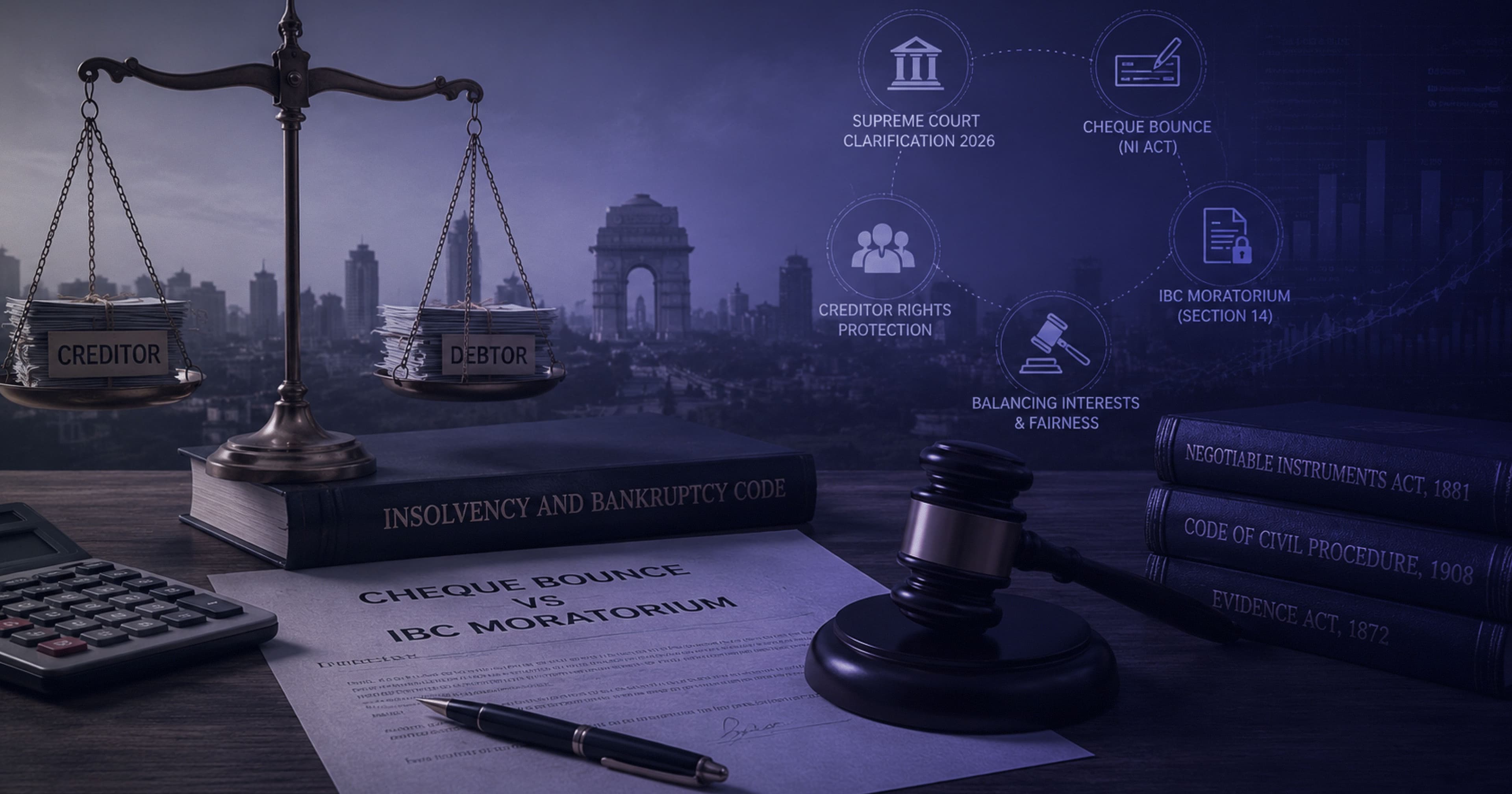
A convicted drawer under Section 138 of the Negotiable Instruments Act, 1881 may ordinarily appeal to the Sessions Court within 30 days of conviction. Under Section 148 NI Act, the appellate court has discretion to direct deposit of at least 20% of the fine or compensation awarded by the trial court while considering suspension of sentence. Such deposit may ordinarily be directed, but it cannot be imposed mechanically. The court must apply its mind to the facts of the case, including financial capacity, nature of the transaction, quantum involved, and whether the condition would effectively defeat the appellant’s right of appeal.
What the Law Says
Section 138, Negotiable Instruments Act, 1881 creates a criminal offence for dishonour of a cheque for insufficiency of funds or if the amount exceeds the arrangement with the bank. A successful conviction carries imprisonment up to two years, a fine up to twice the cheque amount, or both.
The three-stage pre-complaint process is strictly time-bound and courts have treated each limitation window as a jurisdictional requirement:
- Cheque dishonour and bank memo: The cheque must be presented within its validity period and returned unpaid by the drawee bank.
- Demand notice within 30 days: Under Section 138(b) NI Act, the payee must issue a written legal notice to the drawer within 30 days of receiving intimation from the bank of the dishonour. Delhi High Court has confirmed that the day of receiving the bank's intimation is excluded when computing this 30-day window — Econ Antri Limited v. Rom Industries Limited, (2014) 11 SCC 769, applied in subsequent Delhi HC decisions.
- Complaint within 30 days: Under Section 142(b) NI Act, the complaint must be filed within 30 days of the cause of action arising (i.e., after the drawer's 15-day payment window expires). The Supreme Court in H.S. Oberoi Buildtech v. MSN Woodtech (Criminal Appeal, SLP (Crl.) No. 2002 of 2025) held that a complaint filed beyond this 30-day window is not maintainable unless a written application for condonation of delay under Section 142(b) is filed — the court does not have inherent power to condone the delay suo motu.
On appeals, the governing provisions are:
- +Section 148 NI Act (inserted by the Negotiable Instruments (Amendment) Act, 2018): Empowers the appellate court, in an appeal by the drawer against conviction under Section 138, to direct deposit of a sum which shall be at least 20% of the fine or compensation awarded by the trial court. The deposit is to be made within 60 days of the order, extendable by a further period not exceeding 30 days on sufficient cause being shown. Courts have clarified that this power must be exercised after applying judicial mind and not mechanically.
- +Section 430, Bharatiya Nagarik Suraksha Sanhita (BNSS), 2023: Governs suspension of sentence and bail pending appeal — the successor provision to Section 389 CrPC.
Key Precedents
Anuj Ahuja v. Sumitra Mittal, 2025 SCC OnLine Del 1640, decided by the Delhi High Court on 17.03.2025, is directly relevant for Delhi appellants. The Court held that the 20% deposit under Section 148 NI Act cannot be imposed mechanically merely because there is a conviction under Section 138 NI Act.
The appellate court must apply its mind to the facts of the case, including the nature of the underlying transaction, the financial capacity of the appellant, the relationship between the parties, the quantum involved, and whether imposing the deposit condition would effectively deny meaningful access to the appellate remedy.
At the same time, the judgment should not be read to mean that deposit is never required. The correct position is that the appellate court has discretion, and that discretion must be exercised through a reasoned order.
Surinder Singh Deswal alias Colonel S.S. Deswal & Ors. v. Virender Gandhi, (2019) 11 SCC 341 (Supreme Court): Held that Section 148 NI Act applies to appeals against conviction under Section 138 NI Act, including appeals arising from complaints filed before the 2018 amendment. The Court also held that where deposit is directed under Section 148, the amount must be at least 20% of the fine or compensation awarded by the trial court.
Jamboo Bhandari v. M.P. State Industrial Development Corporation Ltd., (2023) 10 SCC 446 should also be noted. It clarifies that the 20% deposit is not an inflexible rule in every case and that exceptional circumstances may justify relaxation or waiver, provided the appellate court gives reasons.
Kaveri Plastics v. Mahdoom Bawa Bahrudeen Noorul, 2025 SCC OnLine SC 2019, decided by the Supreme Court on 19.09.2025: Held that a demand notice under Section 138(b) NI Act must demand the cheque amount. If the notice demands an amount different from the dishonoured cheque amount, the statutory notice may be treated as defective. The judgment is therefore more relevant to defects in demand notice than to complaint limitation.
Rakesh Bhanot v. M/s Gurdas Agro Pvt. Ltd., (2025) 6 SCC 781, decided by the Supreme Court on 01.04.2025: The Supreme Court reiterated that insolvency moratorium protection does not automatically shield natural persons, directors, or signatories from prosecution under Section 138 read with Section 141 NI Act. The moratorium may protect the corporate debtor entity, but proceedings against individuals who are personally liable under the NI Act can continue in accordance with law.
Delhi High Court's 2025–2026 Practice Direction: Service of Summons
In November 2025, the Delhi High Court issued Practice Direction No. 157/Rules/DHC, introducing mandatory digital service for Section 138 NI Act cases under the new Delhi BNSS (Service of Summons and Warrants) Rules, 2025. Key changes that affect all pending and new complaints in Delhi:
- +Summons must now be issued through multiple modes simultaneously, including WhatsApp, email, and direct dasti (hand) service by the complainant.
- +At the time of filing the complaint, the complainant must provide the accused's email address, mobile number, and WhatsApp or messaging app contact details, supported by an affidavit.
- +If the affidavit of service is found to be false, the court may initiate action against the complainant.
This directive reflects the Delhi High Court’s push to reduce delay in Section 138 matters caused by service failures, a major source of pendency before NI Act courts and criminal courts.
Step-by-Step: How to Appeal a Section 138 Conviction in Delhi
- Obtain the certified copy of the conviction judgment from the Magistrate's Court (Metropolitan Magistrate or Judicial Magistrate) without delay — the 30-day appeal limitation begins from the date of judgment, not from when you receive the copy.
- File the appeal before the Sessions Court in the same district — Saket, Rohini, Dwarka, or Tis Hazari, depending on where the trial was conducted.
- File simultaneously under Section 430 BNSS (formerly Section 389 CrPC) for suspension of sentence and bail pending disposal of the appeal, to avoid serving the imprisonment order during the appeal period.
- Address the Section 148 deposit proactively: If you have financial capacity, propose depositing a reasonable amount as a demonstration of bona fides to the appellate court, rather than seeking a full waiver. Delhi courts — as seen in Anuj Ahuja — respond favourably to appellants who show good faith even while challenging the quantum.
- Ground the appeal on substantive law: Strong appeal grounds in Section 138 matters include: defects in the demand notice, such as wrong amount, wrong address, or insufficient time given to the drawer; absence of a legally enforceable debt or liability; the cheque being described as a security cheque where no enforceable liability had crystallised on the date of presentation; procedural lapses in the trial; and contradictions in the complainant’s evidence.
- Attend all dates: Non-appearance triggers warrant and cancellation of bail. Appellants who repeatedly absent themselves find the appellate court less willing to exercise discretion on deposit waiver.
- Consider compounding under Section 147 NI Act: Compounding — the complainant accepting payment and withdrawing the complaint — is permissible at any stage including appeal. It is the most commercially practical resolution when the underlying debt is not genuinely disputed.
For Complainants: Protecting Your Recovery at the Appeal Stage
A conviction in your favour does not guarantee immediate recovery. When the drawer appeals, the sentence is routinely suspended — meaning the convicted drawer is not imprisoned and is free to continue business operations. Complainants must:
- +File objections to deposit waiver applications: If the appellant seeks a waiver of the Section 148 deposit, file a detailed reply setting out the appellant's financial capacity, lifestyle, and assets to counter claims of inability to pay.
- +Monitor compliance with deposit orders: If the appellate court directs a deposit, ensure the amount is deposited within 60 days as required by Section 148(2). Non-compliance can be brought to the court's attention to have the suspension of sentence revoked.
- +Track territorial jurisdiction: The Supreme Court in recent judgments has confirmed that jurisdiction for Section 138 complaints lies with the court where the payee's bank account is maintained, not the drawer's location — verify this is correctly established in your complaint.
- +Apply for release of deposited amount: Under Section 148(3) NI Act, if the appeal is dismissed or decided in your favour, you may apply to the appellate court for the deposited amount to be paid over to you.
Common Mistakes to Avoid
- +Missing the 30-day limitation for the demand notice: Courts treat this as a jurisdictional requirement. A notice sent on day 31 defeats the entire complaint. File no later than day 28 to account for postal transit.
- +Incorrect amount in the demand notice: Kaveri Plastics (SC 2025) held that the statutory notice must demand the cheque amount. If the notice demands an amount different from the cheque amount in a manner that creates ambiguity about the statutory demand, the complaint may fail.
- +Not filing the condonation application with the complaint: If the 30-day filing window for the complaint has lapsed by even one day, a condonation application is now mandatory — courts no longer condone the delay without one.
- +Ignoring the BNSS service obligations: Under the new Delhi HC Practice Direction No. 157, failure to comply with multi-mode service and the affidavit requirement can delay cognizance, giving the accused grounds to challenge the complaint's progress.
- +Treating the 20% deposit as a guaranteed suspension mechanism: Appellate courts are now required to apply independent judicial mind on whether and how much to direct as deposit — the appellant must come prepared with a financial affidavit and a reasoned submission.
The IBC Overlap: When the Drawer's Business Faces Insolvency
Section 138 NI Act proceedings against a director or guarantor of a company admitted to insolvency under the IBC are not automatically stayed by the IBC moratorium. However, proceedings against the corporate debtor entity itself are stayed under Section 14 IBC. Complainants should ensure:
- +The complaint names the director/signatory as the natural person accused, not just the company.
- +Acommercial litigation advocate in Delhi monitors the NCLT Delhi Bench for any moratorium orders that might affect related proceedings.
- +If amounts are recoverable under IBC as financial or operational creditor claims, dual-track recovery through theinsolvency and bankruptcy litigation route may be considered alongside the NI Act complaint.
FAQ
Q: What is the time limit to appeal a Section 138 NI Act conviction? A: The appeal must be filed within 30 days of the conviction judgment before the Sessions Court of the same district. A delay beyond 30 days requires an application for condonation of delay showing sufficient cause. Courts apply this strictly — early engagement with a commercial dispute lawyer in Delhi is essential to avoid missing this window.
Q: Is the 20% deposit under Section 148 NI Act mandatory to suspend sentence during appeal? A: The appellate court has discretion under Section 148 NI Act. If it directs deposit, the amount must generally be at least 20% of the fine or compensation awarded by the trial court. However, the deposit cannot be imposed mechanically merely because there is a conviction. The court must consider the facts of the case, including the appellant’s financial capacity, the nature of the transaction, the quantum involved, and whether the condition would effectively deny meaningful access to the appellate remedy. In exceptional cases, waiver or relaxation may be granted through a reasoned order.
Q: What are valid grounds to appeal a Section 138 NI Act conviction? A: Common grounds include: the demand notice was sent after the 30-day window; the notice demanded an amount different from the cheque amount; the cheque was issued as security for a future obligation rather than in discharge of an existing debt; there was no legally enforceable debt at the time of the cheque; procedural violations in the trial; or contradictions in the complainant's testimony undermining the presumption under Section 139 NI Act.
Q: Can a Section 138 NI Act case be settled during appeal? A: Yes. Section 147 of the NI Act permits compounding of the offence at any stage, including appeal, with the complainant's consent. Once compounded, the conviction is set aside and the appeal is disposed of. This is the most commercially pragmatic outcome when the drawer is able to pay the cheque amount.
Q: What changes has the Delhi High Court made to Section 138 proceedings in 2025-2026? A: The Delhi High Court issued Practice Direction No. 157/Rules/DHC dated 06.11.2025, requiring that summons in Section 138 NI Act cases should not be confined to usual modes alone and should also be issued dasti through the complainant. Trial courts are also to resort to electronic service in terms of the applicable notifications and rules. The complainant must provide available mobile number, WhatsApp or messaging app number, and email address of the accused, supported by an affidavit. The object is to reduce service-related delays in cheque dishonour cases.
When to Consult a Commercial Litigation Advocate in Delhi
Section 138 NI Act matters — whether you are the drawer facing conviction or the complainant seeking recovery — involve strict timelines where a single missed date can determine the outcome. The limitation framework, the new BNSS service requirements, and the evolving Section 148 deposit jurisprudence all require accurate, current legal strategy.
Pramanika Legal represents clients in commercial recovery matters, cheque dishonour proceedings, and appeals before the Delhi District Courts and the Delhi High Court.Schedule a confidential consultation with Advocate Akhil Bharat Kukreja to assess your position in a pending Section 138 matter or plan an appeal strategy.
Related Articles
- +Commercial Litigation & Business Disputes — Pramanika Legal: Overview of commercial recovery, contract breach, and business dispute services in Delhi NCR.
- +Insolvency & Bankruptcy Litigation: When a drawer's company faces IBC proceedings, moratorium rules intersect directly with Section 138 recovery strategy.
- +Arbitration & Alternate Dispute Resolution: Commercial disputes with arbitration clauses may run parallel to NI Act proceedings — coordinated strategy matters.