


Supreme Court on Arbitration Commencement 2026: Notice vs Court Filing — Key Lessons
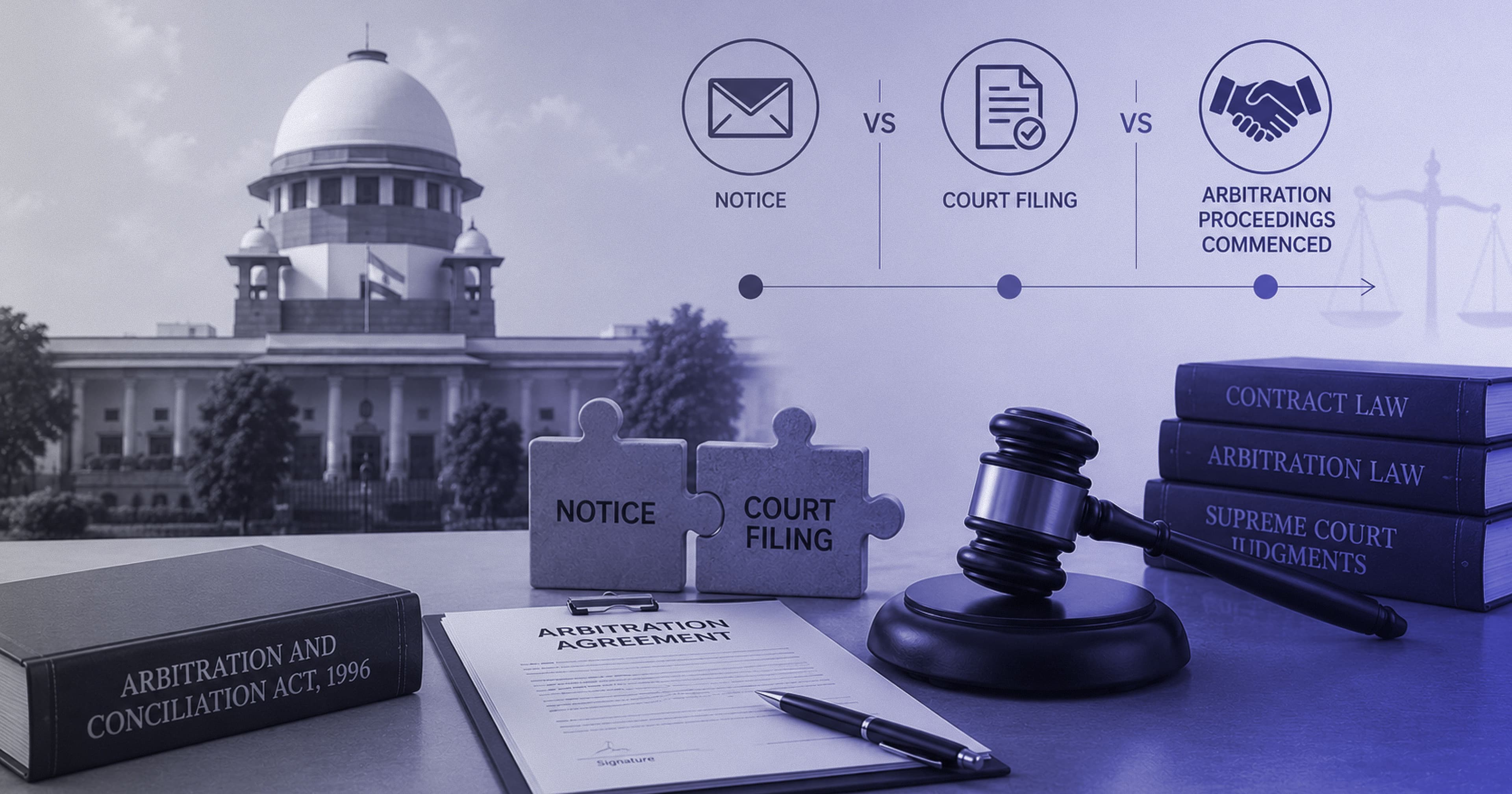
Arbitration legally commences on the date a formal notice invoking arbitration is received by the respondent, not when an application is filed in court. Under Section 21 of the Arbitration and Conciliation Act, 1996, this notice is mandatory and strictly determines the limitation period for commercial disputes.
What the Law Says: Section 21 of the Arbitration and Conciliation Act, 1996
The Arbitration and Conciliation Act, 1996 is the foundational statute governing alternative dispute resolution in India. Section 21 explicitly defines the commencement of arbitral proceedings: unless the parties have agreed otherwise, arbitration commences on the date a formal request for dispute resolution is received by the respondent — the party against whom the claim is brought.
This single date carries two critical legal consequences. First, it stops the clock on the limitation period — the strict, legally defined timeframe within which a claimant must initiate proceedings before the claim becomes time-barred and unenforceable. Second, it formally notifies the counterparty of the nature of the dispute, offering a final window to reach an amicable resolution.
Failing to comply with the delivery requirements of Section 21 renders any subsequent legal action procedurally defective. Courts have consistently held that this is not a curable irregularity — it goes to the root of jurisdiction over the arbitration.
For businesses in Delhi NCR entering into commercial contracts — whether in construction, supply chains, technology services, or real estate — understanding the mechanics of Section 21 is as important as the commercial terms of the agreement itself. Guidance on the full scope of arbitration law is available on the Arbitration and Alternate Dispute Resolution practice page of Pramanika Legal.
Key Precedent: The Supreme Court’s 2026 Ruling
In a significant 2026 ruling, the Supreme Court of India reaffirmed the absolute necessity of the Section 21 notice and resolved a long-standing point of contention in commercial arbitration practice. The Court held, definitively, that filing an application under Section 11 of the Act — which allows a party to request the court to appoint an arbitrator — does not constitute commencement of arbitral proceedings.
The limitation clock stops precisely on the date the invocation notice is delivered to the opposing party. The Court ruled that Section 21 is an absolute prerequisite, not a procedural formality that can be substituted by judicial filing. Claims where the invocation notice itself was time-barred were to be dismissed, irrespective of a subsequently filed Section 11 application.
This ruling has direct implications for commercial dispute lawyers advising clients on the timing of arbitration. The Court’s reasoning reinforces that courts will not cure the fundamental defect of a missing or time-barred invocation notice through later judicial proceedings.
Comparison with Earlier Positions: How the Law Has Evolved
Historically, there was considerable ambiguity in how lower courts interpreted the moment a dispute transitioned from a private disagreement into a formal legal proceeding. Some earlier decisions demonstrated leniency, allowing parties to cure defective Section 21 notices by relying on the date they filed a Section 11 application.
In those older frameworks, the act of approaching a court was sometimes deemed sufficient to pause the limitation clock. This created commercial uncertainty: a respondent could face court summons without any prior notice or opportunity to settle privately.
The modern legal position, firmly established by the 2026 ruling, definitively separates the invocation of arbitration from the judicial appointment of an arbitrator. The two are sequential, not interchangeable. Section 21 notice must come first, and the date of its receipt is the only date that matters for limitation purposes.
This evolution aligns with the broader legislative intent behind the 2015 and 2019 amendments to the Arbitration Act: to reduce judicial intervention, accelerate commercial dispute resolution, and restore genuine finality to the arbitral process.
Step-by-Step: Drafting and Serving a Valid Section 21 Notice
Properly drafting and serving an arbitration notice is the critical first step in managing any commercial dispute. Businesses must follow a rigorous, methodical sequence to ensure their legal rights are protected.
- Review the Original Arbitration Agreement. Examine the underlying commercial contract to identify the dispute resolution clause. Note any mandatory pre-arbitration steps, such as a required conciliation period or mutual discussion phase before formal invocation is permissible.
- Draft a Comprehensive Invocation Notice. Prepare a formal written notice under Section 21. The document must clearly outline the historical context of the dispute, specify the exact contractual breaches, quantify the total claim amount, and invoke the specific arbitration clause by reference.
- Nominate an Independent Arbitrator. If the contract permits party-appointed arbitrators, formally propose the name of a sole arbitrator or nominate your representative for a three-member tribunal, stating their qualifications and confirming their independence.
- Execute Proper Legal Service. Deliver the notice by registered post with acknowledgment due, or to the official email address specified in the contract. Retain all delivery receipts and tracking records as evidence of the exact date of receipt by the respondent.
- Observe the Statutory Waiting Period. Allow the respondent the standard 30-day period — or the specific timeframe in your contract — to reply or agree to the nominated arbitrator before approaching a judicial forum for appointment under Section 11.
Common Mistakes to Avoid
Many high-value commercial disputes face early dismissal due to avoidable procedural errors at the invocation stage. A skilled
- +Skipping mandatory pre-arbitration negotiation or mediation steps specified in the dispute resolution clause, which may be a condition precedent to invoking arbitration.
- +Sending the notice to an outdated branch address rather than the officially registered office of the respondent company. Service at a wrong address does not start the limitation clock.
- +Failing to quantify the financial claim or neglecting to cite the specific contractual provisions breached. A vague notice risks being held insufficient under Section 21.
- +Waiting until the final days of the limitation period to dispatch the notice, creating exposure to postal delays or delivery disputes that may render the notice time-barred.
- +Filing a Section 11 application without first allowing the 30-day notice period to expire, which courts may treat as premature and decline to entertain.
For guidance on these issues in the context of commercial contracts, explore Pramanika Legal’s resources on Commercial Litigation and Business Disputes.
Delhi NCR Angle: Local Courts and the Section 21 Requirement
For corporations, startups, and individuals operating across Delhi, Noida, and Gurgaon, strict adherence to Section 21 is closely monitored by local judicial forums. Whether an application for appointment of an arbitrator is filed at the Delhi High Court or interim relief is sought at Saket District Court, presiding judges routinely require documented proof of Section 21 compliance before entertaining the application.
Where commercial contracts designate the Delhi International Arbitration Centre (DIAC) as the governing forum, institutional rules align with the national statutory position: the date of receipt of the formal invocation notice by the other party determines commencement.
Navigating this procedural ecosystem — and ensuring that notices meet the standards expected by Delhi courts — requires specific local knowledge. An experienced commercial dispute lawyer Delhi can ensure your invocation documents are procedurally sound before they are served.
Frequently Asked Questions
Q: Does an email count as a valid legal notice for starting arbitration?
A: Yes. An email can constitute a valid Section 21 notice if it is sent to the official email address used for business communications or explicitly specified in the contract, and if it clearly invokes the arbitration clause with the required particulars.
Q: What happens if the opposing party refuses to accept the physical notice?
A: If a notice is sent by registered post to the correct registered address and is returned with a remark such as ‘refused’ or ‘unclaimed’, courts generally treat service as validly effected on the date of that refusal. Retain the envelope and postal tracking records as evidence.
Q: Can a party bypass Section 21 and file directly in the High Court?
A: No. Bypassing the mandatory Section 21 notice is a fatal procedural defect. A court will dismiss any Section 11 application for appointment of an arbitrator if the invocation notice was not properly served before filing.
Q: How long must a party wait after sending the notice before filing in court?
A: The standard waiting period is 30 days from the date of receipt of the notice by the respondent, unless the contract specifies a different timeframe. Only after this period expires — without agreement on an arbitrator — may a party approach the court.
Q: What is the limitation period for filing an arbitration notice in commercial disputes?
A: The Limitation Act, 1963 applies to arbitration. For most commercial disputes, the limitation period is three years from the date the cause of action accrues. The Section 21 notice must be served within this period — not the Section 11 application.
When to Consult a Lawyer
Navigating the procedural requirements of arbitration — particularly the Section 21 invocation — requires precise drafting, knowledge of local court expectations, and strict attention to timing. The consequences of a defective or time-barred notice are severe and can permanently bar recovery of a legitimate commercial claim.
Legal advice is particularly important in the following situations:
- +You have a commercial dispute and are approaching the limitation deadline — immediate legal assessment of the cause of action and invocation strategy is necessary.
- +You have received a Section 21 notice from a counterparty and need to assess the validity of the notice, the limitation position, and available responses.
- +Your contract contains multi-step pre-arbitration requirements — mediation, conciliation, or internal escalation — and you need guidance on sequencing.
- +You require representation before the Delhi High Court on a Section 11 application or a Section 34 challenge to an arbitral award.
Pramanika Legal assists businesses and individuals in commercial arbitration matters, Section 21 invocations, Section 11 applications, and award challenges before Delhi courts and arbitral tribunals. To discuss your matter and assess your limitation position, schedule a confidential consultation with Advocate Akhil Bharat Kukreja.
Related Articles
For our analysis of the Delhi High Court’s April 2026 ruling on Section 34 challenges and the limited scope of judicial interference with arbitral awards, read Delhi High Court Upholds Arbitral Award in Infrastructure Dispute: What the Section 34 Ruling Means for Delhi NCR Businesses.
For an analysis of RERA versus arbitration as competing forums for builder-delay disputes in Delhi NCR, read RERA vs Arbitration in Delhi NCR Builder Delay Cases 2026 on the Pramanika Legal Insights hub.
Explore all articles on arbitration, commercial litigation, and dispute resolution strategy at Pramanika Legal Insights.