

Won Your RERA Case but the Builder Won't Pay? How Recovery Certificates Work in Delhi
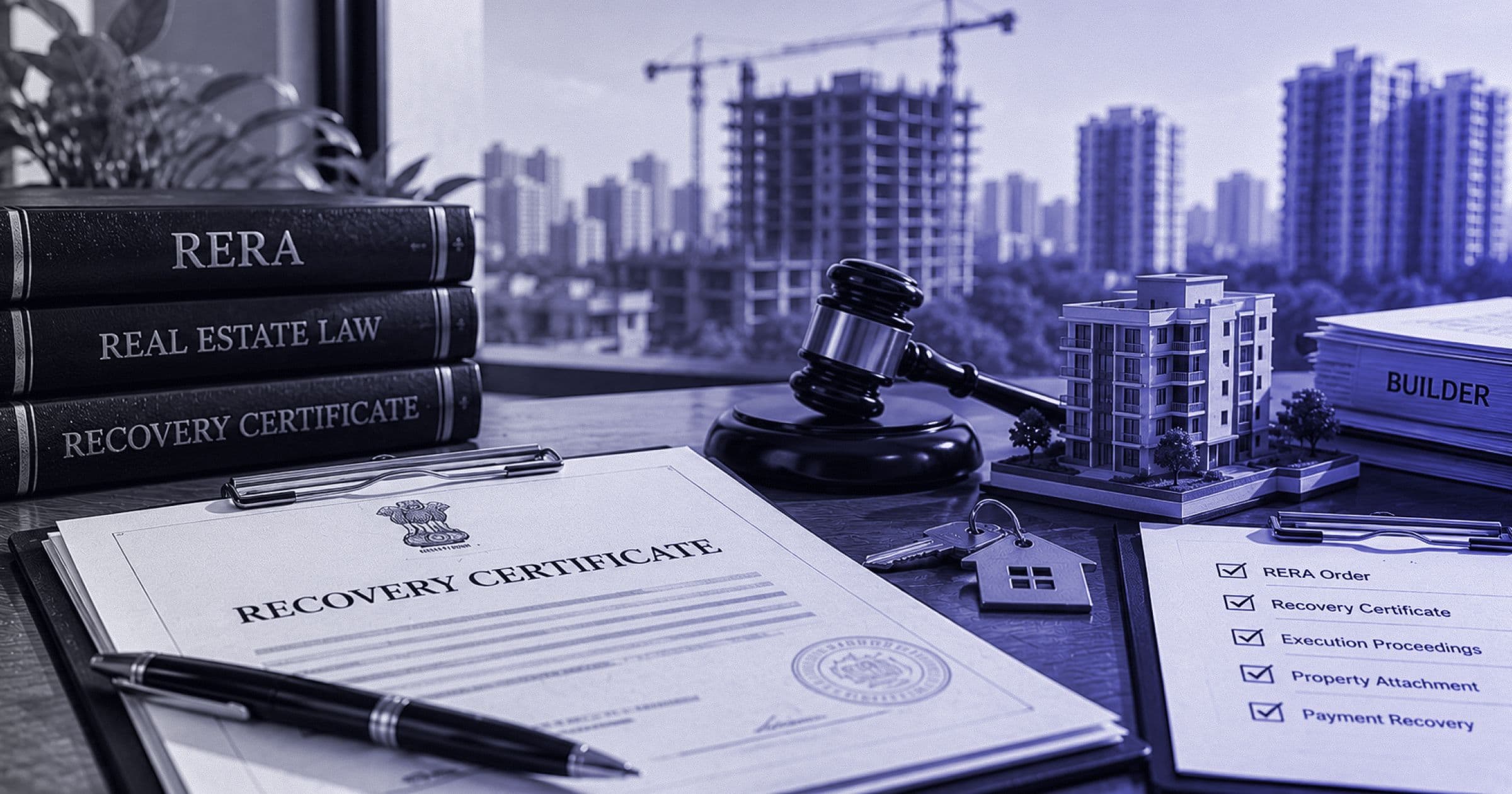
A favourable RERA order is often a major relief for a homebuyer who has spent years waiting for possession or a refund. The authority may direct the developer to return the money paid for an apartment, pay interest for delayed possession, or compensate the allottee for a legally established loss. Yet the order can remain unpaid for months, sometimes years, while the buyer continues paying rent, home-loan instalments and legal expenses.
The real difficulty frequently begins after the homebuyer wins. A developer may ignore the compliance deadline, offer instalments without making payments, file an appeal, or claim that the company has no available funds. The buyer then discovers an important distinction: a RERA order determines an entitlement, whereas enforcement is the process of actually recovering the money.
A search for RERA order not complied by builder commonly leads to advice about lodging another complaint. Similarly, the query builder not paying RERA refund often describes a case that has already been decided and now requires enforcement. That may be the wrong starting point. Where the order already grants a monetary relief, the focus should ordinarily shift to an execution or enforcement request, a RERA recovery certificate, and the revenue authorities or other forum legally empowered to act upon it.
The law is broadly similar across Delhi NCR because Section 40 of the Real Estate (Regulation and Development) Act, 2016 applies nationwide. The practical process, however, differs across Delhi RERA, Uttar Pradesh RERA and Haryana RERA Gurugram. State rules, the nature of the original order, the location of the developer’s assets and any pending insolvency proceedings can materially affect recovery.
What Should You Do If a Builder Does Not Pay After a RERA Order?
Obtain the complete order and establish its compliance deadline. Calculate the outstanding principal, interest and other amounts strictly in accordance with its operative directions. Check whether the developer has obtained an actual stay from the appellate forum. If payment remains due, file the prescribed execution or compliance application before the authority that passed the order, seek recovery under Section 40 RERA, and obtain particulars of any recovery certificate issued to the competent recovery officer or Collector.
Once the certificate is issued, follow the revenue-recovery stage actively. Ask what steps have been taken to identify attachable assets, obtain a written recovery-status report, and pursue an appropriate legal remedy if the competent officer fails to act. Issuance of a recovery certificate is an important enforcement step, not confirmation that the money has already been recovered.
Why Does a RERA Refund Order Remain Unpaid Even After the Homebuyer Wins?
RERA gives an allottee enforceable rights, but it does not guarantee that the promoter maintains a separate pool of unrestricted money sufficient to satisfy every refund order. Some developers have several outstanding orders, competing lenders, stalled projects and depleted bank accounts. Others have property, receivables or unsold inventory, but recovery requires the competent authority to identify those assets and take lawful action.
The stages are different. First, the regulatory authority or adjudicating officer decides the dispute. Second, the builder must comply voluntarily within the period provided. Third, if there is non-compliance, the successful allottee initiates the applicable enforcement procedure. Fourth, where monetary dues are recoverable as arrears of land revenue, a recovery certificate or demand is transmitted to the appropriate machinery. Finally, money actually realised must be accounted for and disbursed to the person entitled to receive it.
An order cannot be treated as recovered merely because the RERA website displays “disposed of”, “execution filed” or “recovery certificate issued”. The legally meaningful questions are whether a quantified demand exists, who is responsible for recovering it, what assets are available, whether any stay or moratorium applies, and what amount has actually reached the allottee.
Section 40 of RERA: How Does the Law Provide for Recovery?
Section 40 creates the central enforcement framework. It contains two parts that should not be casually interchanged.
Section 40(1): Recovery of Monetary Dues as Arrears of Land Revenue
Section 40(1) provides that unpaid interest, penalty or compensation imposed under the Act may be recovered in the prescribed manner as arrears of land revenue. In everyday terms, this allows the statutory recovery machinery to act against a defaulting promoter instead of leaving the homebuyer to depend entirely upon voluntary payment.
Recovery as land revenue does not mean that the homebuyer automatically becomes owner of the builder’s land. It means that the competent recovery authority may invoke processes authorised under the applicable State revenue law, which can include a demand, attachment and lawful sale of attachable property. The nature of the asset, priority of competing claims and statutory procedural safeguards still matter.
Does Section 40(1) Also Cover the Principal Refund Amount?
Yes, where the RERA order directs refund of the principal together with interest. In M/s Newtech Promoters and Developers Pvt. Ltd. v. State of Uttar Pradesh, Civil Appeal Nos. 6745–6749 of 2021 and connected appeals, judgment dated 11 November 2021, the Supreme Court rejected the developer’s attempt to separate the principal refund from interest for recovery purposes.
The Court examined Section 18 and Section 40 together and held that a direction to return the amount deposited, with interest, constitutes a composite monetary obligation capable of recovery through Section 40(1). Requiring a buyer to pursue one process for the principal and another for interest would undermine RERA’s object of expeditious relief.
This ruling is particularly important in RERA refund recovery matters. A promoter cannot ordinarily defeat an otherwise enforceable refund order by arguing that the land-revenue mechanism is available only for interest and not for the money initially paid by the allottee.
Section 40(2): Enforcement of Other Orders and Directions
Section 40(2) addresses failure to obey an order requiring a person to do, or refrain from doing, an act authorised under the statute. Examples may include directions concerning possession, execution of documents or other non-monetary compliance. Enforcement must follow the manner prescribed by the applicable rules and the actual terms of the order.
Some State rules contain machinery resembling execution of a civil-court decree. That does not mean every RERA money decree should be filed directly before an ordinary civil court without first examining Section 40(1) and the relevant rules. A distinction must be maintained between a monetary refund, an order for possession and an award of compensation.
What Can Be Recovered: Refund, Interest, Delay Compensation and Costs
The first task is to read the operative portion of the actual order, not merely its summary. A RERA authority may award the return of deposits with prescribed interest under Section 18(1), or monthly interest for delayed possession where the allottee continues with the project. An adjudicating officer may determine compensation in matters falling within the statutory scheme. The person entitled, the date from which interest runs and the obligation being enforced must be identified accurately.
An illustrative order might direct a builder to refund Rs. 45,00,000/- (Rupees Forty Five Lakh Only), together with interest at the applicable prescribed rate from the dates of deposit until payment. The amount due on the day the order was passed can be different from the amount due when enforcement is initiated. The calculation must respect the particular order and the rate prescribed for the project and State; there is no single universal RERA interest rate applicable to every case.
Interest may continue to accrue where the order expressly requires it. Conversely, an executing authority ordinarily cannot use enforcement proceedings to create a new substantive head of compensation that the original order never granted. A mistaken calculation, duplicate claim, omission of part-payment, or inclusion of unawarded charges can delay the certificate and give the builder a legitimate objection.
Delhi RERA, UP RERA and HRERA Gurugram: A Practical Comparison
Jurisdiction
Where enforcement starts
Key recovery mechanism and follow-up
Delhi RERA
Compliance or enforcement request before the concerned RERA forum; check the original order and applicable Delhi Rules
Section 40 with Rule 23 of the NCT of Delhi General Rules, 2016; seek the recovery certificate and follow up with the competent district revenue authority
UP RERA (Noida / Greater Noida)
Execution request linked to the decided complaint through the UP RERA system
Section 40 read with Rules 23 and 24 of the UP Rules, 2016; RC typically moves to the concerned District Magistrate / Collector for land-revenue recovery
HRERA Gurugram
Execution proceedings before the authority or officer competent in the particular case
Section 40 with Haryana Rule 27 and revenue-recovery law; verify which authority holds the RC after the 2025 High Court ruling concerning delegated Collector powers
This comparison is a guide to the usual path, not a substitute for checking the order, current local procedure and the legal status of any recovery transfer. A project in Noida is not governed by Delhi RERA simply because the purchaser lives in Delhi. The geographical location of the registered project ordinarily determines which RERA regime applies.
Delhi RERA: How Can a Homebuyer Enforce an Unpaid Refund Order?
The National Capital Territory of Delhi Real Estate (Regulation and Development) (General) Rules, 2016 contain a specific recovery provision. Rule 23 states that amounts such as interest, penalty or compensation are to be recovered as arrears of land revenue in the manner provided under applicable local laws. Read with Newtech Promoters, this statutory mechanism is relevant when an order directs a refund together with interest.
The allottee should first verify whether the developer has paid any part of the order, whether the compliance date has passed and whether an appellate authority has granted a stay. The next step is to move the concerned RERA forum for implementation of its own order and ascertain whether a certificate or requisition has been issued to the competent recovery authority. The application should identify the company against which the order operates, the outstanding sum, the interest calculation and the specific enforcement directions sought.
The Delhi High Court has entertained writ proceedings where a recovery certificate exists but meaningful follow-up has not occurred. In Suman Devi v. District Magistrate & Ors., judgment dated 9 August 2024, the Court directed the concerned officer to take necessary steps for execution of a RERA recovery certificate and realisation of the amount in accordance with law. That was not an unconditional direction that money must be paid immediately from government funds; it required the responsible authority to perform the recovery function.
A RERA lawyer Delhi dealing with an unpaid order should therefore establish whether the real delay lies with the promoter, the RERA secretariat, the issuance of the recovery certificate or the revenue officer who has received it. Each point of delay calls for a different representation and potentially a different respondent in court.
UP RERA: Recovery Certificates for Noida and Greater Noida Homebuyers
For projects in Noida and Greater Noida, the Uttar Pradesh Real Estate Regulatory Authority provides a dedicated online facility for requests for execution of RERA orders and viewing execution or compliance status. The buyer should use the original complaint details rather than starting an unrelated fresh complaint asking the authority to decide the same refund entitlement again.
Rule 23 of the Uttar Pradesh Real Estate (Regulation and Development) Rules, 2016 prescribes recovery of dues under Section 40(1) as arrears of land revenue under local laws. Rule 24 separately addresses enforcement of other orders and directions under Section 40(2). The proper step therefore depends on the relief originally granted.
How the UP RERA Recovery Process Usually Moves
After the allottee submits an execution request, the authority can call upon the promoter to explain compliance, examine receipts and compute the amount due. If the amount remains unpaid and the matter falls within monetary recovery, the authority can issue the recovery certificate for action by the District Magistrate or Collector. The revenue machinery may then take lawful steps to recover money or attach eligible assets. UP RERA’s published process guidance recognises that the authority’s order, the certificate and actual disbursement are distinct stages.
The district is important. For a Noida project the relevant recovery authority will often be the District Magistrate of Gautam Buddh Nagar, but the record should be checked for the precise addressee and the location of the promoter’s recoverable assets. A different district may become relevant where the builder owns identified property elsewhere and lawful transfer or coordination of the demand is required.
In April 2026, the Allahabad High Court in Ravinder Kumar Bansal v. State of U.P. & Ors., Writ-C No. 14086 of 2026, directed the District Magistrate, Gautam Buddh Nagar, to consider and dispose of the recovery proceedings arising from a UP RERA recovery certificate, preferably within two months, subject to any legal impediment. This is a practical example of what a writ of mandamus can achieve where a certificate has not been acted upon.
Likewise, in Harish Chandra Singh v. State of U.P. & Ors., decided on 18 May 2026, the Allahabad High Court’s Lucknow Bench directed the District Magistrate/Collector to take necessary steps to comply with a UP RERA recovery certificate within two months of receiving the certified court order, provided no other legal impediment existed. Neither ruling should be interpreted as a universal statutory two-month deadline for every RC; the time period was specified in the individual judicial order.
UP RERA has also provided a dedicated execution and recovery-certificate contact channel for its NCR regional office, enabling documented follow-up on certificate status. A RERA refund lawyer Noida should examine both the portal status and the Collector’s actual recovery file; reliance on either source alone can leave an important gap.
HRERA Gurugram: Recovery Procedure and the 2025 High Court Development
An allottee with a favourable order from Haryana RERA Gurugram should begin by filing or pursuing the prescribed execution proceeding before the competent authority. Haryana Rule 27 and Section 40 govern the enforcement framework, with land-revenue recovery forming a central route for monetary orders. The forum responsible for adjudication and the public authority exercising recovery powers should not be confused.
There was a material development in Haryana. On 11 May 2024, the State issued a notification vesting adjudicating officers of HRERA with powers of a Collector for execution of recovery certificates and transferring certain pending recoveries from district Collectors. In Vatika Limited v. Union of India & Ors., CWP-14937-2024, decided on 24 April 2025 (2025:PHHC:052003-DB), the Punjab and Haryana High Court quashed that notification. It reasoned, among other things, that the notified arrangement improperly combined jurisdiction over enforcement of orders made by different statutory forums.
The judgment clarified that orders of the regulatory authority, appellate tribunal and adjudicating officer must be pursued through the legally competent forum and implemented through the prescribed Section 40 framework. A homebuyer should therefore confirm whether a particular recovery certificate is held by the RERA execution branch, the Collector or another competent recovery officer, and should not assume that an old notification remains the answer in every case. The effect of any later binding appellate or government action must also be checked when proceeding.
Recent decisions show that the recovery process remains an active judicial issue. In Rajesh Khurana & Anr. v. State of Haryana & Ors., CWP-14811-2026, decided on 20 July 2026, the Punjab and Haryana High Court directed the Collector, Gurugram to consider an application for execution of an existing HRERA recovery certificate and endeavour to execute it expeditiously in accordance with law. In Suraj Bhan Chhillar v. Collector, Gurugram & Ors., CWP-25394-2026, decided on 13 August 2026, the Court directed expeditious execution following the petitioner’s undertaking to move the concerned officer.
These cases show why the question is not simply whether an HRERA lawyer Gurgaon can “get an RC issued”. The larger task is identifying who presently has lawful responsibility for execution, whether any attachable property exists, and what order is required when that official fails to proceed.
Important Judicial Decisions Every RERA Decree-Holder Should Understand
M/s Newtech Promoters and Developers Pvt. Ltd. v. State of Uttar Pradesh (Supreme Court, 11 November 2021)
The Supreme Court confirmed that the principal amount ordered to be refunded with interest is capable of recovery through the Section 40(1) mechanism. The Court also examined the statutory division of functions between the RERA authority and adjudicating officer and the promoter’s pre-deposit obligations in appeal. The judgment provides the primary answer to a developer’s argument that an RC cannot cover the principal refund.
M/s International Land Developers Pvt. Ltd. v. Aditi Chauhan & Ors. (Punjab and Haryana High Court, 17 August 2022)
The High Court examined Section 40 and the Haryana recovery rules and stressed recovery in the statutorily prescribed manner, including land-revenue enforcement of monetary obligations. This decision forms part of the background to Haryana’s later changes and the 2025 ruling in Vatika Limited.
Vatika Limited v. Union of India & Ors. (Punjab and Haryana High Court, 24 April 2025)
The Court set aside Haryana’s notification conferring the Collector’s recovery powers on the RERA adjudicating officer. The practical consequence is that counsel must scrutinise the competent executing authority and avoid assuming that a recovery certificate can be implemented under an administrative arrangement that has been judicially invalidated.
Ravinder Kumar Bansal v. State of U.P. & Ors. (Allahabad High Court, 15 April 2026)
The Allahabad High Court required the Gautam Buddh Nagar District Magistrate to deal with an outstanding UP RERA recovery certificate within a specified period, subject to legal impediments. It illustrates the limited but useful relief available in a writ when the grievance is official inaction rather than the merits of the already-decided RERA case.
Rajesh Khurana & Anr. v. State of Haryana & Ors. (Punjab and Haryana High Court, 20 July 2026)
The Court directed consideration of the homebuyers’ application to execute an HRERA recovery certificate. It did not itself order an immediate unconditional payment by the State or guarantee successful recovery; the Collector still had to proceed lawfully after considering the parties.
Surendra Kuamr Agarwal v. Sri Suryapal Gangwar, District Magistrate, Lucknow (Allahabad High Court, 7 May 2026)
This judgment illustrates the limitations of enforcement even after a buyer obtains a favourable direction. The record referred to partial recovery against an RC, unsuccessful efforts to realise the balance because the relevant accounts held insufficient funds, and a returned certificate. The Court did not find wilful disobedience sufficient for contempt on those facts. A certificate and even a mandamus order cannot create attachable assets where none are lawfully available.
Seven Steps to Recover Money When a Builder Ignores a RERA Order
Step 1. Read the Final Operative Order and Check the Deadline
Collect the signed RERA order and any later clarification, rectification, appellate or stay order. Record who must pay, the precise relief, the compliance date and the interest rate and period. Do not rely only on a website status line. If the order directs delivery of possession and adjustment of delayed-possession interest, the execution strategy will differ from a pure refund claim.
Step 2. Prepare a Correct Statement of Outstanding Dues
List every payment made by the allottee, the dates relevant to interest computation, all part-payments by the developer, and the amount still due. Attach bank entries, receipts and a calculation sheet. If the original order fixes a sum, do not reopen it under the guise of calculation. Where further interest is payable, identify the precise source of that entitlement in the order.
Step 3. Verify Appeals, Stays and Other Legal Impediments
An appeal by itself does not necessarily mean the original order has been stayed. Obtain the appellate filing particulars and any written interim order rather than accepting the builder’s assertion. Under the proviso to Section 43(5), a promoter appealing an order requiring payment to an allottee faces a substantial pre-deposit condition, as explained by the Supreme Court in Newtech Promoters. However, money deposited before an appellate tribunal does not automatically become immediately withdrawable by the homebuyer; disbursement depends on the applicable order.
Step 4. File the Proper Execution or Recovery Application
Move the forum that passed the order, using the relevant State procedure or electronic facility. Seek a finding of non-compliance, quantification where necessary, issue or enforcement of a recovery certificate, and transmission to the competent recovery authority. Where the order concerns something other than a monetary refund, invoke Section 40(2) and the relevant State-rule mechanism rather than mechanically asking for land-revenue recovery.
Step 5. Obtain and Track the Recovery Certificate
Obtain the RC number, date, amount, name of defaulting entity, name of the recipient authority and dispatch/receipt evidence. Ask whether the certificate includes accrued interest and whether a revised certificate is needed because of payments or a calculation error. Where several homebuyers have certificates against the same builder, separate amounts and priorities must be documented accurately.
Step 6. Pursue Asset Identification and Actual Revenue Recovery
Address a written representation to the executing authority, enclosing the RC and requesting the current status of demand notices, attachment, bank balances, land or unsold inventory and any lawful coercive process. Asset details must be verified; land held by a different corporate entity or property already subject to other statutory claims cannot be casually treated as the judgment debtor’s free assets. Seek an action-taken report and preserve acknowledgement of every follow-up.
Step 7. Escalate Where the Responsible Authority Remains Inactive
When meaningful recovery action has not followed, consider a reasoned reminder, a fresh request to the issuing RERA forum, and, where appropriate, a writ petition under Article 226 seeking a mandamus against official inaction. Annex the underlying RERA order, recovery certificate, proof of transmission, representations and the absence of action. The court may direct consideration, status reporting or time-bound lawful steps; it does not usually replace the recovery officer or guarantee that the builder has sufficient assets.
What Happens After the Recovery Certificate Is Issued?
The statutory recovery authority may issue demand notices, inquire into assets, attempt attachment or pursue sale processes permitted by the applicable revenue law. Money received must then be accounted for and transmitted or disbursed under the applicable procedure. Delays may occur at the stage of verifying the debtor’s assets, receiving responses from banks, protecting third-party claims or completing auction formalities.
The allottee should follow two records: the RERA execution file and the recovery authority’s file. A portal may show “RC issued” long before a Collector has completed any recovery action. Conversely, some money may have been realised but remain undistributed pending reconciliation, documentation or the necessary administrative direction.
A demand for instant payment merely because an RC exists will not answer the question of whether the certificate can presently be executed. What helps is a clear record showing the next unperformed statutory step and the official legally responsible for performing it.
If the Builder Still Refuses to Pay: What Further Legal Remedies Exist?
Penalty for Non-Compliance Under Section 63
Section 63 provides for a penalty where a promoter fails to comply with an order or direction of the Regulatory Authority. The penalty can accrue for the continuing default, subject to the statutory ceiling linked to the estimated cost of the project. This is a regulatory sanction, not an automatic replacement for recovering the allottee’s own refund. The correct provision also depends on which forum’s order has been breached; Section 64 concerns specified non-compliance with an Appellate Tribunal order and carries different consequences.
Attachment of Bank Accounts, Property or Eligible Assets
A recovery authority acting under the relevant State revenue law may have powers to proceed against the defaulting person’s assets. The process must obey the law governing demand, notice, ownership, encumbrances and priority. The allottee should identify the actual promoter entity in the RERA order and avoid assuming that every company in the developer’s group, or every director personally, is liable for that order without a separate lawful basis.
Criminal Complaint Where There Is Evidence of Cheating
A builder’s failure to honour a refund order is not, by itself, proof of a criminal offence. A police complaint may be justified where there is material supporting dishonest inducement at the inception, diversion under circumstances satisfying a particular offence, forged approvals, fabricated receipts or another independently established criminal ingredient. The Bharatiya Nyaya Sanhita, 2023, including its cheating and criminal-breach-of-trust provisions where factually applicable, must be assessed on the evidence. The criminal process should not be described as an automatic method of executing a civil or RERA monetary order.
Insolvency Proceedings: A Different Recovery Landscape
Where the company liable under the order is subject to a corporate insolvency resolution process, Section 14 of the Insolvency and Bankruptcy Code, 2016 may impose a moratorium affecting individual enforcement and recovery against the corporate debtor. The allottee’s strategy may then require submission or updating of a claim through the insolvency professional, scrutiny of the project’s treatment in the resolution plan and attention to the statutory status of homebuyers as financial creditors.
The Supreme Court in Pioneer Urban Land and Infrastructure Ltd. v. Union of India, (2019) 8 SCC 416, addressed the IBC position of real-estate allottees and the relationship between remedies. A recovery certificate is not a device to override an operative IBC moratorium. Nor does a RERA refund order automatically allow a single allottee to bypass the collective insolvency process. If the builder is undergoing CIRP, the company against which enforcement is sought and the scope of the moratorium must be verified before taking coercive steps.
Consumer Proceedings: An Additional Remedy, Not a Second Execution of the Same Order
In Imperia Structures Ltd. v. Anil Patni, (2020) 10 SCC 783, the Supreme Court held that the availability of remedies under RERA does not, by itself, exclude a homebuyer’s remedy under consumer-protection legislation. However, the fact that consumer and RERA remedies may coexist does not mean that a buyer can ignore final adjudication, suppress parallel proceedings or obtain duplicate recovery for the same loss.
A homebuyer who already holds an unpaid RERA refund order should not assume that filing a fresh consumer complaint will convert that order into a consumer decree capable of execution in the District Commission. The appropriate forum and effect of previous proceedings must be analysed carefully. For a purchaser deciding the first remedy, the choice may be different; for a successful RERA decree-holder, effective enforcement of the existing order is usually the immediate question.
What If the Builder Says an Appeal Is Pending?
Ask for the case number, copy of appeal, proof of pre-deposit and the precise interim order. There is a legal difference between filing an appeal, satisfying statutory requirements for its consideration and obtaining a stay on enforcement. Where a valid stay exists, its terms control the next step. Where none exists, the builder cannot ordinarily avoid compliance merely by asserting that litigation may continue.
Section 43(5) is also frequently misunderstood. The prescribed promoter pre-deposit depends on the nature of the direction being challenged. For an appeal involving payment to the allottee, the requirement is not simply an automatic 30% deposit of every amount; the statute and Newtech Promoters draw a distinction between penalties and amounts payable to an allottee. A successful buyer should verify whether a deposit exists and whether the Appellate Tribunal has made any direction about its release.
What If the Recovery Certificate Is Returned Unexecuted?
An unexecuted or returned certificate is not necessarily a declaration that the builder owes nothing. It may mean that the particular recovery officer could not locate sufficient attachable assets or that the certificate requires administrative or procedural action elsewhere. Obtain the written return report explaining what enquiries and recovery efforts were undertaken. Check whether the promoter has other attachable assets, another relevant corporate entity has separately assumed liability, or the same claim is affected by insolvency or an earlier charge.
In Surendra Kuamr Agarwal v. District Magistrate, Lucknow (7 May 2026), the Allahabad High Court considered a record in which only part of the amount was recovered, bank-account attachment had not yielded the balance, and the certificate had been returned to RERA. The Court declined contempt relief on the particular facts. The lesson is that enforcement strategy must investigate available assets and actual recovery steps rather than assume that repeated contempt petitions will themselves produce funds.
Common Mistakes That Delay RERA Recovery
- +Assuming that winning the original complaint automatically results in a bank credit, without filing an execution request.
- +Filing a fresh complaint for the same relief instead of using the prescribed enforcement procedure.
- +Confusing the promoter’s appeal with an actual stay, or overlooking a stay that has been granted.
- +Seeking a recovery certificate for the wrong company, a wrong calculation or charges that the order never awarded.
- +Treating an RC as proof that the Collector has seized the money, without obtaining the recovery file or asset status.
- +Failing to follow up after a certificate is dispatched, particularly where it was returned or transferred between officers.
- +Accepting informal settlement assurances without payment dates, written safeguards or a clear treatment of the original order.
- +Ignoring the IBC moratorium, competing secured claims or the identity of the actual corporate debtor.
- +Treating non-payment alone as proof of cheating and assuming an FIR will deliver immediate financial recovery.
- +Pursuing contempt without first establishing a clear order, a responsible officer and the circumstances of alleged wilful disobedience.
Documents to Keep Ready Before Consulting a RERA Recovery Lawyer
- +Copy of the final RERA order, along with any rectification, review, appeal or stay order.
- +Builder-buyer agreement, allotment letter and relevant payment receipts.
- +Bank statements or ledger showing the amounts actually paid and refunded, if any.
- +A date-wise calculation of principal, interest, charges allowed and part-payments.
- +Proof of service of the order or payment demand, where available.
- +Execution application number, recovery-certificate copy and details of its recipient.
- +Letters, emails or portal screenshots showing follow-up with RERA and the Collector.
- +Material indicating the correct builder entity, available assets or pending insolvency proceedings.
The documents should be organised chronologically. A long compilation of brochures and marketing material is less helpful at the recovery stage than a precise order, calculation, certificate and evidence showing exactly where enforcement has stalled.
Practical Delhi NCR Scenarios
Delhi Buyer: Refund Ordered but No Recovery Action
A purchaser obtains an order requiring the developer to return the deposited money with interest. The compliance date expires, but the developer responds only with informal emails. The first step is to document non-payment and pursue implementation through Delhi RERA, not file a second case asking whether the original booking was valid. Once the certificate is issued, follow up with the specified recovery officer. Where that official does not act, a properly supported Article 226 petition may be considered.
Noida Buyer: Recovery Certificate Issued but Collector Has Not Collected
A buyer of a Greater Noida apartment sees an RC number on the UP RERA portal but receives no money. The appropriate follow-up is to obtain the issued certificate, verify that the Gautam Buddh Nagar revenue authorities received it, and seek an action-taken report. The 2026 Allahabad High Court orders illustrate that judicial directions can compel officials to consider and pursue pending recovery, subject to any legal impediment.
Gurgaon Buyer: An HRERA Order Against a Builder with Several Outstanding Claims
A homebuyer has an order for refund plus interest and an execution proceeding before HRERA Gurugram. The builder cites a pending appeal while the certificate’s location is unclear. Counsel should first verify the stay and any appellate deposit, identify the competent executing forum under the post-Vatika legal position, and track whether recovery proceedings have been commenced against the legally liable promoter’s assets. A large group of affected buyers may benefit from coordinated asset information and consistent enforcement follow-up, without merging distinct individual entitlements indiscriminately.
Frequently Asked Questions
1. What Should I Do When a RERA Order Is Not Complied With by the Builder?
Obtain the signed order, calculate what is still due, verify whether any stay has been granted and file the appropriate execution or recovery request before the competent RERA forum. Where a certificate is issued, track its progress before the designated recovery officer. Court intervention may be appropriate if the responsible authority remains inactive.
2. Can RERA Recover the Entire Principal Amount or Only Interest?
For an order requiring refund of the deposited principal with interest, the Supreme Court in Newtech Promoters held that the composite monetary amount can be recovered through Section 40(1). The builder cannot ordinarily insist on splitting the principal and interest into separate enforcement mechanisms.
3. How Long Does RERA Recovery Take After an RC Is Issued?
There is no nationwide guaranteed period within which every certificate produces payment. Time depends on the revenue-recovery procedure, assets available, objections, competing claims, stays and insolvency status. Some courts have imposed case-specific deadlines on recovery officials, but those directions should not be presented as a universal statutory timeline.
4. Is a RERA Recovery Certificate the Same as Money in My Bank Account?
No. A recovery certificate authorises or initiates a statutory recovery process. The executing authority must still recover money from a legally liable person or assets, and the amount must be accounted for and disbursed. The certificate is evidence of an enforceable demand, not evidence of completed payment.
5. Can the Collector Attach the Builder’s Property to Enforce My Order?
The competent officer may take measures authorised under the applicable State land-revenue law, potentially including attachment or sale of eligible assets. Whether particular property can be proceeded against depends on ownership, statutory priorities, other encumbrances, the recovery stage and any operative moratorium or stay.
6. Does the Builder’s Appeal Automatically Stop Recovery?
Not necessarily. Ask for the specific stay order. A filed appeal and an actual interim suspension of enforcement are different things. The promoter’s pre-deposit obligations under Section 43(5) also need to be understood in light of the relief appealed against.
7. Can I File a Writ Petition If the District Magistrate Does Not Execute the RC?
In an appropriate case, yes. Recent decisions from the Allahabad and Punjab and Haryana High Courts show that a writ seeking directions to the competent recovery officer can be considered. However, the court ordinarily directs lawful steps, not payment from the State irrespective of whether recoverable assets exist.
8. What If the Builder Has Entered Insolvency?
Find out whether a corporate insolvency resolution process and Section 14 moratorium are operative against the actual entity liable under your order. Individual recovery may be restricted. The allottee should examine claim submission and the applicable IBC process rather than assuming that an earlier RC takes priority over insolvency law.
9. Can I File a Criminal Complaint Because the Builder Has Not Paid My RERA Refund?
Non-payment alone does not establish cheating or criminal breach of trust. Criminal proceedings require evidence satisfying the ingredients of the particular offence, such as dishonest inducement or other independently provable misconduct. The RERA execution process remains the ordinary route for enforcing a monetary order.
10. Can I Start Consumer Court Proceedings After Winning My RERA Case?
RERA and consumer remedies are not generally mutually exclusive, as explained in Imperia Structures. But the effect of an already-decided RERA claim, the risk of conflicting decisions and the prohibition on double recovery must be assessed. A fresh consumer case is not automatically an execution petition for an unpaid RERA order.
11. Where Can I Check the Status of a UP RERA Recovery Certificate?
UP RERA operates an official execution-request and status facility on its website at up-rera.in. The portal gives useful procedural information, but it should be supplemented by written confirmation from the authority to which the certificate was transmitted and, when necessary, the District Magistrate’s recovery office.
12. What If the Builder Offers Instalments After the Recovery Certificate Is Issued?
A settlement can be considered, but it should record the exact admitted amount, payment schedule, treatment of interest, consequences of default and effect on ongoing execution. Do not withdraw an enforceable proceeding merely because the builder gives an oral promise. Any agreed modification should be reflected through the appropriate legal process.
Why Choose Pramanika Legal for RERA Refund Recovery and Enforcement?
A successful recovery application requires more than repeating that the builder disobeyed the order. Counsel must read the relief granted, calculate the legally recoverable amount, identify the executing authority, locate the recovery certificate, examine the builder’s assets and distinguish a delayed administrative process from a genuine legal impediment. In Delhi NCR, that can involve Delhi RERA, UP RERA, HRERA Gurugram, district revenue authorities, appellate tribunals and High Courts.
Pramanika Legal advises and represents homebuyers and property purchasers in RERA disputes, delayed-possession claims, builder refund matters, execution and recovery-certificate proceedings, and related litigation in Delhi, Noida, Gurgaon and surrounding jurisdictions. The objective is to identify the legally available route to actual enforcement, rather than treat an order on paper as the end of the matter.
Where multiple allottees have favourable orders against the same project or promoter, a coordinated review can identify common facts about available assets, execution status and insolvency without overlooking differences between their respective orders and amounts.
Conclusion
Winning a RERA case is an important first step, but the dispute is not over until the builder complies or the lawfully recoverable amount is realised. Section 40 provides the principal recovery mechanism, and the Supreme Court’s ruling in Newtech Promoters confirms the availability of that route for a refund of principal together with interest. The practical work then becomes procedural: calculate the sum, file execution, secure the recovery certificate, identify the officer responsible, track assets and pursue lawful escalation when nothing moves.
Delhi, Noida and Gurgaon share the same central statute, but their implementing rules and the officials responsible for enforcement are not interchangeable. The 2025 Haryana ruling and the 2026 recovery decisions from Uttar Pradesh and Haryana show why a current, jurisdiction-specific strategy matters. Neither an RC nor a writ guarantees money where the liable entity has no recoverable assets, but a properly documented case is far stronger than indefinite reminders to the builder.
If you hold an unpaid RERA order or have been told that your recovery certificate is pending, contact Pramanika Legal at www.pramanikalegal.com to assess the order, execution record, amount outstanding and next enforceable step.