

Anticipatory Bail in 2026: How Section 482 BNSS Replaced Section 438 CrPC
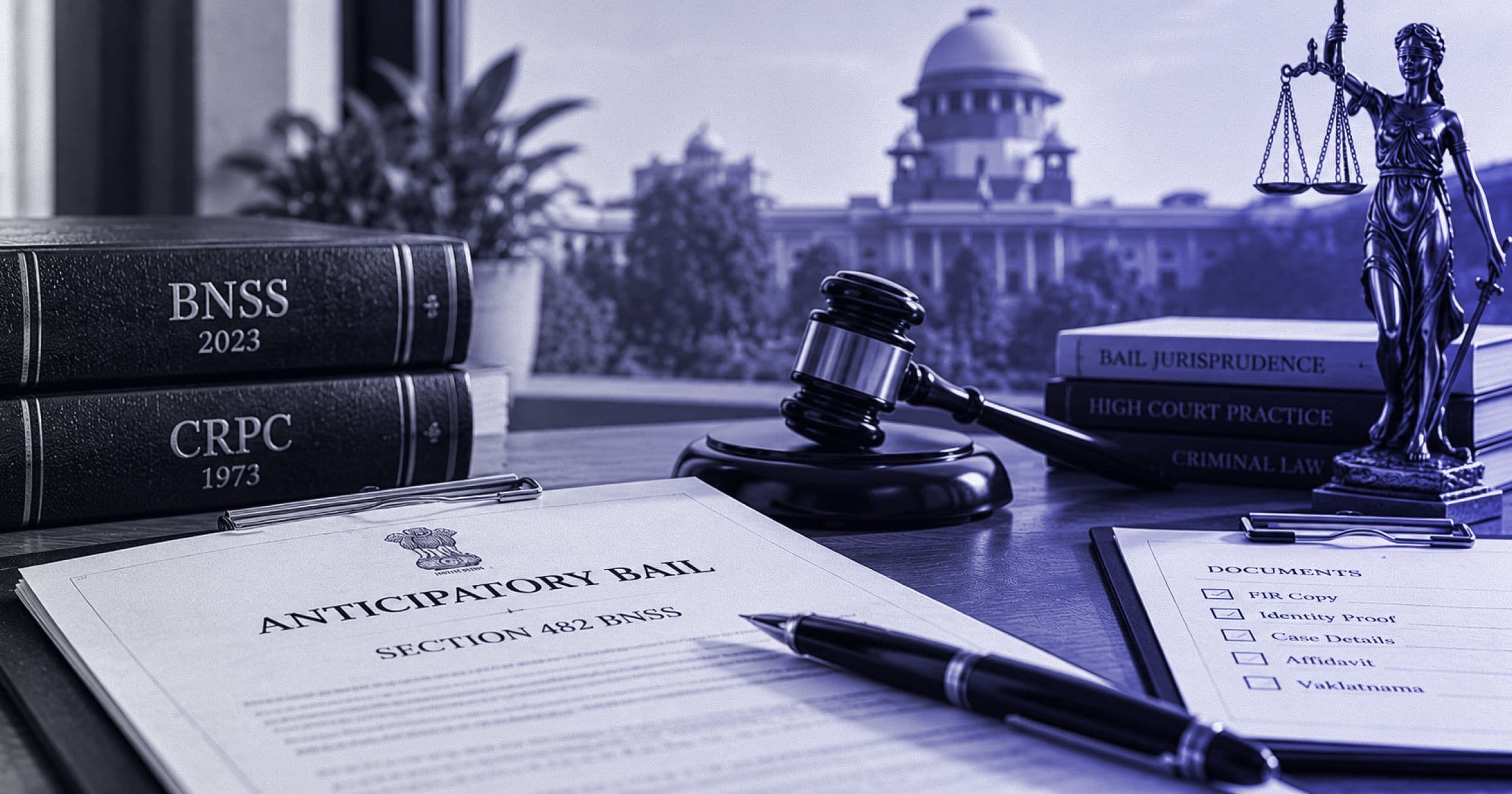
If an FIR has been filed against you, or you expect one, you may be able to get protection from arrest before it happens. This is called anticipatory bail. Since the Bharatiya Nagarik Suraksha Sanhita (BNSS) came into force on 1 July 2024, it is granted under Section 482 BNSS, which replaced the well-known Section 438 of the CrPC.
This guide is for people facing everyday criminal cases: a property dispute that has turned into a forgery or cheating FIR, a business disagreement reported as criminal breach of trust, or a family dispute. If your case involves the ED, PMLA or another economic offence, read our separate guide on anticipatory bail under Section 482 BNSS in PMLA and economic offence cases.
What is anticipatory bail?
Anticipatory bail is a court direction that, if you are arrested in a particular case, you will be released on bail. You apply for it before any arrest. It is relevant only for non-bailable offences. For bailable offences, the police must release you on bail anyway.
The court is not deciding whether you are guilty. It is deciding whether you need to be taken into custody while the case is investigated.
Section 438 CrPC vs Section 482 BNSS: what changed
The core of the law is the same, but there are differences in drafting.
- +Which courts can grant it: unchanged. Both the High Court and the Court of Session can grant anticipatory bail under either law.
- +Factors the court considers: Section 438 listed them in the section itself, including the nature of the accusation, past record, risk of fleeing and intent to humiliate. Section 482 does not list them, but courts continue to weigh similar factors based on case law.
- +Interim protection and notice to the prosecutor: Section 438 had specific sub-sections, (1A) and (1B), on these. They are not reproduced in Section 482.
- +Standard conditions: the same under both laws: being available for questioning, not pressuring witnesses, and not leaving India without permission.
- +Offences excluded: Section 438 excluded certain rapes of girls under 16. Section 482 excludes offences under BNS Sections 65 and 70(2), which cover sexual offences against minors.
Which law applies to your case? Investigations and proceedings that were pending on 1 July 2024 generally continue under the CrPC, so Section 438 still applies to them. For cases registered after that date, the application is filed under Section 482 BNSS. People still search for "Section 438" because older cases and court orders use it.
When should you apply?
You can apply as soon as you have a genuine reason to believe you may be arrested in a non-bailable case. This usually happens in one of these situations:
- +An FIR has been registered that names you.
- +A complaint has been filed and the police have started calling you or your family.
- +You have received a notice from the police asking you to appear.
- +Someone has openly threatened to "get you arrested" in a dispute, and has filed or is likely to file a complaint.
A note on police notices. For offences punishable with up to seven years, the police are generally expected to issue a notice of appearance under Section 35(3) of the BNSS (formerly Section 41A CrPC) instead of arresting straight away. If you receive such a notice and comply with it, arrest is often not necessary. In serious or non-bailable cases, it may still be sensible to apply for anticipatory bail, so get advice before you respond to the notice.
Common everyday cases where people seek anticipatory bail include property disputes turned into forgery, cheating or trespass FIRs, business disputes alleging cheating or criminal breach of trust, matrimonial complaints of cruelty under BNS Section 85 (formerly IPC 498A), and money disputes recast as cheating cases.
Sessions Court or High Court?
Both courts have the power to grant anticipatory bail. In practice, the application is usually filed first in the Sessions Court for the area where the FIR is registered. If the Sessions Court refuses, a fresh application can be made to the High Court. Going straight to the High Court is generally reserved for special circumstances, and the court may ask why you did not approach the Sessions Court first.
Step-by-step process
- Get the FIR or complaint. In Delhi, copies of most FIRs can be downloaded online. If the FIR is not available, your lawyer can work from the complaint or the notice you received.
- Prepare the application. It sets out the facts, your side of the story, why custody is not needed, and that you will cooperate with the investigation.
- File it in the Sessions Court. The court issues notice to the State, and the investigating officer is usually asked to file a status report.
- First hearing. The court may grant interim protection from arrest until the next date, or ask for a reply first.
- Final hearing and order. After hearing both sides (and the complainant, if they appear), the court grants or refuses anticipatory bail.
- Comply with the conditions. Join the investigation when called and follow every condition in the order.
Documents checklist
- +Copy of the FIR, complaint or police notice
- +Your ID and address proof
- +Documents that support your version, such as agreements, payment records, emails and chats
- +Proof of roots in the community, such as employment, property ownership or family responsibilities
- +Details of any previous criminal cases, or a statement that there are none
- +Passport details, if you have one
The more clearly your documents show a civil dispute or a weak accusation, the stronger your application.
Conditions courts commonly impose
- +Joining the investigation and appearing before the investigating officer when called
- +Not contacting, threatening or influencing the complainant or witnesses
- +Not leaving India without the court's permission, and sometimes depositing your passport
- +Furnishing a personal bond, with or without a surety
- +Keeping your phone number and address updated with the investigating officer
Breaking a condition can lead to the bail being cancelled and you being arrested. If travel is important to you, raise it at the hearing. Travel restrictions sometimes lead to a Look Out Circular, and our guide on cancelling an LOC and getting your passport back explains what to do if that happens.
How long does protection last? In Sushila Aggarwal v. State (NCT of Delhi) (2020), the Supreme Court held that anticipatory bail is not ordinarily limited to a fixed period. It can continue until the end of the trial unless the court sets a limit in a particular case.
How long does it take?
There is no fixed timeline. It depends on the court, how urgent the situation is and how quickly the police file their report. In some cases interim protection is granted at the first hearing; in others the court waits for the police report before deciding. Applying early, before the police act, gives you the most room.
How this plays out in Delhi NCR: three illustrations
These are illustrative scenarios, not real cases.
A property dispute that became an FIR. Two brothers disagree over a family property in West Delhi, and one files an FIR alleging forgery. The other brother, who has documents showing a registered family settlement, applies for anticipatory bail and shows that the dispute is essentially civil. If you are on the other side of a property forgery, read our guide on what to do when someone forges a sale deed on your property.
A director facing a GST complaint. A company director in Gurgaon fears arrest over alleged fake input tax credit. GST arrests follow their own rules, explained in our guide on anticipatory bail for directors in GST cases.
A cyber fraud complaint naming an account holder. A trader in Noida is named because a disputed payment passed through his account. Our article on anticipatory bail strategy in cyber fraud cases covers this situation.
Conclusion
Anticipatory bail under Section 482 BNSS works much like the old Section 438 CrPC. The key steps stay the same: apply early, usually in the Sessions Court, with documents that show your side, and follow every condition once it is granted. What changes the outcome is how clearly the application shows why custody is not needed.
If you have received a police notice or expect an FIR, Pramanika Legal can review your situation before you respond. Read more on our anticipatory bail lawyer page and our white-collar crime and criminal litigation practice, or contact us.
Frequently asked questions
Is Section 438 CrPC still valid? For cases registered after 1 July 2024, anticipatory bail is filed under Section 482 BNSS. Section 438 CrPC still applies to proceedings that were already pending on that date.
Can I get anticipatory bail before an FIR is registered? Yes, if you have a genuine reason to believe you may be arrested, for example a complaint already filed with the police. A vague fear without any specific basis is usually not enough.
Which court should I approach first? Usually the Sessions Court for the area where the FIR is registered. The High Court is generally approached if the Sessions Court refuses.
Do I need to go to the police station after getting anticipatory bail? Yes, if you are called to join the investigation. Cooperating with the investigation is a standard condition, and breaking it can lead to cancellation.
How long does anticipatory bail last? Ordinarily it is not limited to a fixed period and can continue until the end of the trial, unless the court sets a time limit in your case.