

CBI Raid at Office? Your Rights and How to Protect Laptops & Data in Delhi
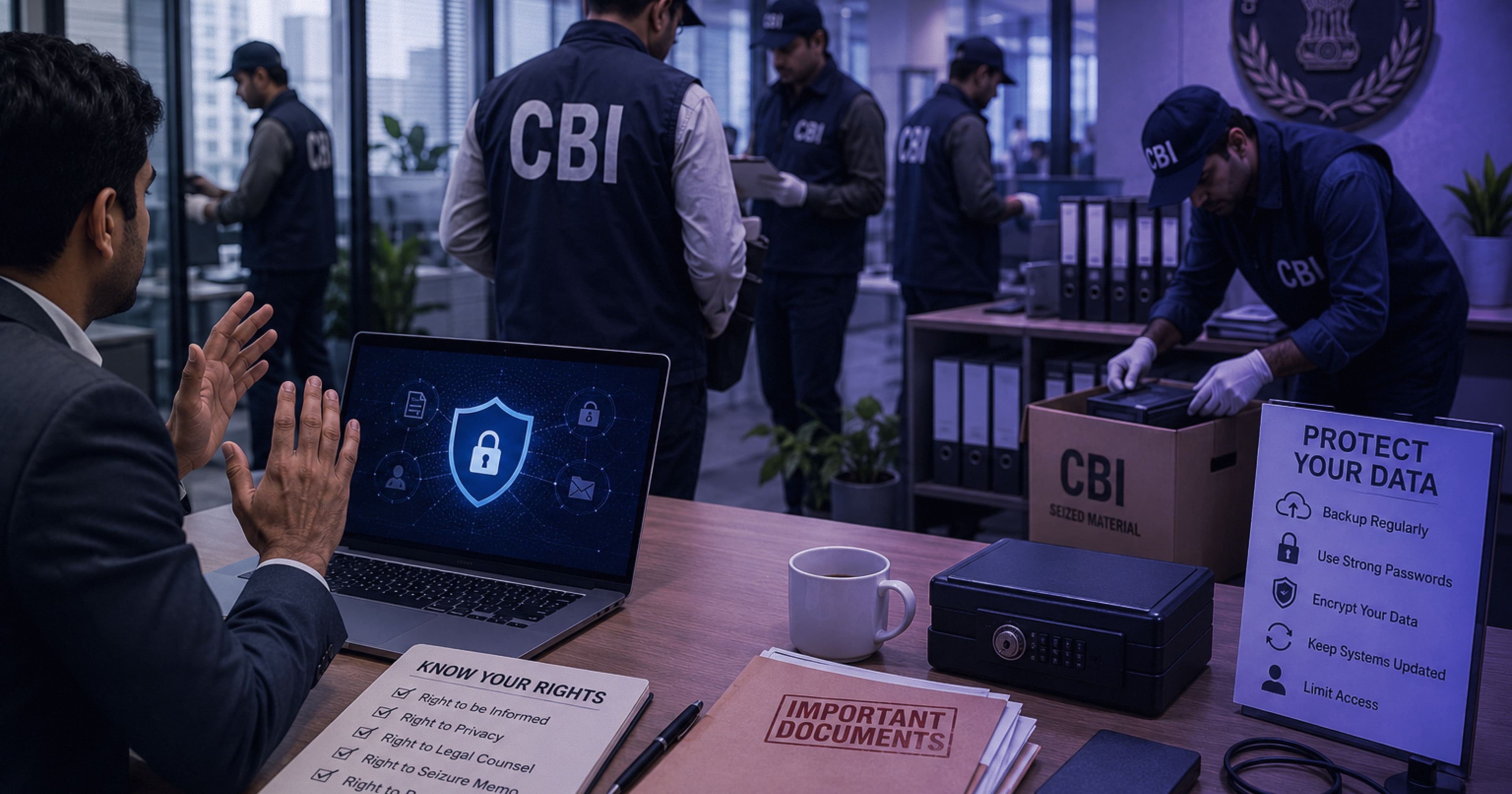
A CBI raid does not suspend your rights — it tests whether you know them. You have the right to see the search authorisation, insist on two independent witnesses, demand that the search be audio-video recorded under Section 105 of the BNSS, and refuse to part with a device without a hash value and seizure memo. What you do in the first sixty minutes determines whether seized data becomes usable evidence or a legal liability for the investigating agency.
What the Law Says
The Bharatiya Nagarik Suraksha Sanhita, 2023 (BNSS) — which replaced the CrPC from 1 July 2024 — governs how a search and seizure must be conducted. Section 105 (for cognizable offences, which covers most CBI economic-offence raids) makes it mandatory for the investigating officer to record the entire search and seizure process using audio-video electronic means, and to forward that recording to a Magistrate without delay. This is not optional camera-friendly conduct — it is a statutory precondition, and its absence is now a live ground to challenge a seizure.
Section 63(4)(c) of the Bharatiya Sakshya Adhiniyam, 2023 (BSA) — the successor to Section 65B of the Evidence Act — makes a certificate, including the hash value (a unique digital fingerprint that proves data hasn't been altered), mandatory before any copied or cloned electronic record can be used as evidence. Without a properly executed hash-value certificate at the point of seizure, the prosecution's own digital evidence becomes vulnerable to challenge.
The CBI itself derives its search and seizure powers from the Delhi Special Police Establishment Act, 1946, read with the BNSS, and remains bound by its own 2020 Crime Manual protocols for handling digital evidence pending the finalisation of nationwide guidelines. Executives should think of this as white-collar crime and criminal litigation exposure the moment a raid begins, not after charges are framed.
Article 20(3) of the Constitution protects against self-incrimination — no one can be compelled to be a witness against themselves, which is directly relevant to demands that an executive verbally disclose a device password on the spot. Article 21's right to privacy, affirmed by the Supreme Court in K.S. Puttaswamy v. Union of India (2017), extends to informational privacy — a principle raid targets can invoke against indiscriminate, unselective device seizure.
Key Precedent
In Arjun Panditrao Khotkar v. Kailash Kushanrao Gorantyal (2020) 7 SCC 1, the Supreme Court held that a certificate is a mandatory precondition for admitting secondary electronic evidence — no certificate, no admission, regardless of how incriminating the content appears. Corporate defense counsel routinely uses this ruling to keep improperly certified cloned data out of trial altogether. Anvar P.V. v. P.K. Basheer (2014) 10 SCC 473 established the same principle for the predecessor provision and remains good law on the point.
Separately, and directly on point for raid conduct, the Supreme Court has been hearing Foundation for Media Professionals v. Union of India, W.P. (Crl.) No. 395/2022, since 2022, repeatedly directing the Union government to frame formal, binding guidelines for the search and seizure of digital devices. As of the most recent hearings in 2026, no final guidelines have been notified — the Court has directed that, in the interim, all central agencies including the CBI must follow the safeguards set out in the 2020 CBI Crime Manual. That gap between "guidelines pending" and "guidelines binding" is not a technicality — it is where an aggressive defense finds its strongest procedural arguments, because an agency that skips even the interim manual's safeguards has no fallback justification.
The Zero-Hour Playbook: What to Do When the Raid Starts
- +Ask for the authorisation before anything else. Read the search warrant or authorisation letter; note the officer's name, rank, and the specific premises and offence covered.
- +Insist on two independent witnesses (panchas) being present for the entire search — their absence is a direct procedural defect.
- +Confirm audio-video recording has started under Section 105 BNSS before any device is touched. If it hasn't, say so on record.
- +Call your lawyer immediately and keep the call visible. There is no statutory bar on an officer permitting counsel to be present or reachable by phone, and prudent investigating officers accommodate this to protect their own seizure from later challenge.
- +Do not verbally disclose passwords under pressure. Note any demand for a password or biometric unlock and the manner in which it was made — this becomes relevant to an Article 20(3) challenge later.
- +Demand the hash value be generated and shared for every device or drive copied on-site, per Section 63(4)(c) BSA.
- +Insist on a detailed seizure memo listing every item taken, signed by the witnesses, with a copy handed to you on the spot.
- +Do not obstruct, but do not volunteer beyond what is asked. Cooperation and silence are not contradictory.
Common Mistakes to Avoid
- +Handing over passwords or unlocking devices without insisting on a hash-value record first.
- +Allowing the search to proceed without confirming audio-video recording has begun.
- +Signing a seizure memo without reading every listed item.
- +Waiting until after the raid to call a lawyer instead of during it.
- +Assuming a raid means guilt — a search authorisation is not a finding, and treating it as one internally can trigger panicked, self-incriminating conduct.
- +Failing to preserve your own contemporaneous notes of witness names, timings, and any procedural lapse the moment the officers leave.
The Delhi NCR Angle
CBI economic-offence matters arising from Delhi NCR raids are typically tried before the Special CBI Courts at Rouse Avenue, with related proceedings sometimes routed through Patiala House Courts. Anyone searching for a CBI raid lawyer in Delhi NCR should look for counsel who can move fast — filing an application before the jurisdictional Magistrate to enforce compliance with Section 105 BNSS recording requirements, or challenging an uncertified digital seizure, often has to happen within days, not weeks, of the raid.
Frequently Asked Questions
Can I insist on my lawyer being present during a CBI raid?
There's no absolute statutory right to have counsel physically present during the search itself, but nothing bars you from calling a lawyer immediately and keeping them reachable throughout — most investigating officers accommodate this, and refusal itself becomes a relevant fact later.
Can I refuse to give my device password?
You can decline to verbally state it under pressure and invoke Article 20(3)'s protection against self-incrimination; the legal position on compelled biometric or password disclosure remains contested and fact-specific, so document exactly what was demanded and how.
What is a hash value and why does it matter?
It's a unique digital fingerprint of a file or drive generated at the moment of seizure — Section 63(4)(c) BSA makes this part of the mandatory certificate for any cloned electronic evidence, and its absence is a direct ground to challenge admissibility.
Can the CBI seize our entire company server?
Agencies are expected to seize only what is relevant to the authorised offence; a blanket, unselective seizure of unrelated corporate data is vulnerable to challenge as disproportionate, particularly given the Supreme Court's pending directions in the Foundation for Media Professionals litigation.
What if the raid wasn't audio-video recorded?
That is a direct breach of Section 105 BNSS and can be raised immediately with the supervising officer and later before the court as a procedural defect affecting the seizure's validity.
When to Consult a Lawyer
A raid is not the moment to improvise. Advocate Akhil Bharat Kukreja advises corporate clients on real-time raid response, digital evidence certification challenges, and downstream white-collar crime defense strategy, including matters touching cybercrime and data privacy exposure. If your office or executives are facing an active or anticipated CBI, ED, or Income Tax search operation, schedule a confidential consultation before the first device is unlocked.
Related Articles
ED, CBI, or EOW Raid Summons on Business in Delhi NCR: First 48-Hour Legal Playbook
Best Cyber Crime Advocate in Delhi NCR: ED, CBI, EOW Raids and PMLA Defence 2026
White-Collar Crime & Criminal Litigation — Practice Area Overview