

Income Tax Raid: What to Do and How to Save Seized Cash and Gold (2026)
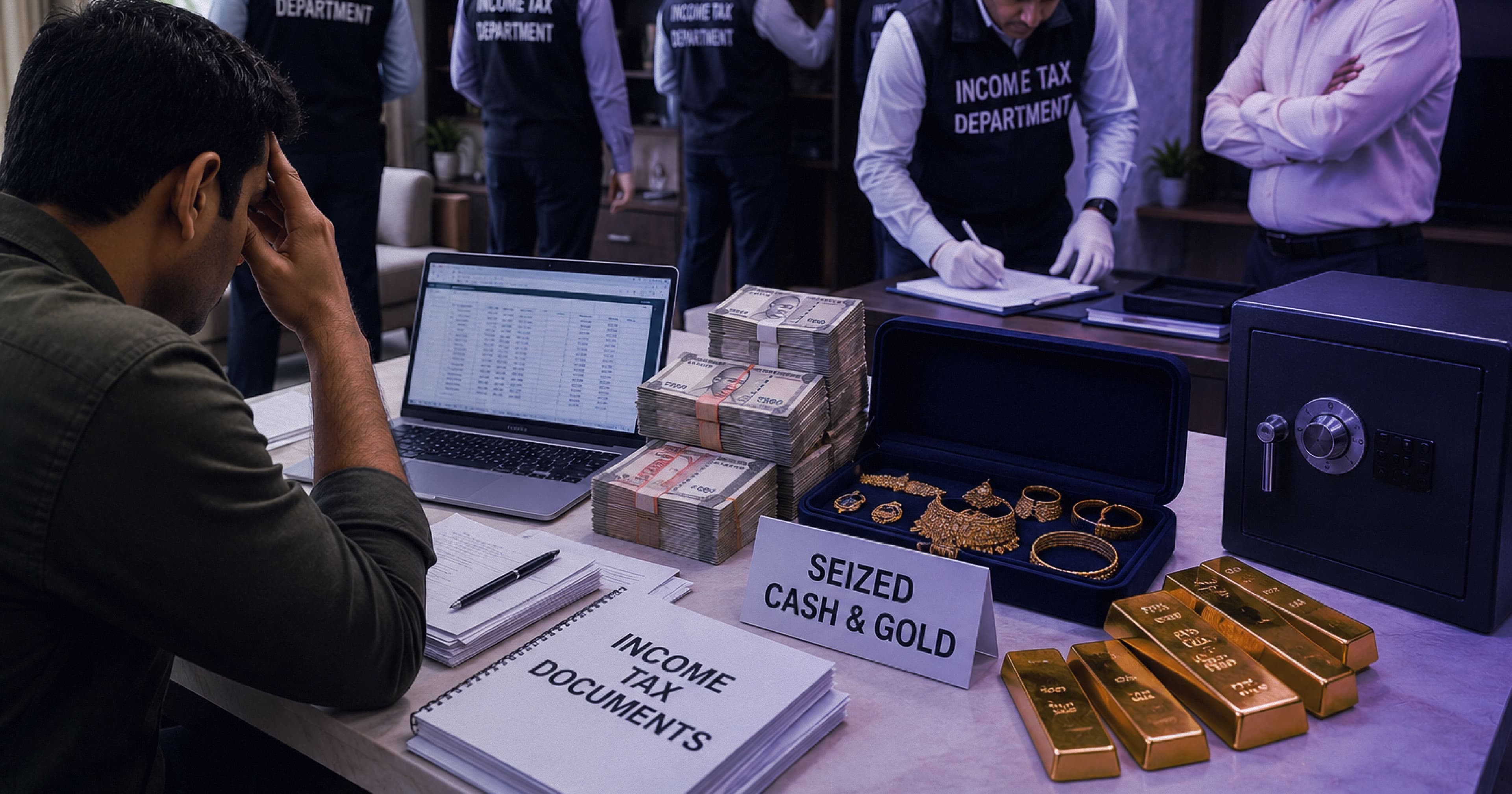
An Income Tax search under Section 132 does not end with the raid — it ends with what you say, sign, and file in the days after. A statement recorded under Section 132(4) carries real evidentiary weight, but Indian courts have consistently held it is not conclusive, especially when extracted late at night without corroborating material. Seized cash and jewellery are not gone: Section 132B lets you apply for release of assets you can document as legitimately sourced, provided you move within the statutory window.
What the Law Says
Section 132 of the Income Tax Act, 1961 authorises search and seizure where the department has "reason to believe" that undisclosed income or assets exist. That belief must have a rational connection to the material available — a search built on a roving inquiry, with no genuine nexus, can itself be challenged before the jurisdictional High Court under Article 226.
Section 132(4) empowers the authorised officer to examine any person present on oath and record a statement, which the Act expressly permits to be used as evidence. This is a real evidentiary tool, not a formality — but it has never been treated by courts as automatically conclusive. An assessee can show a statement was incorrect, and where it was extracted under coercion, exhaustion, or without a fair opportunity, its weight is diminished accordingly.
Section 132B governs what happens to seized cash, jewellery, and other assets. An application for release of an asset can be made to the Assessing Officer, supported by proof that it represents disclosed, explained income — bank withdrawals, gift deeds, sale documents, prior wealth statements. Filing this promptly, rather than waiting for the assessment to conclude, is often the difference between assets released in weeks versus years.
Following a search, Section 153A governs the resulting assessment, generally covering the six assessment years preceding the search (extendable to ten years in specified circumstances involving larger undisclosed income). Undisclosed income admitted and paid during the search can attract a materially lower penalty rate under Section 271AAB — but only where the disclosure is genuine and the tax is actually deposited, not merely promised under pressure in the room.
Key Precedent: The Real Law on Midnight Statements
The Gujarat High Court's ruling in Kailashben Manharlal Chokshi v. CIT, [2010] 328 ITR 411 (Guj.), is the precedent that matters most for a raid conducted through exhaustion and late hours. The Court held that additions cannot be sustained merely on the strength of a Section 132(4) statement without corroborative material, and specifically observed that a statement recorded at such odd hours cannot be treated as fully voluntary. This is the doctrinal foundation for challenging a disclosure figure extracted from an exhausted assessee at 2 a.m. with no independent evidence behind it.
The Supreme Court in Pullangode Rubber & Produce Co. Ltd. v. State of Kerala, (1973) 91 ITR 18 (SC), established the governing principle: an admission is an extremely important piece of evidence, but it is not conclusive, and the person who made it can show it was incorrect. That principle has been applied consistently in tax search cases for over five decades and remains the backbone of every credible retraction.
Retraction is not automatic relief, however. In Bannalal Jat Constructions (P) Ltd. v. ACIT — where the Rajasthan High Court's ruling was carried to the Supreme Court, which dismissed the special leave petition — the courts made clear that a retraction has to be timely and backed by credible, contemporaneous evidence of coercion or factual error. A bald, unsupported retraction filed months later, with no documentary explanation, does not disturb the original statement.
Note on the aggregate position: search-and-seizure litigation in 2026 continues to develop through High Court and Tribunal rulings applying these established principles to new facts, but we could not verify a single, standalone 2026 Supreme Court ruling that has categorically declared Section 132(4) statements from night-time searches inadmissible as a class. The real, load-bearing precedent for that argument remains Kailashben Manharlal Chokshi read together with Pullangode Rubber — and it is a strong argument on its own.
Asset Recovery: Getting Seized Cash and Jewellery Back
Recovering seized assets is a documentation exercise, not a plea for mercy. The stronger and faster the paper trail, the faster the release.
- +File a Section 132B application for release of the asset as soon as the source can be documented — do not wait for the full assessment to conclude.
- +For cash, produce bank withdrawal records, prior cash-in-hand disclosures, or sale proceeds documentation matching the amount and timing.
- +For jewellery, produce purchase invoices, wealth-tax or income-tax disclosures from prior years, and — where relevant — evidence of inheritance or gifts (a family settlement deed, a gift deed, or prior return disclosures naming the item).
- +Where digital or virtual assets were seized, note that the definition of 'property' under the Act now extends to virtual digital assets, so the same documentation logic applies — exchange statements and transaction history stand in for bank records.
- +Push for a decision within a reasonable time; unexplained departmental delay in disposing of a Section 132B application can itself be challenged.
Procedural Traps: Surviving the Section 132(4) Examination
The examination under Section 132(4) is where most search cases are won or lost — not in the eventual assessment. A few realities worth knowing before you are ever in that room:
- +There is no absolute right to have a lawyer physically present during the examination itself — Indian courts have upheld this in the context of fiscal-statute interrogations. What you can do is request breaks, ask for time to consult your CA or advocate between rounds of questioning, and insist on reviewing the statement before signing it.
- +Answer precisely what is asked. Do not volunteer figures, estimates, or explanations beyond the specific question — a vague, exhausted guess becomes a number the department will hold you to.
- +If you are pressured into agreeing to a disclosure figure you cannot substantiate, do not treat the statement as final. File a sworn retraction by speed post to the Assessing Officer within 24 to 72 hours, with a specific, item-by-item explanation for each figure you are disputing.
- +A retraction that simply says 'I was tired and under pressure' will not succeed on its own. It succeeds when paired with documents — bank statements, invoices, prior disclosures — that show what actually happened.
Common Mistakes That Cost HNIs and Business Owners
- +Signing an inflated voluntary disclosure during exhaustion and never formally retracting it — silence after the raid is read as acceptance.
- +Filing a retraction that is late, vague, or unsupported by evidence — courts have repeatedly rejected 'self-serving' retractions with nothing behind them.
- +Waiting for the assessment to conclude before applying for release of seized cash or jewellery under Section 132B, rather than filing as soon as documentation is ready.
- +Assuming the search itself cannot be challenged — where the 'reason to believe' behind the warrant is genuinely absent, a writ petition under Article 226 remains available.
- +Treating the Section 271AAB reduced penalty rate as guaranteed regardless of whether the admitted tax is actually paid and the disclosure is genuine.
Where This Applies Across India
Income Tax search operations fall under a uniform central statute, so the same framework — Sections 132, 132(4), 132B, and 153A — applies whether the raid takes place in Delhi, Mumbai, Bengaluru, or elsewhere. What differs is the forum: assessment appeals proceed before the jurisdictional Commissioner of Income Tax (Appeals) and the Income Tax Appellate Tribunal bench for that region, while a challenge to the legality of the search itself goes before the relevant High Court. Pramanika Legal, based in Delhi, coordinates search-related white-collar crime and criminal litigation matters before the Delhi High Court, ITAT Delhi, and — for clients searched elsewhere — through coordinated representation with local counsel.
Frequently Asked Questions
Are statements recorded under Section 132(4) during a midnight raid legally binding forever?
No. They carry significant evidentiary weight and are presumed voluntary unless shown otherwise, but courts have held they are not conclusive — particularly where recorded at odd hours without corroborating material, as in Kailashben Manharlal Chokshi v. CIT. A prompt, evidence-backed retraction can successfully displace an unsupported figure.
Can I refuse to answer questions during the search?
You are legally required to answer truthfully once examined on oath under Section 132(4); refusal or false answers can attract separate consequences. What you can do is answer precisely, avoid volunteering beyond the question asked, and request breaks to consult your CA or advocate.
How do I get my seized cash and jewellery back?
File a Section 132B application to the Assessing Officer as soon as you can document the lawful source of the asset — bank records, invoices, prior disclosures, or gift and settlement deeds. Filing early, rather than waiting for the assessment to conclude, materially shortens the timeline.
What penalty rate applies if I disclose undisclosed income during the raid?
Section 271AAB provides a materially reduced penalty rate for undisclosed income admitted and substantiated during the search, with the tax actually paid — as opposed to the higher rate that applies where income is detected without admission. The reduced rate depends on the disclosure being genuine and the tax being deposited, not merely promised in the room.
Can I challenge the legality of the search itself?
Yes. Where the 'reason to believe' behind the search authorisation lacks a rational connection to the material available, or the search amounts to a roving inquiry, a writ petition under Article 226 before the jurisdictional High Court can challenge the search itself, separate from any later assessment appeal.
How long does the department have to complete assessment after a raid?
Section 153A assessments generally cover the six assessment years preceding the year of search, with the assessment itself required to be completed within the statutory time limit prescribed under the Act, extendable to a ten-year lookback only in specified circumstances involving larger undisclosed income.
When to Consult a Lawyer
The gap between a search that ends in a manageable assessment and one that spirals into years of litigation is almost always decided in the first 72 hours — what gets said, what gets retracted, and what gets filed. Advocate Akhil Bharat Kukreja advises HNIs and business owners on search-and-seizure defense, Section 132(4) retraction strategy, and asset recovery under Section 132B, alongside related cybercrime and digital asset exposure where virtual digital assets are seized. If your business or home has been searched, schedule a confidential consultation before your next statement to the department.
Related Articles
ED, CBI, or EOW Raid Summons on Business in Delhi NCR: First 48-Hour Legal Playbook
Best Cyber Crime Advocate in Delhi NCR: ED, CBI, EOW Raids and PMLA Defence 2026
White-Collar Crime & Criminal Litigation — Practice Area Overview
Explore all raid response, tax defense, and white-collar crime articles at Pramanika Legal Insights.